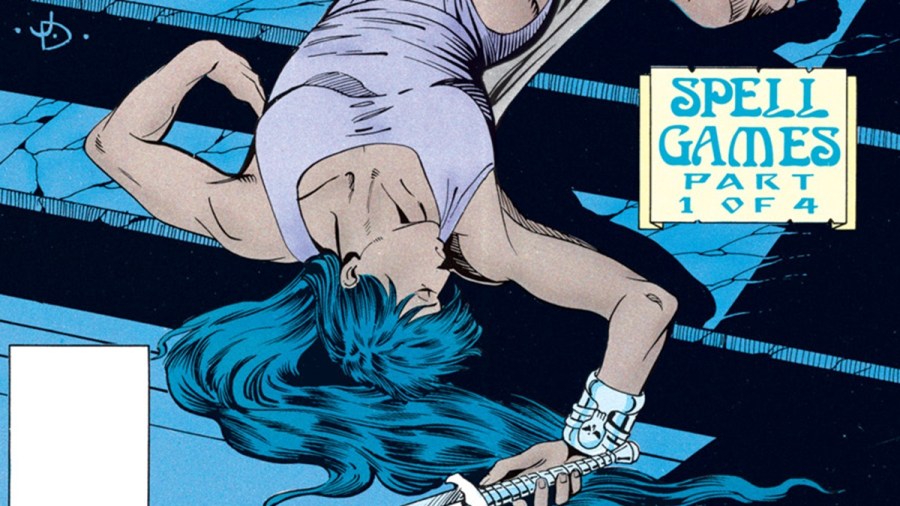
On the whole, I really like the Advanced Dungeons & Dragons comic. There are nonetheless a few things about it that I find grating, and almost all of them are on display in “Spell Games.”
The Problem of Vajra
My big issue with “Spell Games” boils down to the handling of Vajra’s character. We know from “The Gathering” that she’s an escaped slave, and we know from “The Spirit of Myrrth” that she has a hostile relationship with Conner. She is also a butt-kicking warrior woman written in the late 1980s/early 1990s, and that means she suffers from the “strong single woman” tropes that plagued such characters at this time.
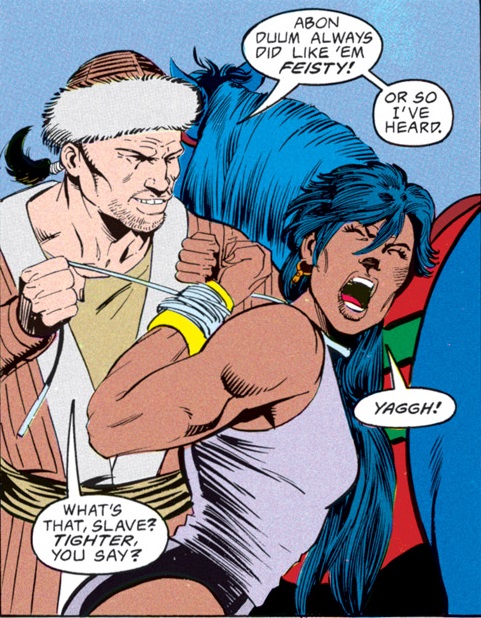
I’ll delve into these matters more as I analyze the story but basically, despite Vajra’s supposed combat prowess and independence, she doesn’t win many fights and rarely solves a problem for herself. Despite being framed as a protagonist, she never makes the action happen–she’s always reacting to the schemes of her slaver Abon Duum, Conner, or an old friend named Salabak.
Vajra’s is a story that could have been improved with more diversity on the creative team. She’s the only black woman in the main cast, and also the only former slave among our core protagonists. The writer on this story is Dan Mishkin, and the editor is Elliot S. Maggan–two white guys born in the 1950s. The creative team is telling a story that parallels real-world situations that they are extremely isolated from. That leaves them relying on a lot of clichés about black people, slavery, and women that got a pass in the 1990s but make the story painfully generic as a result. What should have been Vajra’s story is instead her ping-ponging between manipulative men who use her for their own plots.
In Media Res
Just because this is my least favorite of the AD&D comic stories doesn’t mean that it doesn’t have some good points. One thing I like is that the cover, which shows an unconscious Vajra taken down by a poison dart, is actually the starting point of the story. The tale begins in media res with Vajra waking up and fighting back against the slavers who darted her.
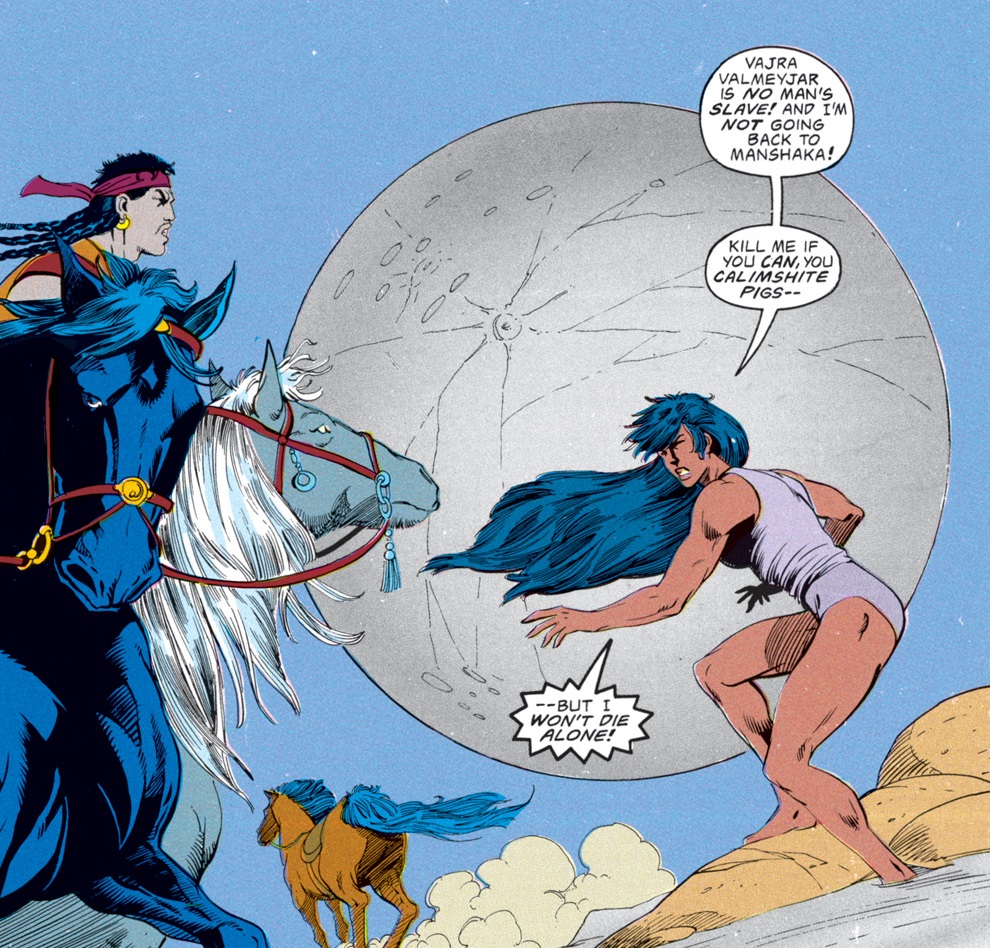
Unfortunately, the rebellion is short-lived and Vajra gets recaptured.
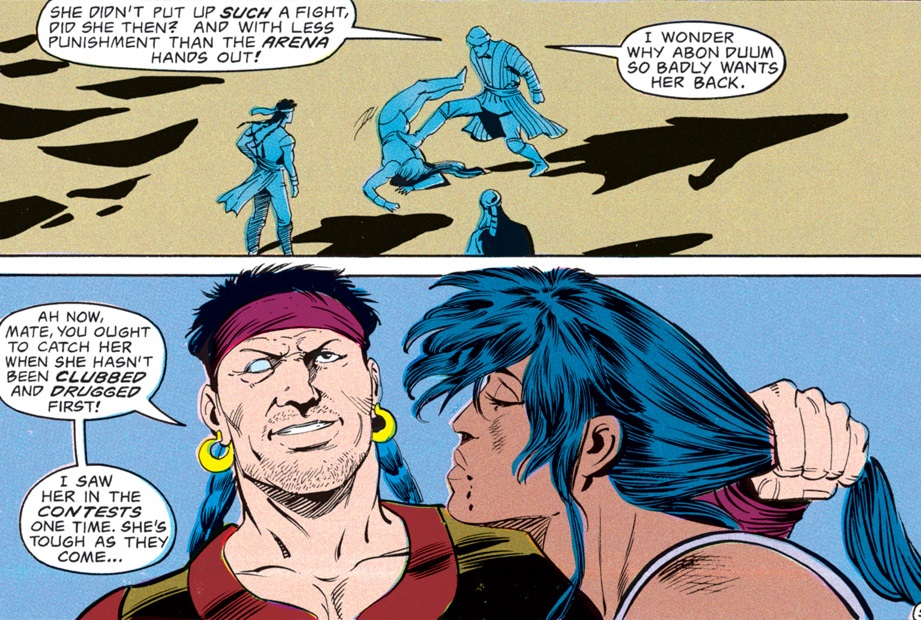
Luckily for Vajra, an old friend comes to her rescue. The former slave Salabak summons up an illusion of a dracolich and dispatches the slavers, keeping Vajra from the slave pens for now.
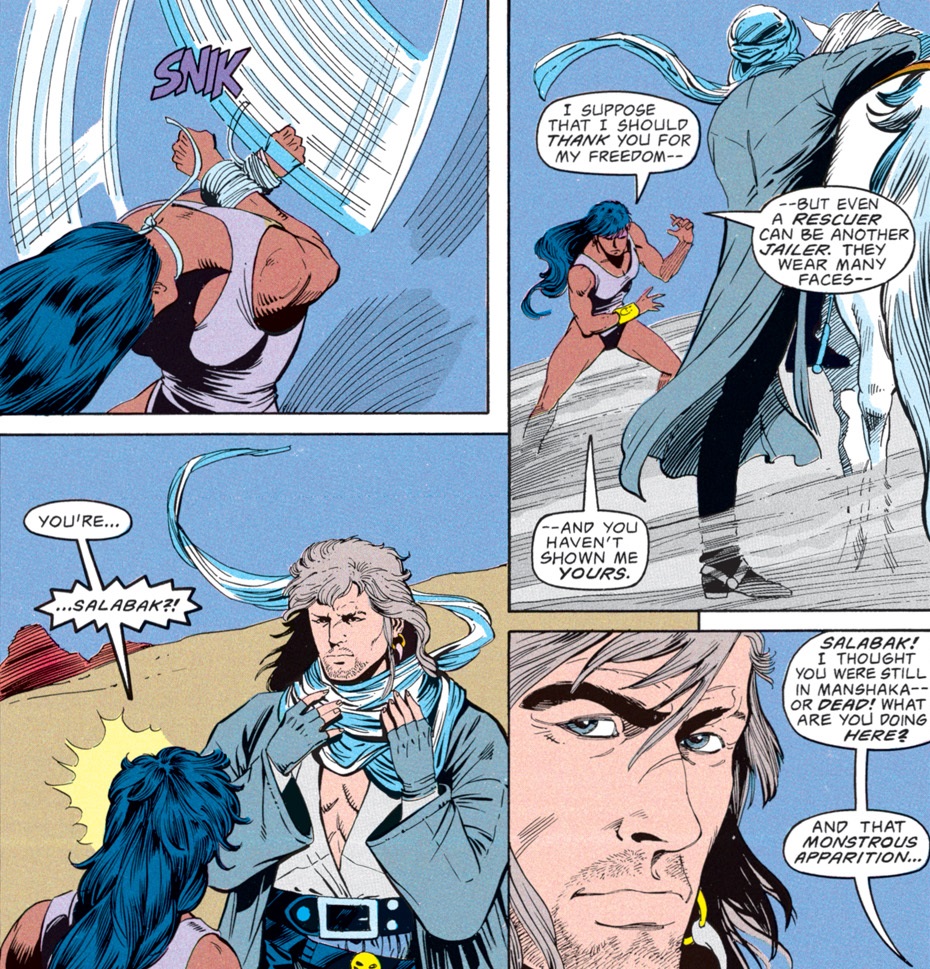
Salabak can’t speak because Abon Duum has sliced his vocal chords. On the one hand, artist Jan Duursema makes this work by using facial expressions and body language very well. On the other hand, it often renders him as a plot device who influences Vajra’s fate without really giving full insight as to the why behind his actions.
The Problem of Conner
Accompanying Salabak are Conner and Timoth. Conner’s presence in this story is necessary, as he is tied to Vajra’s backstory, but it’s the other part of “Spell Games” that I really don’t like. Conner is a typical Forgotten Realms NPC, in that he’s a middle-aged man who out-smarts and out-hustles everyone in a way that could only happen in fantasy stories written by middle-aged men. His smarminess reaches truly ridiculous levels in this story, but that’s only part of his problem.

The other part of Conner’s problem is that he never really atones for his actions. We find out in the following pages that he taught Vajra, a street urchin, how to fight and steal, only to sell her into slavery and walk away. He admits to the crime and says in this story and others that he’s remorseful, but he never changes his ways.
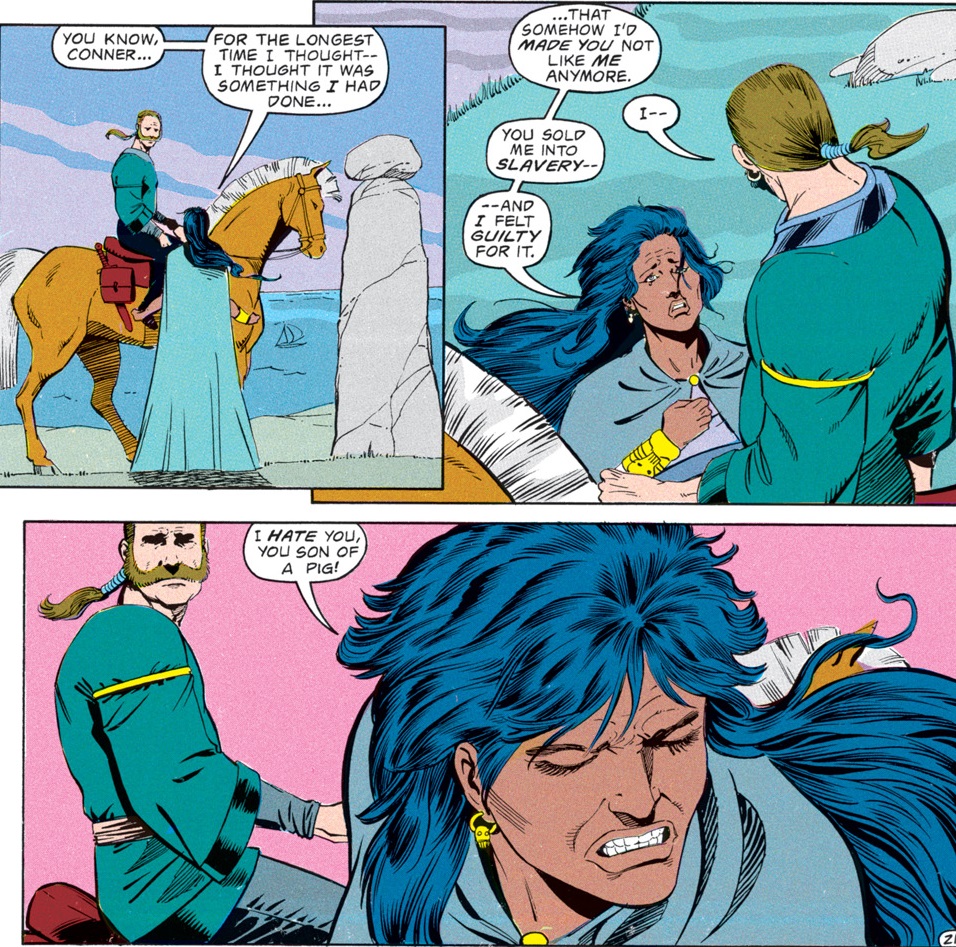
As the story progresses, Conner involved Vajra in a long con to manipulate Abon Duum, but he never clues anyone else in as to what he’s doing. Moreover, he gets angry and offended whenever Vajra questions him. This includes one point where he seemingly sells her back into slavery, causing Vajra to relive the betrayal she felt as a child, only for him to snap at her when she reacts harshly.
Although this should be Vajra’s story, Conner is the one who drives the action. But at the same time, he never really develops as a character and we readers never get a look behind his schemes. What should be a story about Vajra instead becomes a stage to show off how clever Conner is–except that the only reason he’s so clever is because everyone around him is made artificially stupid so his ploys work.
Expedition to Calisham
Aside from the initial fight, most of the first issue of this story is occupied by Vajra’s flashbacks to her life as a beggar, the training she received from Conner, and his subsequent betrayal. The plot really kicks into gear when the group returns to Selûne’s Smile and finds that Vajra’s kidnapping was a diversion away from Abon Duum’s real target: the strange shapeshifting child that Conner has been protecting.
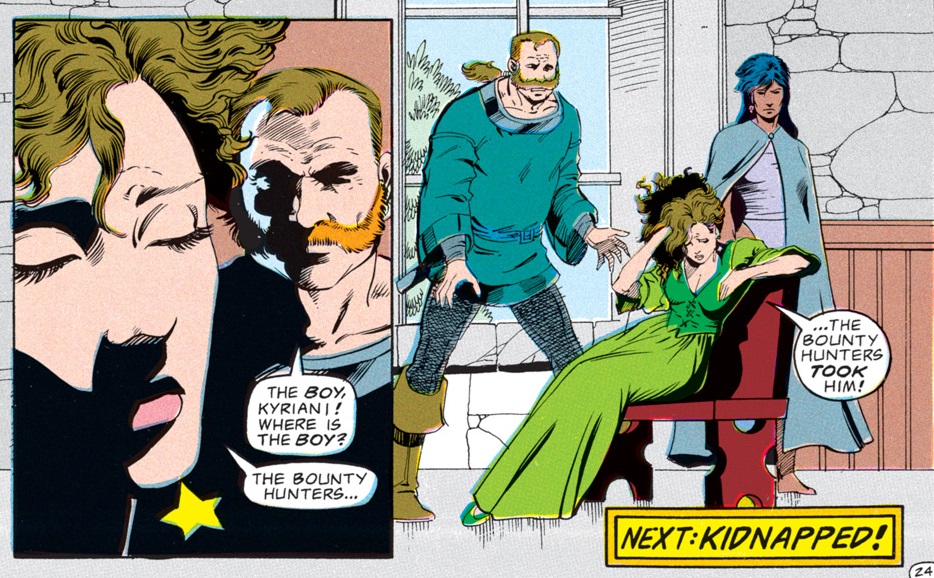
Kyriani has been drugged, and I guess she doesn’t join the group because she’s still sleepy. Instead, Conner, Salabak, and Vajra depart for Calisham, where Abon Duum runs his operation.
Their trailing skills must be rusty, because no sooner have they identified one of Duum’s men that a minion of the slaver uses a wand of telekinesis to throw them half a city away. A beggar offers to help Vajra up, and our heroine gets an immediate talking to from Conner for trusting a stranger.

Conner is, of course, correct about the beggars being part of the guild, because Conner is basically never wrong in this story.
To drive that point home we get some foreshadowing about Salabak. See, he’s one of the few people in Toril that Vajra trusts, and his ability to project telepathic images came about after he lost his voice. Conner is immediately suspicious about this tale, while Vajra defends her friend.

As you might expect, Salabak will turn traitor later on in this story, just as Conner suspects. This story would honestly be much more bearable if it didn’t repeat the same three beats over and over again: Conner says something, Vajra tells him that he’s wrong and she hates him, and then Conner calls Vajra stupid when it turns out he was right.
Chasing a Cat
Despite his suspicions, Conner uses Salabak’s abilities to track down the missing child. Salabak creates an illusion of the cat the child transforms into. One of Abon Duum’s men sees the illusory cat and runs straight to his boss to make sure that the cat is still in their possession.

The person holding the cat child is not Abon Duum himself, but we get a glimpse of Vajra’s old tormentor when the underling makes a joke about keeping the cat for himself.
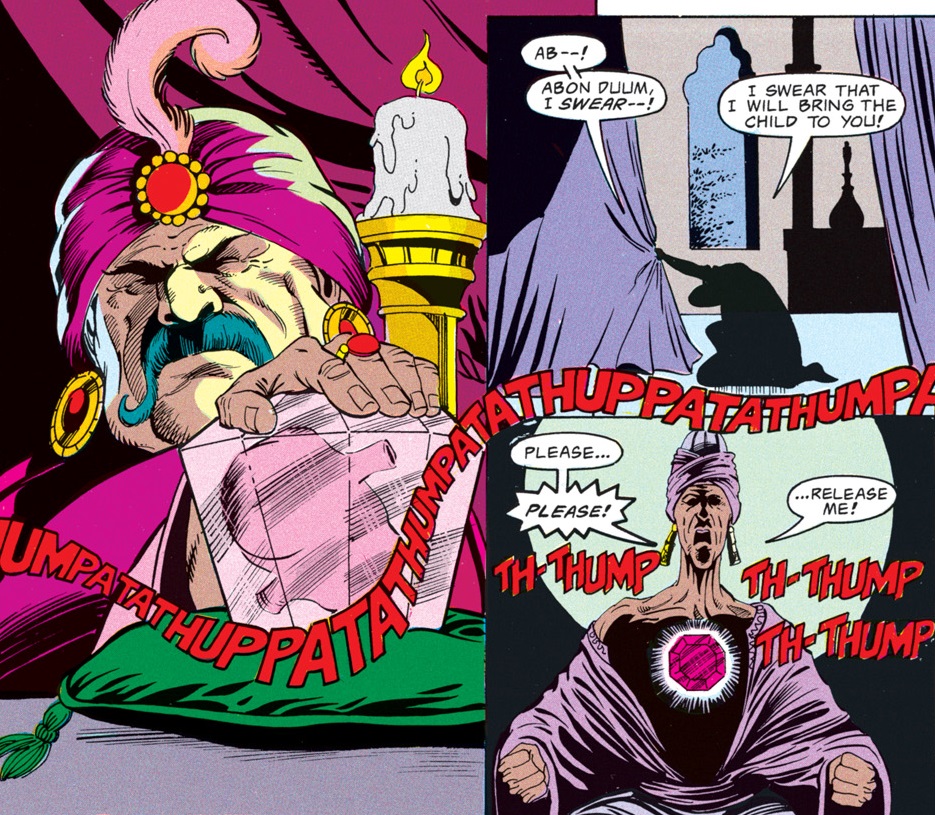
Salabak and Vajra watch the whole scene from outside the wizard’s palace. Conner, meanwhile, talks with a shady figure and gets upset when Vajra has the gall to ask a question.
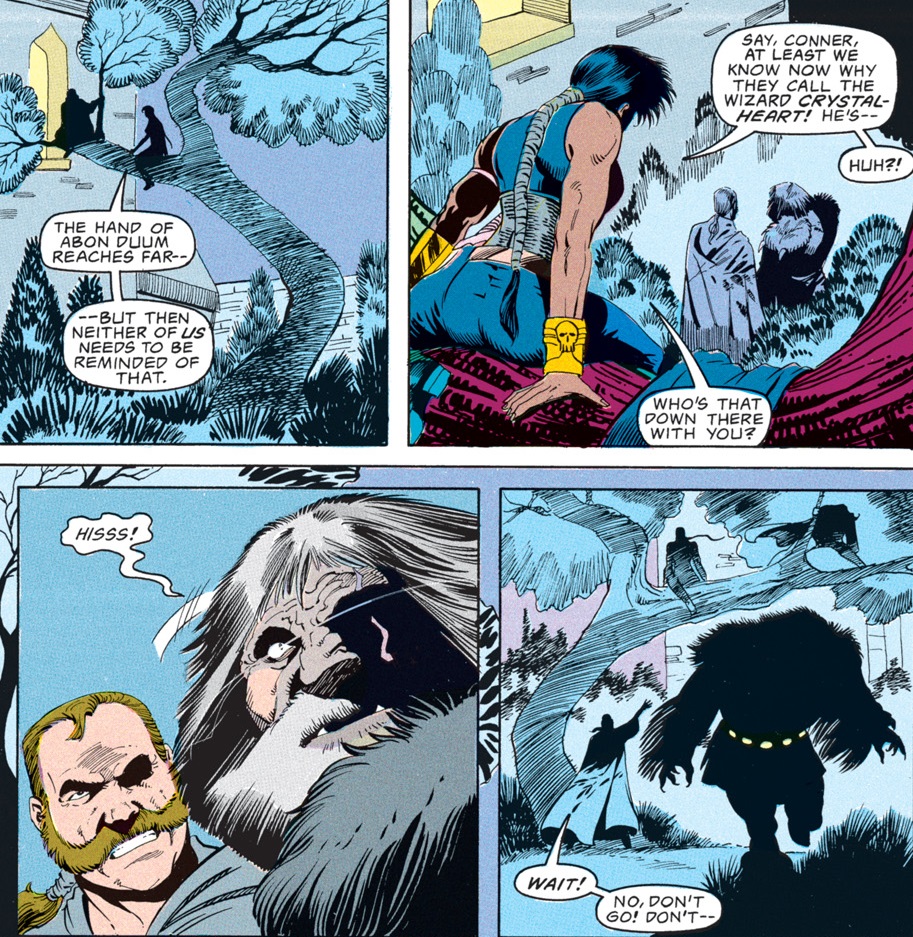
Conner once again insults Vajra for not intuiting his plan (complete with calling her “girl,” which he frequently does whenever he wants to emphasize how wise and worldly he is compared to her) and runs off to speak with his contact. This gives Salabak and Vajra time alone, which leads to…
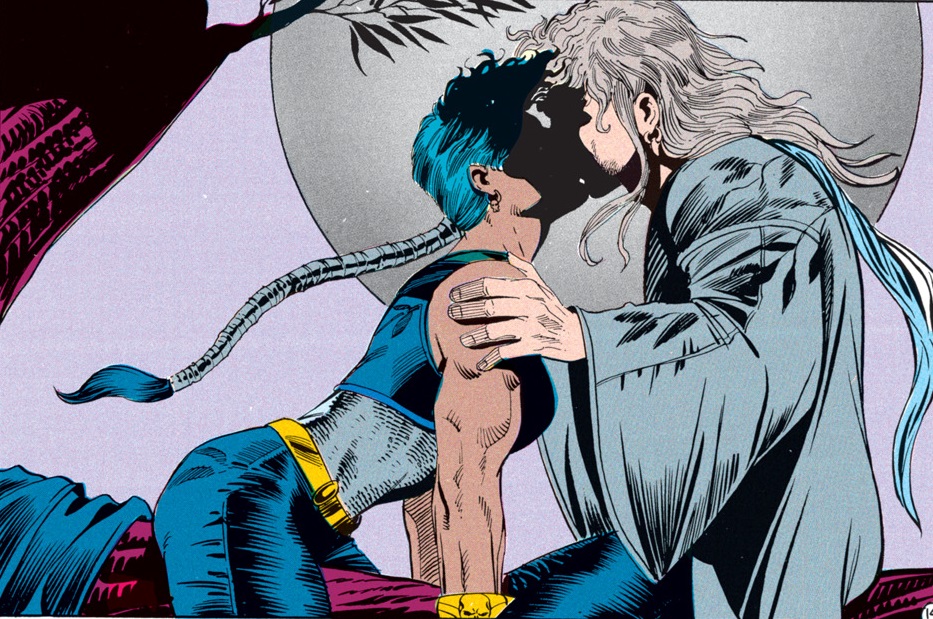
I don’t really hate that Vajra would have feelings for someone she spent a slave pen with. I do, however, hate that this move is just a setup so Salabak’s eventual betrayal can hurt more. Vajra has no agency of her own in this story; she’s simply someone for the men to use and betray at every turn.
Speaking of Betrayal…
Conner’s plan to retrieve the cat child is to use Vajra as bait, with him posing as a bounty hunter who is returning Abon Duum’s prize slave. He presents the idea very cavalierly, and this is one of the many areas where I wish the creative team had a more personal connection with Vajra’s story because asking someone to relive the worst trauma of their life shouldn’t be portrayed with the lightness of just another clever con.
It’s honestly a bunch of bunk that using Vajra as bait is suggested to be the only plan that will work. Salabak’s illusion powers have shown themselves to be good enough to present someone in exact detail, and no reason is given as to why Conner couldn’t present an illusory Vajra instead. That’s one of the perils in writing fantasy literature; once you introduce magic as a plot device, it gets harder to write consistent situations where said magic can’t solve the problem in an instant.
Regardless of the merits of Conner’s plan, it goes awry because he ties Vajra’s bonds too tight and she makes the not unreasonable assumption that he has betrayed her again.

Conner and Vajra escape, but without the cat child. Once in relative safety, Conner dismisses his error with, “Accidents happen” and tells Vajra that she should have trusted him.
Again, Conner sold Vajra into a lifetime of slavery as a gladiator. Every time he tells her that she should trust him, he should have that thrown back in his face. This wasn’t a short span where he eventually freed her; she went from childhood to adulthood in the arena and had to escape herself. And since then, as seen in “The Gathering” and this story, she’s had to contend with bounty hunters trying to recapture her. Conner has done nothing to earn trust from Vajra and should be thanking his lucky stars that she didn’t cut him open the moment she saw him again.
And it’s not exactly like Conner shows nobility after the escape. In fact, he just walks off and abandons Vajra, who gets jumped shortly afterward and returned to slavery.
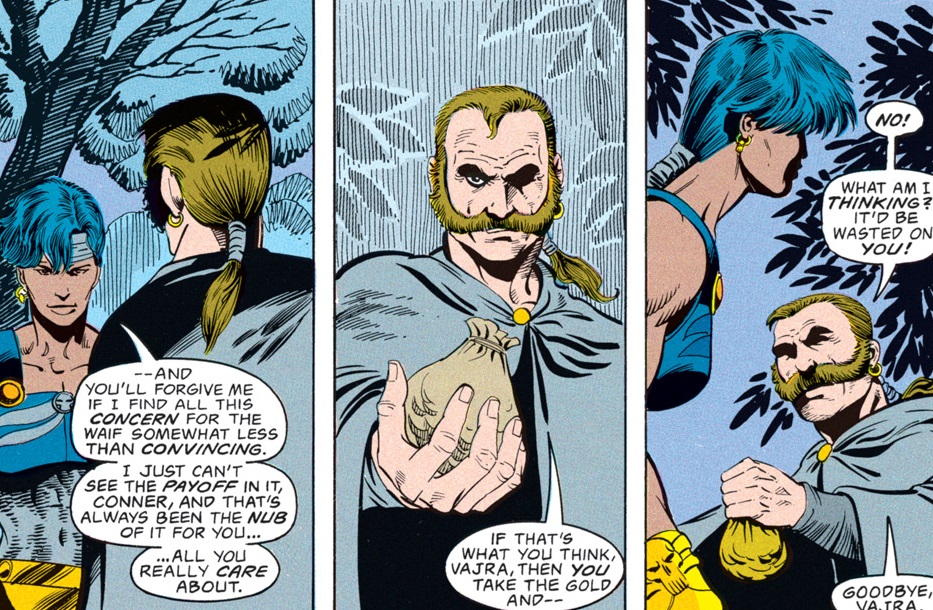
As it turns out, Vajra getting sent back to the slave pens was Conner’s Plan B. He plans to release her from a life of murder and servitude, but first decides to hit the local whorehouse.
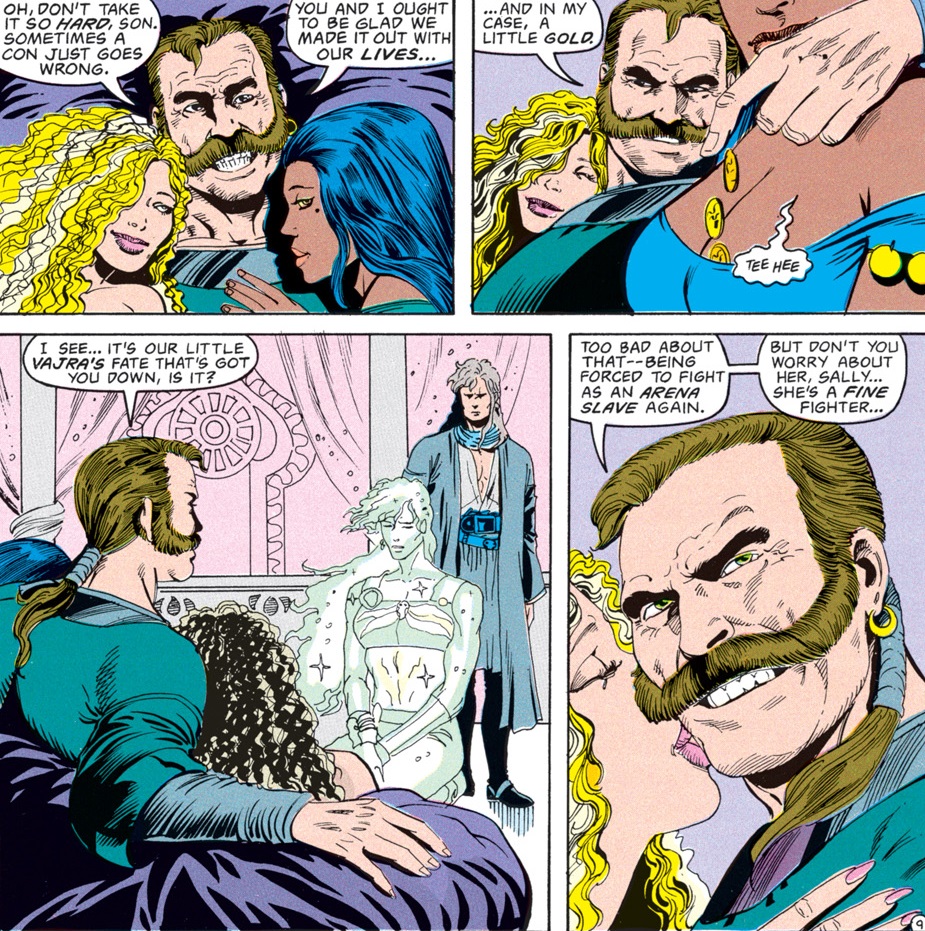
Oh, sorry…this is right around the time when D&D was trying to become more family friendly. So they’re not prostitutes…they’re “dancing girls.”
Into Servitude Again
After getting bonked on the head, Vajra wakes up in front of Abon Duum. But she can’t exact the revenge she has fantasized about, because the cat child has now been enchanted to serve Duum.
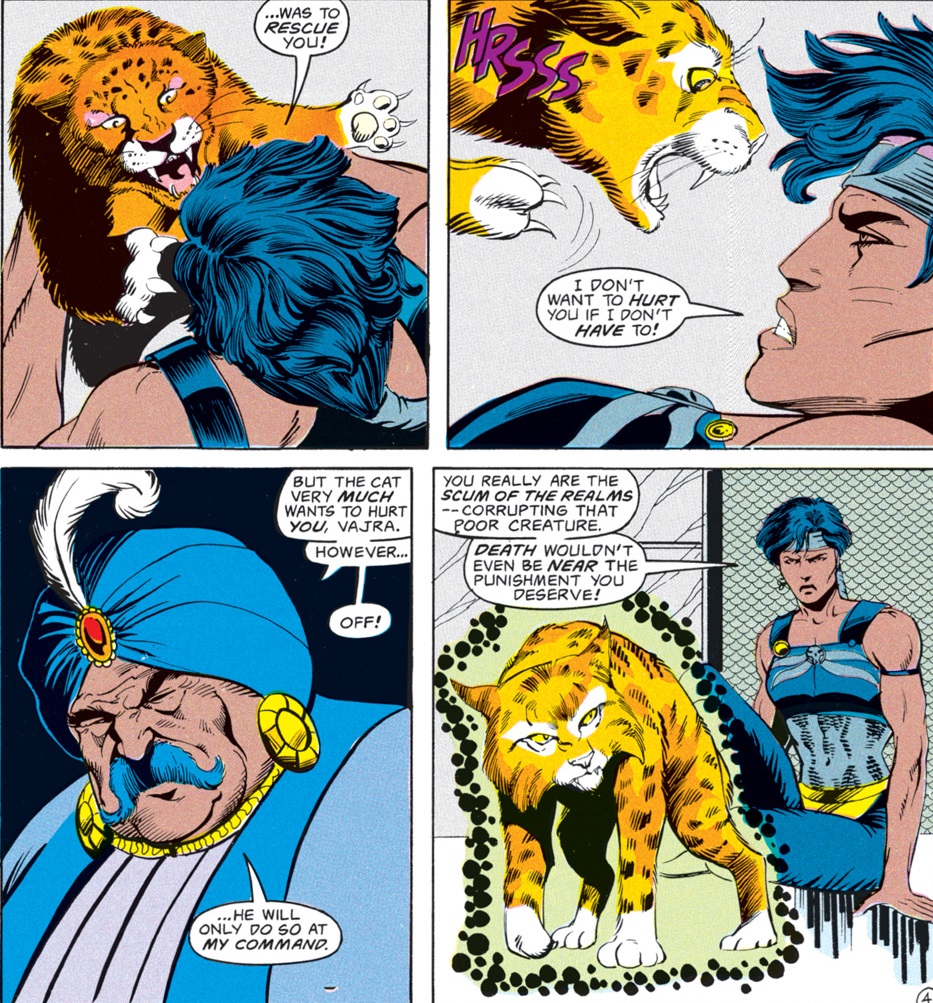
Once again forced to fight in gladiatorial games, Vajra puts on a good showing against a troll before discovering that Conner and Salabak have a plan to free her.

Not to harp on the need for diverse experiences in writing, but Conner’s flippant attitude really grates on me here, and it could have been avoided with a different perspective on the story. He’s playing the part of the merry rogue, but he just made Vajra relive the most terrible moments of her life. This gets overlooked because for the creative team, slavery is a thing that happens in storybooks rather than real life. It’s very easy to make light of it and side with the “charming” rogue when you’ve never had to deal with any trauma close.
I’m not saying that you need to have experienced slavery to write about slavery. I’m saying that it is important to recognize the concept for what it is and think long and hard about how it should be integrated into a story. The same goes for sexual assault. When folks who have never experienced these things work them into a story as a plot device, it’s very easy to make light of them, as Conner consistently does in this story, which is the wrong way to treat such serious crimes.
Salabak conjures up the illusion of a manticore attacking Abon Duum, and Vajra uses the diversion to escape. She tries to rescue the cat child, but he is still in the sway of Abon Duum. With nothing else to do but save herself, she flees into the dungeons, looking for a way out. Instead, she finds a silver dragon.

Maybe the dragon is supposed to be blue, since it seems evil. Either way, Vajra gets a save from the old man she saw speaking with Conner…a man who turns out to be the legendary Catlord.
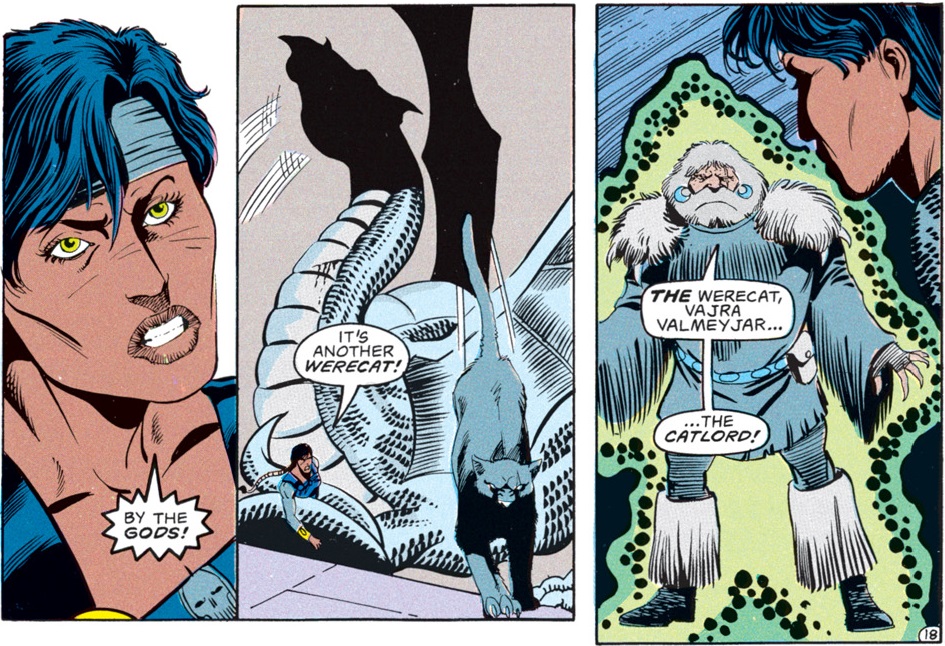
The Catlord is the ruler of all felines–he’s basically a demigod. And he’s very unhappy with Conner, who swore to him that the cat child wouldn’t fall into Abon Duum’s hands. Conner tries to talk his way out of things by saying he just needs one more day to make things right, but the Catlord has the mercurial temper of a cat.
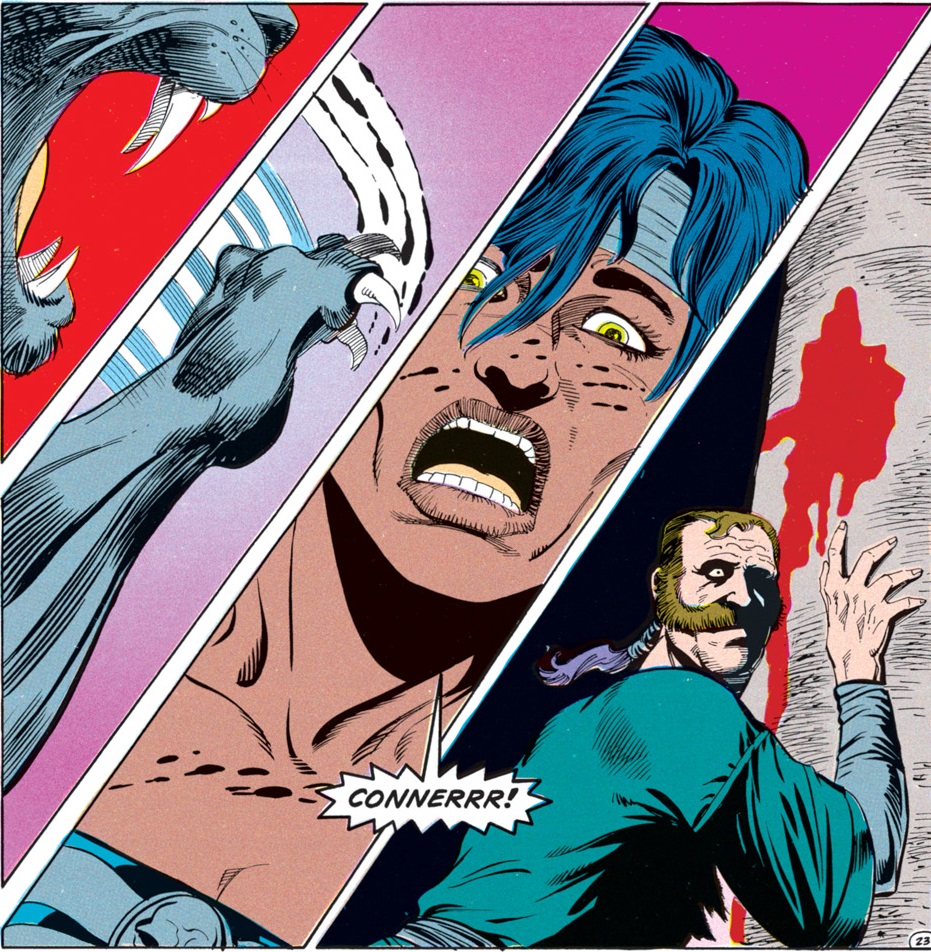
One of the interesting layers put on the Conner/Vajra relationship is that, despite the fact that Conner betrayed her in horrifying fashion, Vajra still remembers the kindness of the man who took her in and acted as a surrogate father. She hates him, but she can’t let go of her love for him. So her watching him die is actually quite tragic and pulls at the heartstrings.
Or it would…if this wasn’t all part of yet another scheme by Conner.
The Inevitable Betrayal
After washing Conner’s blood off his claws, the Catlord explains some of what is going on.

The cat child is to become the new Catlord, and was given to Abon Duum to learn the ways of the world. Fooled by Duum, the Catlord tried to collect the child only to discover that the slaver had struck a deal with Malar, the Beastlord. The Catlord, overwhelmed, received aid from Conner, who claimed that a god had sent him to protect the child. Unable to win the fight against Malar, the Catlord distracted the god long enough for Conner to steal the child.
Of course, the plan ultimately failed and Abon Duum got the fledgling demigod back. And that’s not all he has on his side. The next morning, Vajra awakens to find Abon Duum before her, with the Catlord at bay because Salabak is holding a knife to the cat child’s throat.

And this is where the scope of the story gets out of hand.
See, for three issues, this story was a straightforward matter of vengeance and treachery involving an escaped slave and her captor. But the fourth issue turns into a chess game between gods, as Abon Duum forces the Catlord to teleport them all to the plane of Gladsheim.

Duum possess an artifact called the claw of Malar, and plans to use that to kill Tyr, the god of justice.
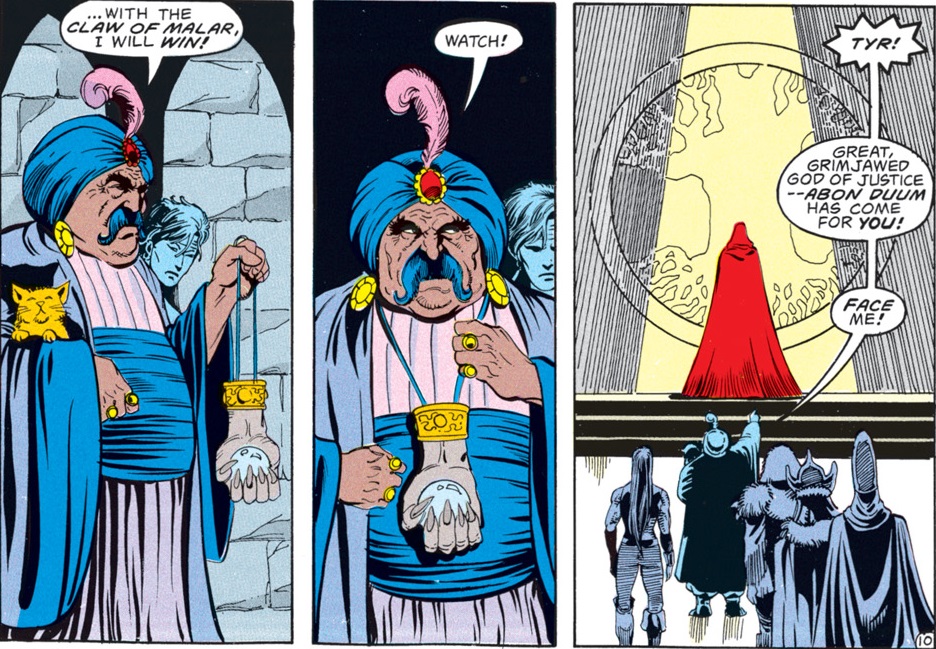
Except that it’s not Tyr hanging around there in Gladsheim, but…
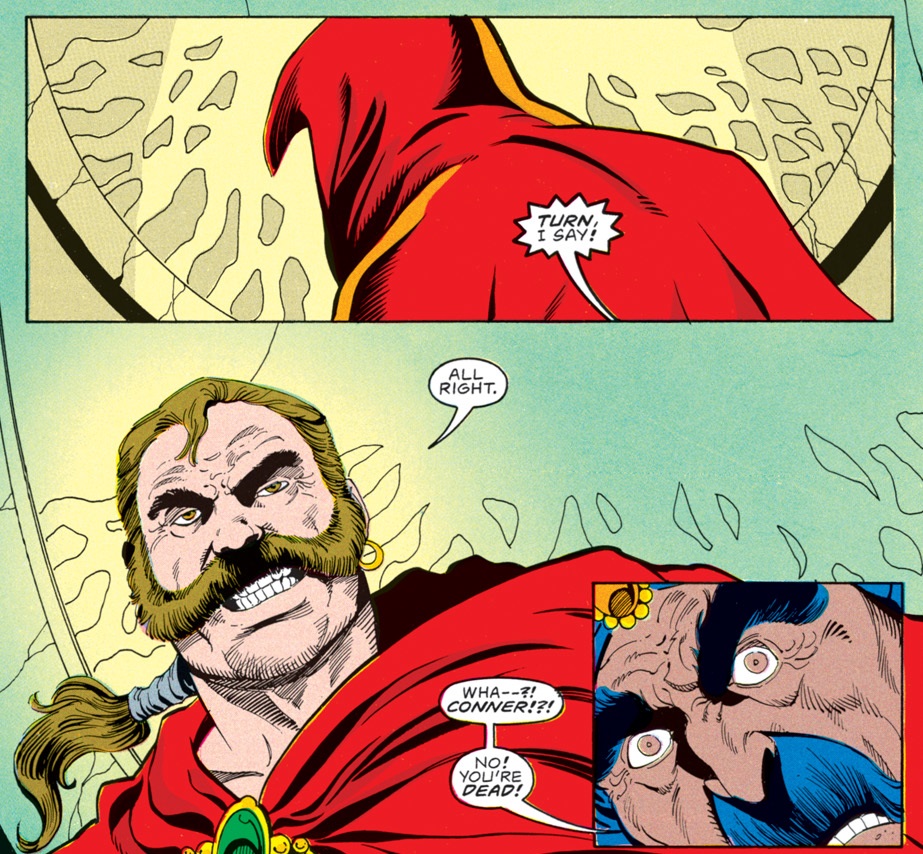
This bit is very clumsily foreshadowed three pages earlier when Abon Duum says that Conner once claimed to have made a deal with someone on the Outer Planes.
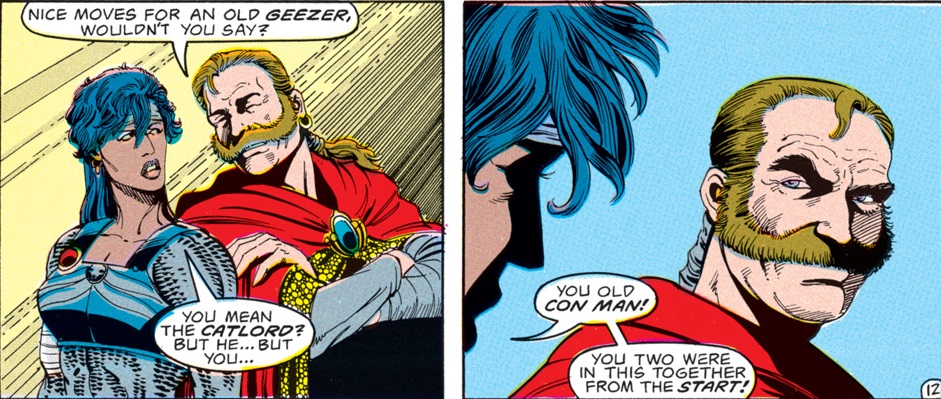
This is all played up as a triumph of Conner’s clever scheming, but it really falls apart upon examination. Ultimately, Conner just needed Abon Duum to have the cat child and to think he was dead. The whole selling-Vajra-back-into-slavery thing was, as far as I can tell, extraneous to the plot. It’s like the story was going in one consistent direction for three issues, and then someone at the last minute said that it had to be about a cosmic battle between gods.
Ah, but Duum still has the cat child…right?
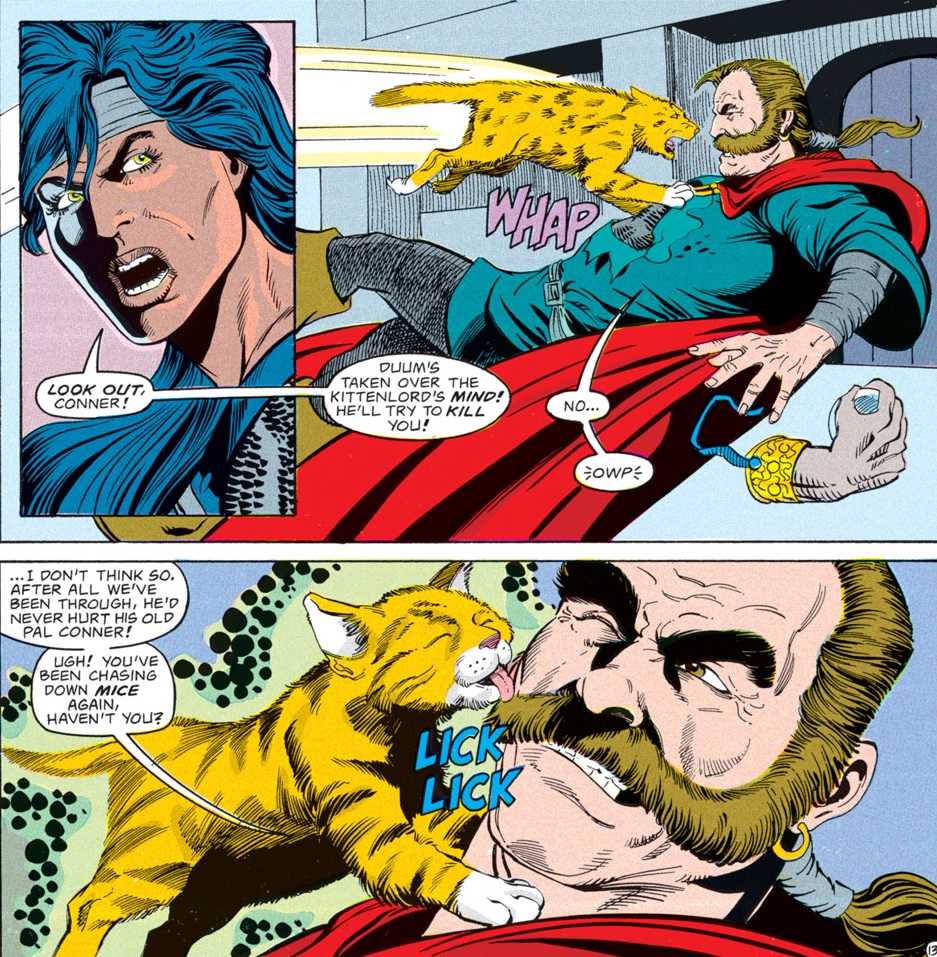
Nope. Magic enchantments apparently can’t override the buddy plot that he and the “Kittenlord” have shared.
So…again…none of the trauma Vajra went through matters. She risked her life to save someone who wasn’t truly under Abon Duum’s control in the first place.
Still not amazed by Conner’s wheeling and dealing? How about an appearance by Tyr, the actual god of justice, who apparently had a deal in place with Conner?

And this is the main problem with Conner: he’s always implied to be one step ahead of everyone, but we got barely any setup for this. So it’s not really clever planning on his part but rather the writers bending over backwards to make him seem awesome.
And hat of Salabak? Well, back on Toril, he tries to kill Vajra…even though doing so doesn’t actually aid him now that Abon Duum has been left behind to face an angry Tyr. You’d think that this would maybe be a chance for Vajra to get a moment where she defeats a bad guy, but instead a froghemoth appears out of the swamp they’re fighting in and eats Salabak while Conner drags Vajra to safety:
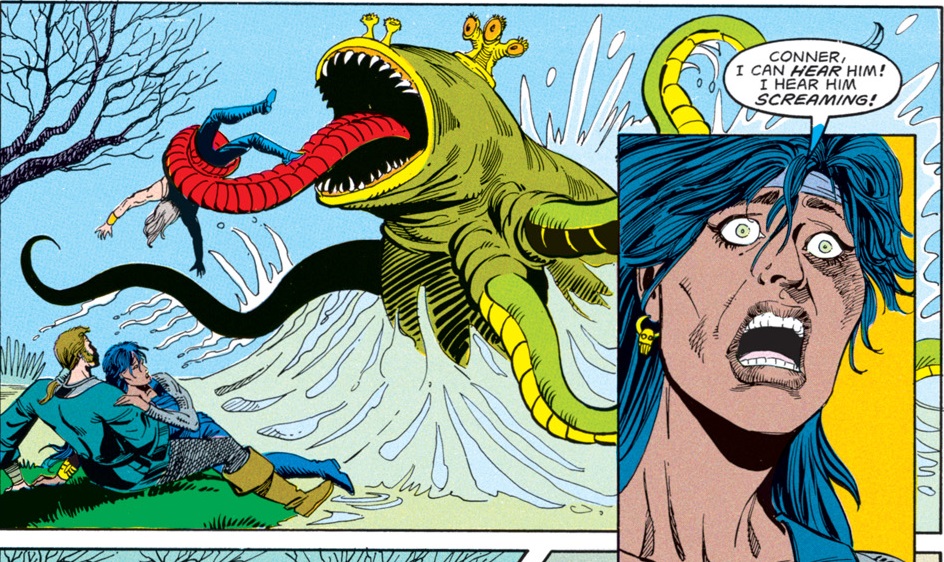
Given the general quality of these comics, there is no way this story turned out as intended. I’m convinced that the final issue was thrown together in a rush to meet a deadline, because it is just one left-field solution after another to resolve this mess of a plot.
Conner’s Redemption?
With the bad guys dead or facing judgment and the Kittenlord reunited with the Catlord, there’s just one loose end to tie up: Conner’s past with Vajra.
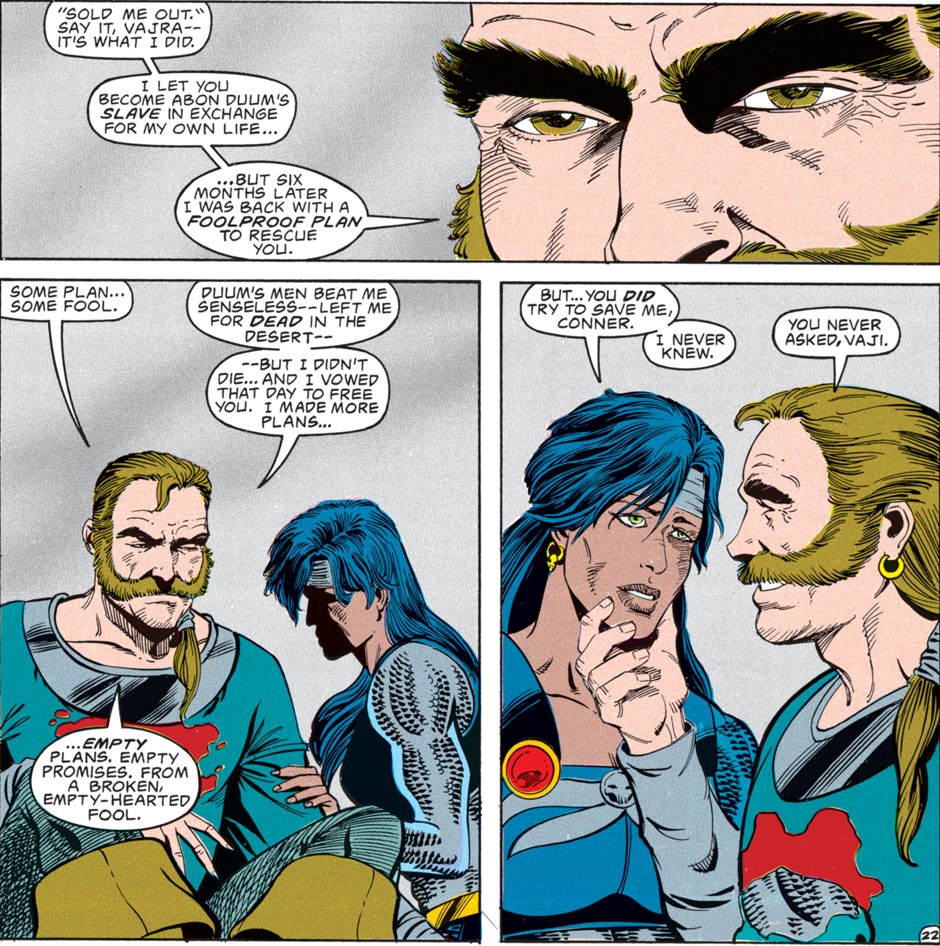
Does the revelation that Conner tried and failed to free Vajra redeem him? Maybe to a degree, but I’d say it falls flat due to the events of the story.
We’ve just seen Conner wheel and deal in matters of gods, always staying one step ahead and possessing the ability to fake his own death with ease. If his plans had hit a hitch in the road or he had shown to be rattled by anything that happened in the story, maybe I would buy that he couldn’t have freed Vajra before. Heck, if he hadn’t sold her right back into slavery and then gone frolicking with hookers, maybe this scene would ring true. As it is, Conner treated Vajra terribly throughout this whole story and grinned while he did it. He was one step ahead of everyone from the first page but put them all through torment because the story wanted him to look clever.
And this is why I keep harping on the idea that a more diverse creative team could have saved this story. “Spell Games” should be about Vajra, but it’s about Conner instead. Vajra doesn’t have any agency in the plot; she’s just someone to be manipulated by three men so they can look powerful, dangerous, or clever.
The reason the story wound up this way wasn’t out of any sort of bigotry or malice, but simply because creators gravitate toward the characters they identify with most. Stories in the Forgotten Realms are written almost entirely by middle-aged (or older) men, and so the folks who get the best parts are almost always middle-aged (or older) men. In “Catspaw,” we saw that with Khelben and Mirt. In the novel line, we see that with Elminster. And here we see it with Conner. Vajra is by far the more interesting character, in my opinion, but nobody plotting this story identified with her strongly enough to make her the true protagonist of her own story.
Diversity in media isn’t about filling quotas or removing white men from stories; it’s about opening the gates to perspectives that normally get ignored. There is a much better story to be told here than what we got. Unfortunately, Vajra was an interesting female character written in a time when pop media didn’t typically know what to do with such characters. As a result, we got the kludgy mess that is “Spell Games” instead.
 Babbling Brooks