
I have a special spot for dwarves in fantasy RPGs these days, largely because I wrongly ignored them through most of my teen years. AD&D had a million supplements on elves, and I loved the idea of playing nigh-immortal magical beings. Dwarves, gnomes, and halflings got largely overlooked in those days (the Player’s Handbook Reference Series, which had a book for every race and class in the game, even shortchanged the latter two by shoving them together in The Complete Book of Gnomes and Halfligns rather than giving them a chance to really shine).
In my later years, I’ve come to appreciate foul-tempered, beer-loving, hairy people–and not just because I have become one. In the Fell’s Five comics, Khal became one of my favorite characters thanks to the juxtaposition of his stoic warrior nature and the gentle poet within. So if the comic had to get canceled before its time, I’m glad it went out on a note that highlighted these qualities.
Without further ado, let’s check in on Khal’s love life with the final storyline of this series, “Down.”
Continue reading “Comics & Quests: Down”
Since we spent the first half of this volume of Dungeons & Dragons in the past, I thought it made sense to break the summary into two parts. We’re now back in the present, with our heroes trapped in the Feywild.
I’m not pumped about the word “Feywild,” which originated in 4th edition D&D along with its counterpart, the Shadowfell. However, I guess they’re catchier than the previously-used “Realm of Faerie” and “Plane of Shadow.” More importantly to Wizards of the Coast/Hasbro, they are trademarkable terms that the company can monetize.
In game terms, the Feywild and Shadowfell were meant to be more accessible than they used to be, allowing for lower-level adventurers to travel the planes without requiring high-level magic or bespoke magical gates. Almost every setting decision in 4th edition D&D was to create a world (and multiverse) full of perils where adventurers would find fights anywhere they went. So far, Fell’s Five are carrying that spirit with them well.
Continue reading “Comics & Quests: First Encounters, part two”
To me, the most disappointing thing about D&D comics is that they don’t last. The stories tend to be fun, the worldbuilding is nice, and the cast of characters is usually great. But licensing issues or low sales often lead to the cancellation of a series within a couple of years.
This is the case with the 4th edition Dungeons & Dragons comic, which is an especially big shame because the second arc spends time introducing our heroes’ backstories. Write John Rogers really created a story that had room to grow, but situations beyond his control prevented the seeds he planted from fully bearing fruit.
Still, it’s a fun ride while it lasts. With that said, let’s jump into the middle arc of this series, “First Encounters.”
Continue reading “Comics & Quests: First Encounters, part one”
Originally published on Sidekickcast.com February 9, 2016
Running an RPG with evil characters tends to be difficult. While it’s perfectly possible for players to create complex evil characters (and I’ve seen it done at my table before), they just as frequently interpret the “E” in their alignment block as a reason to maim and kill every NPC they come across.
Personally, the next time I run a game with evil PCs, I’ll probably hit my comics collection for inspiration. Specifically, the John Ostrander-written Suicide Squad title that launched in 1987 is one of the best examples of a story that made the audience cheer for the bad guys.
The concept behind Suicide Squad wasn’t all that groundbreaking – the government selects a group of super criminals to take on jobs that heroes can’t – but the execution was brilliant. Taking it into an RPG requires players who really like the concept, but I think it could work quite well in the right circumstances.
Continue reading “Getting Villainous: Suicide Squad as an RPG Campaign”

Originally published on BabyCenter.com October 8, 2015
Superhero comics are a big part of my life, and it seems I’ve handed that down to my kids as well. Reading a comic book every night as part of the bedtime routine has certainly helped. One problem with mainstream comics, though, is that they’re quite often very sexist.
Continue reading “The Important Thing Comics Taught Me About Kids”
Originally published on BabyCenter.com September 15, 2014
Last month, my wife bought herself a new t-shirt. It was a Supergirl shirt, and it came with a cape attached via Velcro. Our son got extremely excited about the idea of Mommy being a superhero, and we thought it would be fun to get him a Superman shirt with a cape so the two could be superheroes together.
Weeks later, my son has worn his Superman shirt every single day.
Continue reading “My Son Wore a Superman Suit for a Month: Here’s What I Learned”
As D&D moved into the 21st century, it started focusing less on trying to tell a broad swath of fantasy stories and more on trying to create a unique identity for itself as a brand. You could see that starting with 3rd edition ending the halfling-as-hobbit motif, and you can see it in the way the 4th edition Dungeons & Dragons presents its opening storyline compared to how 2nd edition’s Advanced Dungeons & Dragons did it.

This is the cover of issue #2 of Dungeons & Dragons, which kicks off the “Shadowplague” story. It could basically be a movie poster about a superhero-esque fantasy story, complete with the “edgy” half-smile of the main character. (In fact, this could basically be concept art for Dungeons & Dragons: Honor Among Thieves.)

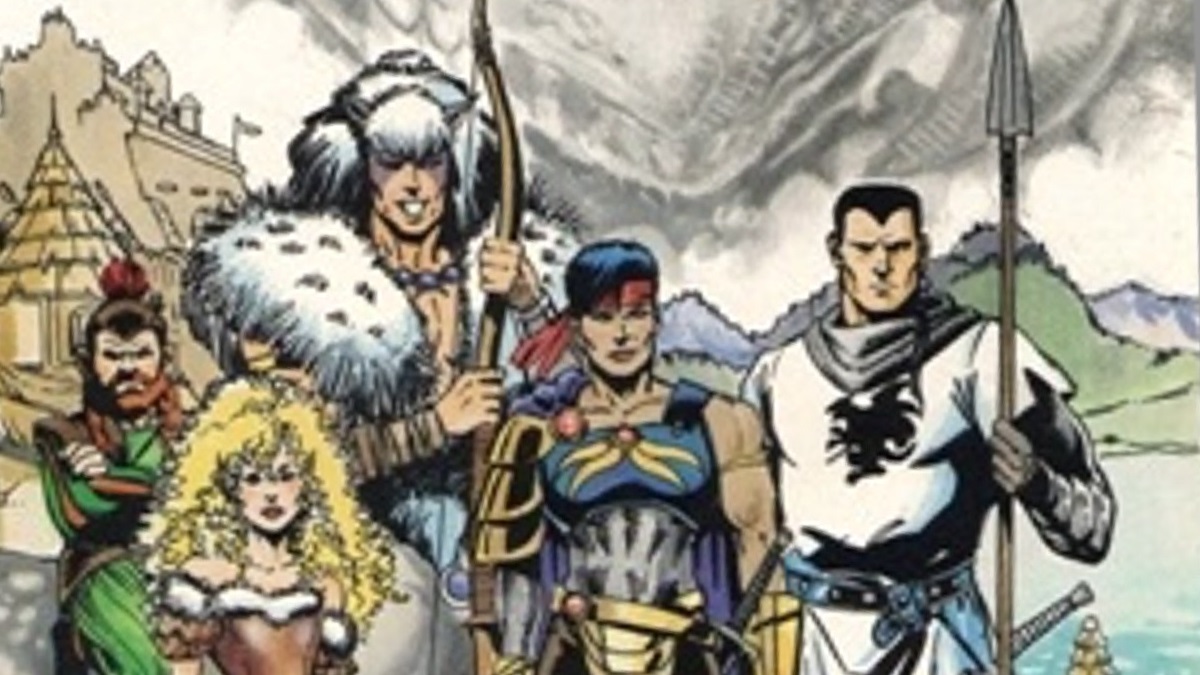
This is the image from “The Gathering,” which shows the part in a more straight-on fashion. There’s some personality there, with the dour dwarf, the serious paladin, and the smiling archer, but you could basically put it on the cover of any fantasy novel.
For better or worse, the “Fell’s Five” comics followed Wizards of the Coast’s vision of D&D as a brand, rather than as a vehicle for the fantasy genre at large. The 4th edition comics are faster-paced, full of sarcastic dialogue, and generally designed like an action movie. These work together well and make it one of my favorite RPG comics, but I sometimes wonder if the reason the comic didn’t last very long is because the good times it offers can be found in virtually any other action-oriented media of the era.
Continue reading “Comics & Quests: Shadowplague”
The end of the license for DC Comics didn’t mean the death of D&D comics, but it did create a long dry spell for D&D comics that I found interesting. The sporadic releases over the next couple decades were largely adaptations of RA Salvatore novels (which never quite hit home with me) or tales that lacked the humorous and chaotic bent found among the heroes of Waterdeep or the Realms Master crew. But then 4th edition D&D came out and it brought something new with it…
Except for the original brown box released in 1974, 4th edition is the one iteration of D&D I’ve never really played. I’ve run some test encounters here and there, but the system never grabbed me enough to want to play an adventure, let alone a campaign, of it. For me, it was too miniatures-focused, too obsessed with defined powers, and spent too much energy chasing the World of Warcraft feel that had come to dominate fantasy of the early 2000s. Wizards of the Coast did little to sell me on the edition; much of the early marketing badmouthed earlier editions as unfair and unfun and the complete overhaul of the Forgotten Realms setting reinforced the idea that this was an edition for people who didn’t like the way D&D used to be.
But the comics…man, the comics turned out great.
Titled Dungeons & Dragons: Fell’s Five in its collected format, this comic was written by John Rogers with art by Andrea Di Vito. The best I can define it as is the energy of Honor Among Thieves, but a decade earlier. It’s funny, it’s action-packed, and it’s probably the best D&D comic I’ve ever read.
Unfortunately, it’s also short. The comic only lasted 16 issues, and I’ll be covering it in four entries here. But better to have something short and sweet than nothing at all. While I’ll never look back at 4th edition fondly, at least it gave us this little gem.
Continue reading “Comics & Quests: Fell’s Five”