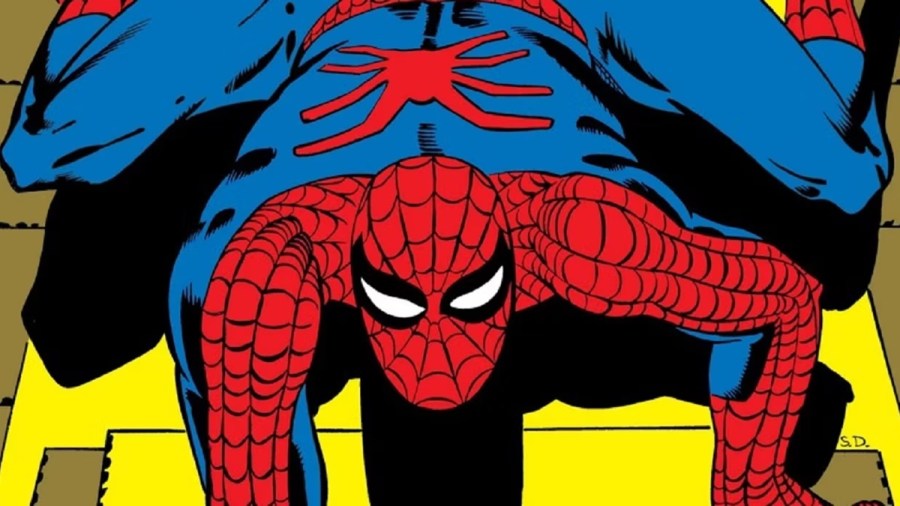
And a lean, silent figure slowly fades into the gathering darkness, aware at last that in this world, with great power there must also come — great responsibility!
Spider-Man used to be one of my favorite comic book characters. Now he’s not. Those who followed the character circa 2007-2008 can probably guess why. If you can’t, we’ll be getting to that soon enough.
Spider-Man’s Not-so-Secret Origin
Spider-Man’s origin, both in comics and in the publishing world, has got to be one of the most retold stories in the industry. According to Stan Lee, he got bored in a meeting and noticed a fly on a wall. He then pitched the idea of a superhero who could cling to walls. He further elaborated on the concept, making Spider-Man a teenager so the comic would appeal to young readers.
The idea was seen as ludicrous by others, because teenagers were sidekicks, not superheroes on their own. But Amazing Fantasy was ending its run with issue #15, so Stan got his shot at debuting the character there. He turned the concept over to Jack Kirby (who may or may not have pitched the idea of a superhero called Spider-Man to Lee), who did some designs for the character, but none of the designs seemed to click right. Then Lee passed it over to Steve Ditko, who designed the iconic costume and solidified many of the concepts behind the character. Amazing Fantasy #15 was a smash hit, and the editor who laughed at Stan’s concept came back a few months later to talk about “that Spider-Man character we both liked.” Spidey got his own series shortly afterwards, and has been Marvel’s most recognizable character ever since.

In terms of look and powers, Spider-Man has undergone several big changes, but few of them have stuck around. His most recognizable costume is still based on Ditko’s original design. His powers still include super strength, agility, and his spider sense. He still travels via web-slinging. Other abilities have come and gone, but most of the big changes to the character have been seen as an ill-fated attempt to mess with success…as we will soon see.
The Death of Gwen Stacy
Throughout his early years, Spider-Man got one of the best supporting casts in comics. Aunt May, J. Jonah Jameson, Robbie Robertson, Flash Thompson, and many more characters began as window dressing in the Lee-Ditko stories but remain central to Peter Parker’s life today. In addition, nerdy little Peter Parker actually turned out to be quite a hit with the ladies, garnering the attention of Betty Brant, Mary Jane Watson, and Peter’s apparent true love, Gwen Stacy. A common theme with the character was his strange combination of good and bad luck. As Peter Parker, he had all the breaks and good fortune in the world. But he often had to turn his back on good luck because of his sense of responsibility. His Uncle Ben died because he was selfish, and he’s never lived that down.
Although Peter had a revolving door of love interests, Gwen Stacy gradually emerged as his main squeeze. Their relationship weathered many troubles. Among other things, Gwen’s father was killed by Dr. Octopus and, in a misunderstanding, Gwen blamed Spider-Man. Despite tragedy and misunderstanding, Peter and Gwen kept getting back together. Then the Green Goblin killed her.

Gwen Stacy’s death is probably the biggest death in comics at the time. This wasn’t death by origin story or someone who had been around for two issues. This was a major supporting player who had been around for years. Moreover, it was the hero’s primary love interest who died. And, unlike the many, many shock-value deaths to come, Gwen didn’t come back.
The knife in the side keeps getting twisted for Spider-Man, too. It all happened because the Green Goblin discovered his secret identity, then used it to lash out at the people Peter loved. He kidnapped Gwen and tossed her off the Brooklyn bridge, but Spider-Man shot out a webline, saving her like he always seemed to. Except this time, there was a snapping sound. In saving her, Spidey had potentially killed her by his own hand.
While not signaling a costume or powers change, Gwen’s death was a huge turning point in Spider-Man comics. It put the Green Goblin on the map, even though he died the same issue. (Unlike poor Gwen, the Goblin would be back…again and again and again.) For the comics industry as a whole, it signaled the end of the Silver Age and the start of the darker Bronze Age. And it caused Spider-Man to grow up in a big way.
The Black Suit
In terms of costume changes, very few can be considered as successful as Spider-Man’s black suit. He originally got it during the Secret Wars event, which was Marvel’s first really huge crossover, written in response to DC’s success with Crisis on Infinite Earths. Spider-Man and many other superheroes were transported to an alien world by a cosmic being known as the Beyonder who chose to test both heroes and villains in a grand battle royale. While the quality of the series wasn’t all that great, it did have some memorable moments, such as the Hulk catching and holding an entire mountain range and, of course, Spider-Man’s black costume.

During one of the battles of the Secret Wars, Spider-Man’s costume got badly damaged. He and some other heroes discovered an alien machine that created new costumes. Knowing that alien technology can always be trusted, Spidey used the machine and was gifted with a black costume that could change appearance based on his thoughts, enhanced his strength and speed, and gave him an unlimited supply of webbing. The suit also had a presence in Spider-Man’s mind, though, subtly influencing his thoughts.
The fun part about the costume change is that there was initially no explanation for it. Secret Wars began with a group of heroes gathering at a strange site, then emerging from that same site with everything changed. For the heroes, months had gone by. For everyone else, mere moments had. In the literal blink of an eye, Colossus and Kitty Pryde ended their long-standing relationship, the Hulk had a broken leg, the She-Hulk had replaced the Thing as a member of the Fantastic Four, and Spider-Man had his new costume. The Secret Wars limited series explained these changes, and readers didn’t find out how Spider-Man got the change in clothes until eight issues in. By that time, the post-Secret Wars events of the comics had revealed that the costume was actually an alien symbiote that bonded with its host. With the help of Reed Richards, Spider-Man got rid of the symbiote, but apparently liked the black costume enough to create a cloth replica. For a while, Spider-Man alternated between his red and blue costume and his black one. This led to some amusing bits with J. Jonah Jameson, who ascribed sinister intent to everything Spider-Man did, and who insisted that the costume change was some scheme of Spider-Man’s. In reality, it was a matter of, “Oh, my red and blue tights have a stain. I guess I’ll fight crime in black tonight.”
The black costume might have been a temporary change, or it might have become a permanent alteration in look, but instead it became a cornerstone in Spider-Man’s history when it created one of Spidey’s most deadly foes. The symbiote escaped apparent death and wound up bonding with Eddie Brock, a rival photographer of Peter’s who blamed his failings in life on Spider-Man. The result was Venom, a souped-up version of Spider-Man who had a homicidal streak to him. Venom would go on to menace Spider-Man for years, and eventually became an anti-hero when his suit spawned the even more deadly symbiote known as Carnage. With Venom’s emergence, Spider-Man went back to his red and blue suit permanently, but the change had covered about five years of comics…pretty significant as far as these things go.
The Spider-Marriage
Among the many effects of Gwen Stacy’s death was the way it changed Mary Jane. Previously the smoking hot “bad girl” to Gwen’s virgin-like purity, Mary Jane became a more serious character following Gwen’s death. The issue after Gwen’s death, she revealed some of her true self to Peter in her attempts to comfort him. From those beginnings, a relationship between her and Peter began. Ultimately, Peter revealed his secret identity to Mary Jane, who may have already known, depending on how you want to read the subtext of the comics.

In 1987, the relationship came to a head as Peter and Mary Jane got married. There was a lot of hoopla for the comics event, including a mock-live version of the wedding officiated by Stan Lee. If Gwen’s death had forced Peter to start growing up, the marriage to Mary Jane firmly demonstrated that the kid superhero had become a man. Even back then, there was a lot of debate on whether it was a good idea, with editor-in-chief Jim Shooter supposedly against the marriage. In the comic scripts, both characters were shown as having some doubts the night before, which gave the writers a convenient back door to escape from and return to status quo to normal should the move prove to be unpopular. But it wasn’t, and Spider-Man and Mary Jane stayed together as a married couple for the next twenty years.
The con side of the marriage argument was that it made Spider-Man seem too old, when he originated as a teenager. Of course, the X-Men also originated as teenagers, and I don’t see people arguing that they should stay that way. While I can see the importance of keeping Spider-Man somewhat young, his relationship with Mary Jane was ultimately well-written enough that it became a good thing for the character while also not aging him too much – even married, Peter was still only in his early 20s.
The Clone Saga
Back in the 1970s, there had been a story where a supervillain known as the Jackal cloned Peter Parker. The two Spider-Men fought, one died, and his body was dropped into a smokestack to keep people from discovering who Spider-Man was. That one-off story came back in the 1990s and proceeded to hijack comic book like some sort of radioactive mutant dinosaur out to steal kids’ lunch money.

At the time that the Clone Saga started in 1994, Spider-Man had four separate ongoing titles. This saga ran through all of them, and it didn’t stop for three years. This storyline was the first of many attempts by writers to “fix” the Spider-marriage and bring back a younger, single Peter Parker. Part of the catalyst for the saga was that Peter wasn’t just married anymore – Mary Jane was now pregnant. A lot of folks thought it was a bad thing for Spider-Man to be a dad. Actually, as a whole, Marvel seemed to hate the idea of parents at the time. Prior to the Clone Saga, Bruce Banner (aka the Incredible Hulk) was supposed to have a child as well, and Marvel editorial forced Betty Banner to have a miscarriage under the logic that readers wouldn’t like her anymore if she was a mother.
Basically, the idea behind the Clone Saga was this: the supposedly dead Spidey-clone of before wasn’t really dead. He had spent a few years wandering the world as Ben Reilly, combining the first name of Uncle Ben with Aunt May’s maiden name and fighting crime as the Scarlet Spider. Ben returned as part of the schemes of the allegedly-dead Jackal, who had created more Spider-Man clones including the new supervillain Kane, who made his mark in Spidey’s comics by killing Doctor Octopus. The plan by the creative team was to reveal Peter to have been the clone and Ben to be the real Peter Parker. This would allow Peter to go off into the sunset with Mary Jane and his new baby while bringing a young, single Spider-Man back. And, if the move proved to be unpopular, a switcheroo could take place that would reinstate Peter as the real deal.
Then the marketing team got hold of it.
Marketing noticed that the Clone Saga had boosted sales and ordered the storyline to be expanded. It grew to monster proportions, went through numerous creative teams, and started spawning plotholes right and left. Peter was revealed to be the clone, then he was revealed the be the real deal. He retired as Spider-Man, then he came back. Ben Reilly took over as Spider-Man for a bit, changing the costume some, and even got possessed by the Carnage symbiote at one point. Peter started to lose his powers, then got them back. By 1996, marketing had created the beast that could not be fed, and nobody knew how to get out of it. It got so bad that the creative team even discussed Mephisto, Marvel’s version of Satan, cropping up and magically retconning it all away. They ultimately rejected that idea, because while the Clone Saga had been stupid, that idea was even stupider.
Finally, Norman Osborn, aka the original Green Goblin, was brought back to life. Ben was revealed to be the clone, and Norman was revealed to have masterminded the whole thing. Moreover, Norman wound up taking Mary Jane’s baby from the hospital after birth, doing away with her off-panel and ridding continuity of Spider-Man’s child while building up his own EvilCred™. Shortly thereafter, Aunt May, who had died before the Clone Saga, came back, revealed to have never actually died but instead to have been a part of Norman’s evil machinations to ruin Peter’s life. The status quo went back to what Spider-Man had been like in the 1970s and 1980s, with Aunt May fretting over her nephew and Peter constantly trying to balance the responsibilities of his normal life with his superhero identity. But there was still that pesky marriage thing to deal with…
One More Day
Through the early 2000s, Marvel toyed with the idea of getting rid of Spider-Man’s marriage in various ways. At one point, a stalker blew up a plane Mary Jane was on, but sales plummeted and she returned, unharmed, soon afterward. But then came “Civil War” and “One More Day.”
Aside from gaining organic webshooters in an attempt to get synergy with the then-current Sam Raimi Spider-Man movies, Spidey remained largely unchanged throughout the years, black costume and identity crisis aside. But he joined the Avengers in the 2000s, which allowed him to form a close friendship with Iron Man. Tony Stark, as he is wont to do, started tinkering with Peter’s suit, creating an “Iron Spider” look that lasted until the “Civil War” crossover event.

Unfortunately, “Civil War” was anything but kind to Spider-Man.
In that event, the government decided that superheroes needed to register with the government so they could be monitored. This led to a schism in the superhero community, with Iron Man leading the pro-registration side and Captain America leading the anti-registration side. A cool concept was ruined by the fact that everyone was on a different page. The pro-regs were written as fascists, the anti-regs as guerrilla terrorists, and the heroes as a whole stopped being heroic. In the midst of this, Iron Man convinced Spider-Man to set an example for the rest of the superhero community and reveal his identity to the world. After all, his loved ones were safe under the protection of the Avengers, right?
Well, Spider-Man revealed his identity in an event that made national news in the real world and that Marvel claimed would be a permanent change (in reality, it was undone within two years). Spider-Man soon realized that he was fighting on the wrong side of the Civil War because Iron Man and company were total dicks, ignoring things like due process and using mind-controlling nanites, among other things. Spidey fled with Mary Jane and Aunt May in tow and went into hiding. But it was only a matter of time until Spider-Man’s foes took a shot at him now that his secret identity had been revealed. Wilson Fisk, the Kingpin of crime, hired an assassin to go after Peter’s loved ones. The assassin shot Aunt May, fatally wounding her. And despite having friends ranging from Mr. Fantastic to Doctor Strange, Peter found no luck in curing his old aunt of a bullet wound until he decided to make a deal with the actual Devil.

Mephisto, the guy who was too far-flung for the Clone Saga writers, showed up and offered to save Aunt May if Peter and Mary Jane gave up their marriage.
Now, any hero – hell, any moderately decent person, would have told Mephisto to go piss off. But instead, Peter browbeat Mary Jane into agreeing to the deal. And, just like that, the Spider-marriage was done, after many years of trying to put the genie back in the bottle.
Did I mention he made a deal with the Devil?!
The deal with Mephisto not only negated the marriage, but inexplicably retconned away Spider-Man’s organic webshooters, undid the revelation of his identity, and brought Harry Osborn, a long-dead supporting character, back to life.
The identity part was later explained in the storyline “One Moment in Time,” which explained that Mr. Fantastic, Iron Man, and Dr. Strange teamed up to wipe the world of the knowledge that Peter Parker was Spider-Man. Again, people who couldn’t treat a bullet wound got together and erased the memories of everyone on Earth.
I would argue that Spider-Man never recovered from “One More Day,” and that the character has struggled to find consistently good storytelling since that story’s release in 2007. But the fallout of that tale and more will have to come in another installment. In Part Two of Spider-Man’s Superhero Evolution, we’ll discuss, among other things, something…superior.
Images: Marvel Comics
 Babbling Brooks