
I have many criticisms about the various editions of Dungeons & Dragons, but one thing has remained consistent for at least 35 years: tehe comics based off the games are tons of fun. Since I love trips down memory lane, I’m going to spend some time waxing nostalgic about some comics which readers of this blog may have forgotten, never heard of, or been born well after. First up: the simply-titled Advanced Dungeons & Dragons.
Back in the late 1980s, DC Comics got a license to produce various D&D comics. The first was based on the Dragonlance series, and I have sadly not read that one. The second was set in the Forgotten Realms and introduced a mishmash of hapless adventurers who struggled through adventures that ranged from epic to ludicrous. The first four issues served as their origin story, in a tale dubbed “The Gathering.”
The Fallen Paladin
“The Gathering” begins with the flashback to six years ago. Here one of our heroes, Priam Agrivar, meets an ignoble fate thanks to a monstrous wizard and a staff of withering. The wizard kills Agrivar’s father and leaves the once-mighty paladin unable to pick up a weapon when the staff strikes his hands.
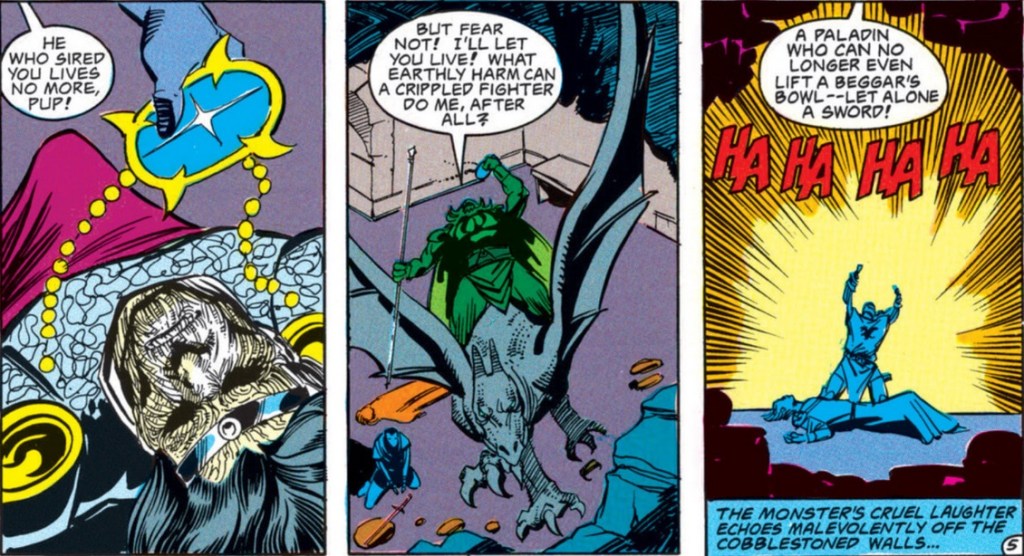
Right off the bat, the comic gives a hint that it’s not going to reflect game mechanics exactly, erring instead on the side of narrative drama. In the game, a staff of withering ages a person as a whole, not their specific body parts. The hit to Agrivar would have aged him by a decade, possibly making him middle-aged, but it wouldn’t have rendered him unable to fight.
That level of rules nitpickery would hinder the story that co-plotters Michael Fleisher and Jan Duursema want to tell, however. A constant in D&D comics is that the stories use the trappings of the game but set aside the mechanics when convenient.
More Intrepid Adventurers
Speaking of crippled hands, in the present day the half-elf Cybriana experiences her own troubles when a simple cantrip turns her hand into immovable crystal.
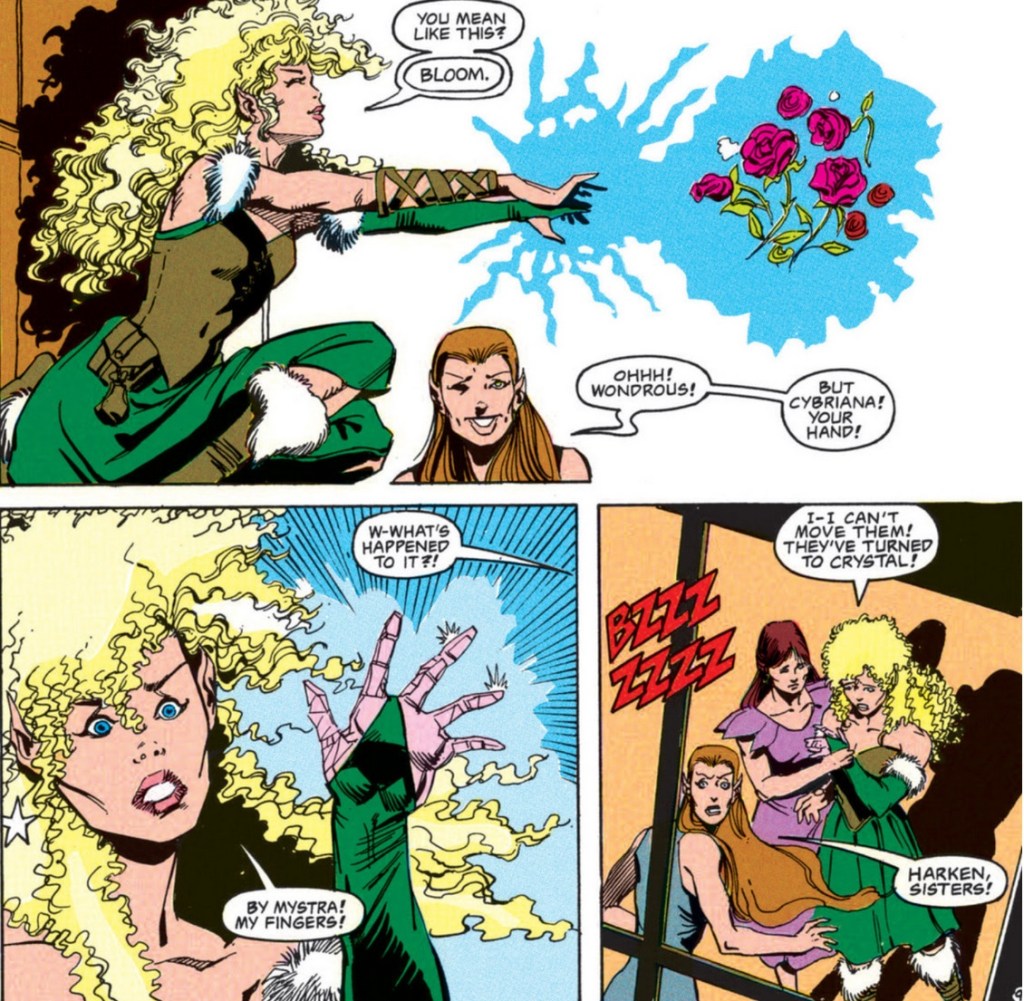
Cybriana is one of the main protagonists of this series, but for this first story she plays the role of damsel in distress and plot device. Whne a group of chasme (giant fly-demons that put people to sleep with the beating of their wings) attacks, she even rolls her ankle and stumbles before being captured, like many a hapless woman in old-school action stories.
Luckily for Cybriana, her shout of fear brings a pair of other adventurers, the dwarf Onyx the Invisible and Timoth Eyesbright. They rush in and save the day, with Timoth playing the role of noble hero and Onyx acting as a typical dour dwarf who is put out at having to play hero. With Timoth’s encouragement, the pair agree to act as bodyguards for Cybriana as she travels to Waterdeep to find the paladin Agrivar so he can help her find her kidnapped twin sister. Thus, half an issue in, our adventuring party is formed up and ready to go.
Mostly.
You All Meet in a Tavern
Cybriana, Onyx, and Timoth all reach Selûne’s Smile in Waterdeep, where the innkeeper Luna has one more adventurer to introduce them to: the former gladiator Vajra.
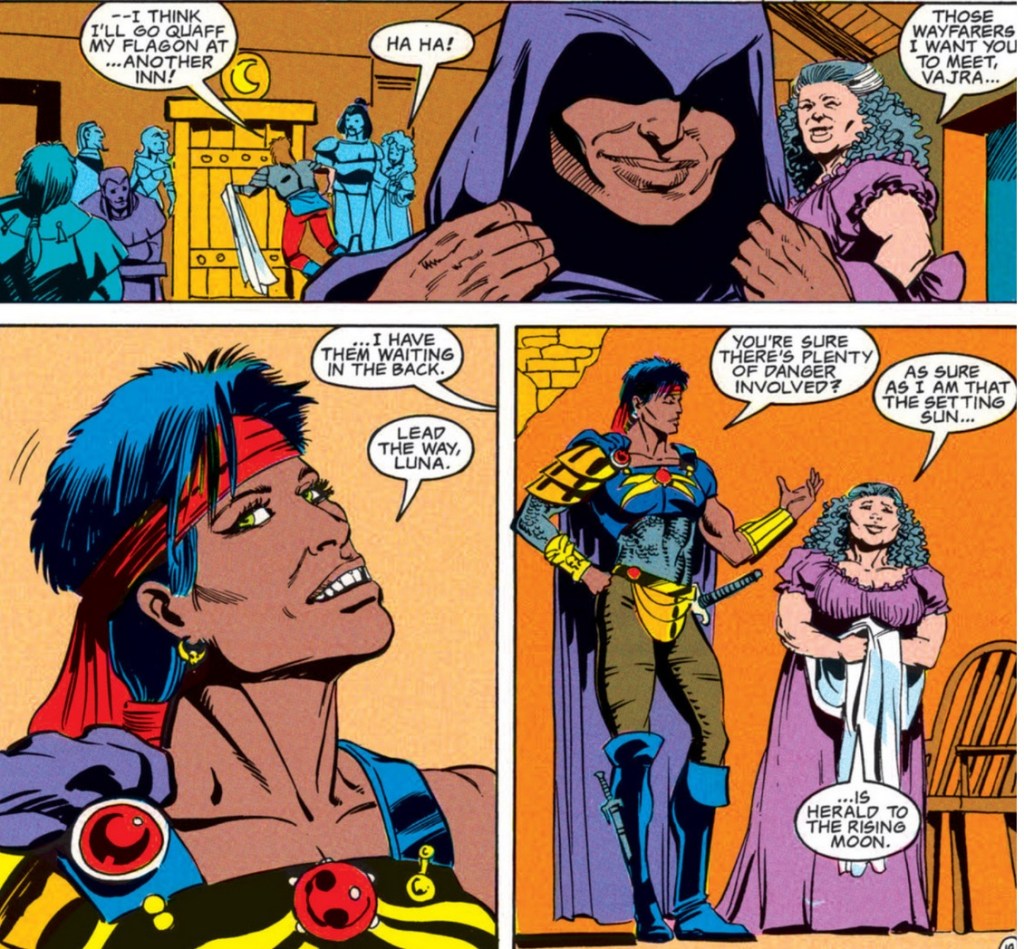
As my discussion of this book goes on, you’ll hear me complain a lot about Vajra. She’s a great character who I want to see more of, but the stories constant put her in peril rather than letting her shine in combat like she should.
Regardless of how she gets utilized, Vajra is important to Cybriana because she knows about Agrivar’s whereabouts. In fact, he’s right outside the inn…
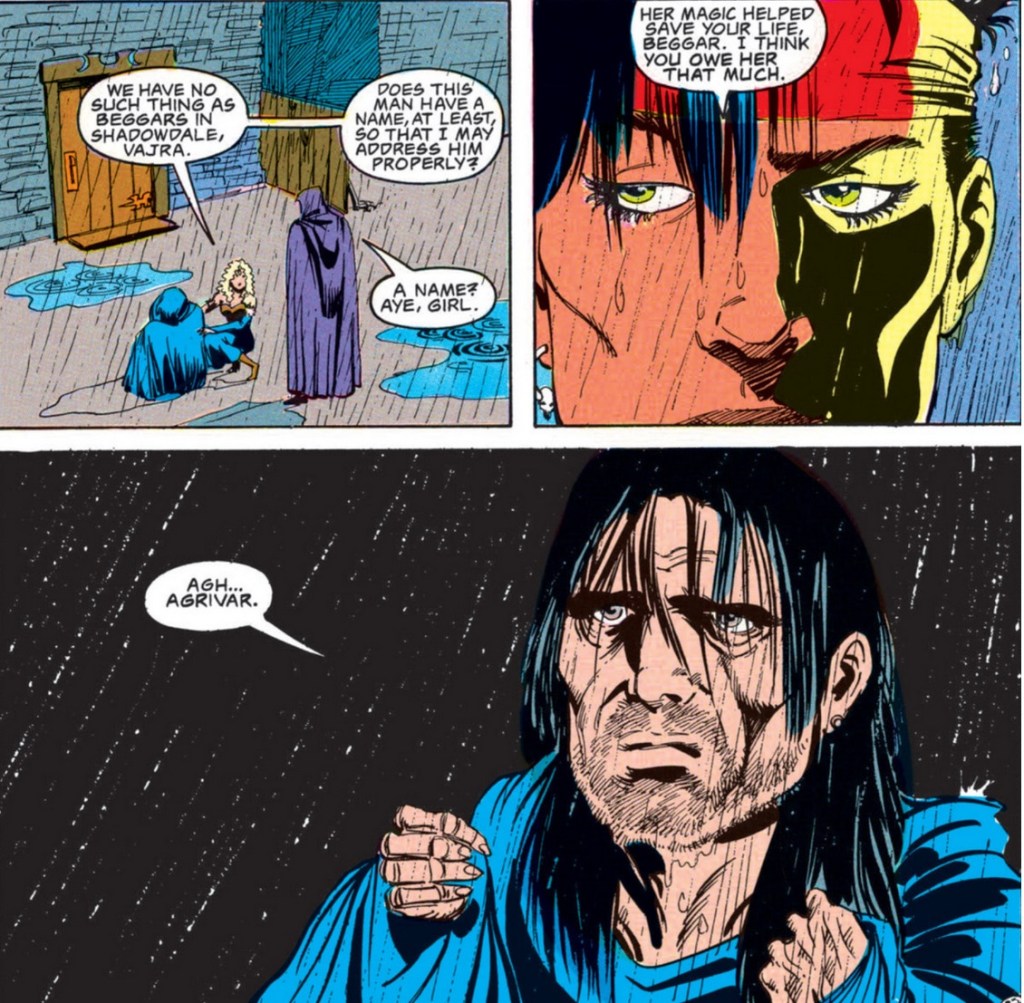
As it turns out, Agrivar has become a drunk since losing his ability to fight. This is bad news for Cybriana, who believed he would be able to help her find her missing sister. But why does Cybriana need a washed up paladin when she has a trio of capable warriors ready to help her already?
Um…shut up, that’s why.
Fix the Broken Character
The only explanation we get about Cybriana’s interest in Agrivar is that she “has faith” in him. Personally, I think it’s because Cybriana had an elven upbringing, and elves view things in a longer time frame than humans. So while six years of drunken destitution is a life-changing thing for Agrivar, Cybriana figures it’s just a transition and he just needs a nudge to get over this phase. That’s all my reading into the comic, however; there isn’t anything on the page that backs that up.
Regardless of the reasoning, the whole group departs Waterdeep and seeks out the smith Jogaoh (no, don’t ask me how to pronounce the name), who can supposedly restore Agrivar’s ability to fight. They find the smith after a pet of his nearly devours them.
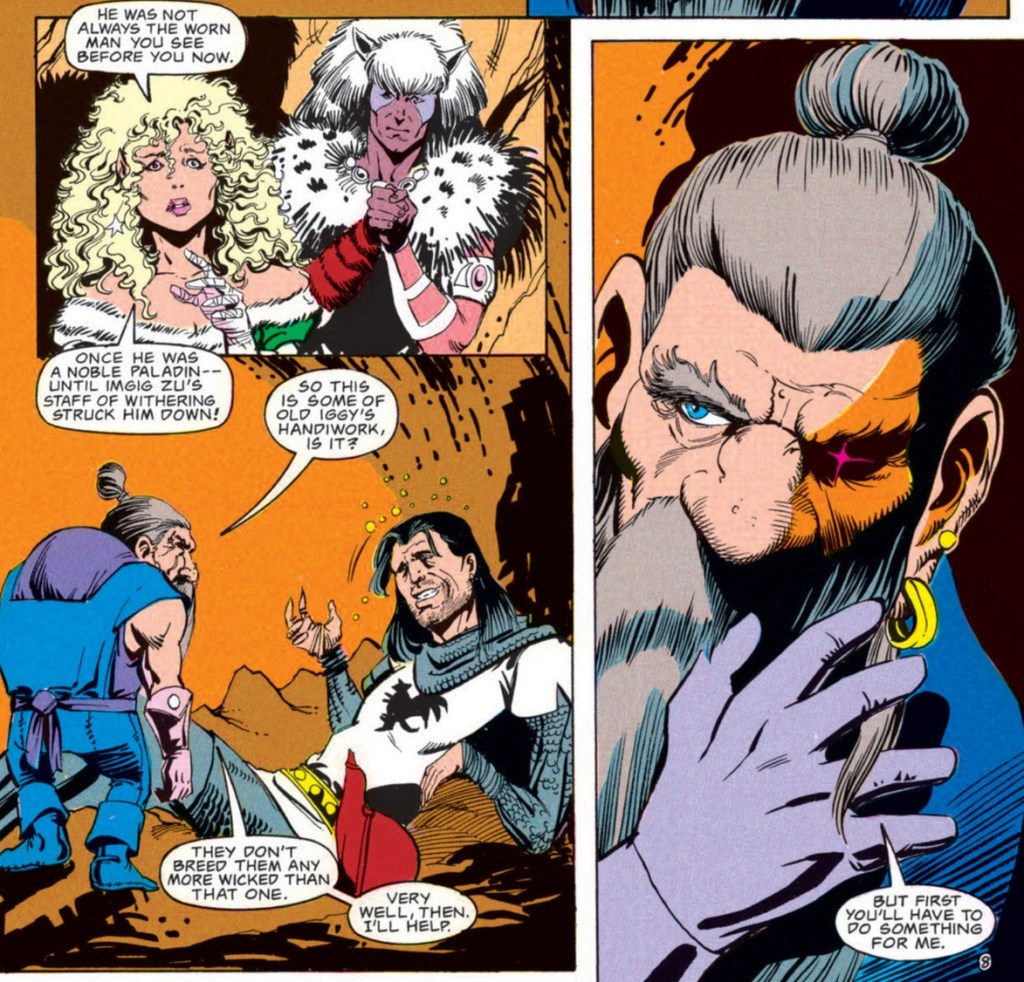
I’m all for restoring a paladin’s will to fight, but maybe the adventurers shouldn’t have brought so many wine flasks with them? In just about every panel, Agrivar is swigging a drink. It seems like they should manage his alcoholism first and his hands second.
Planting Some Seeds
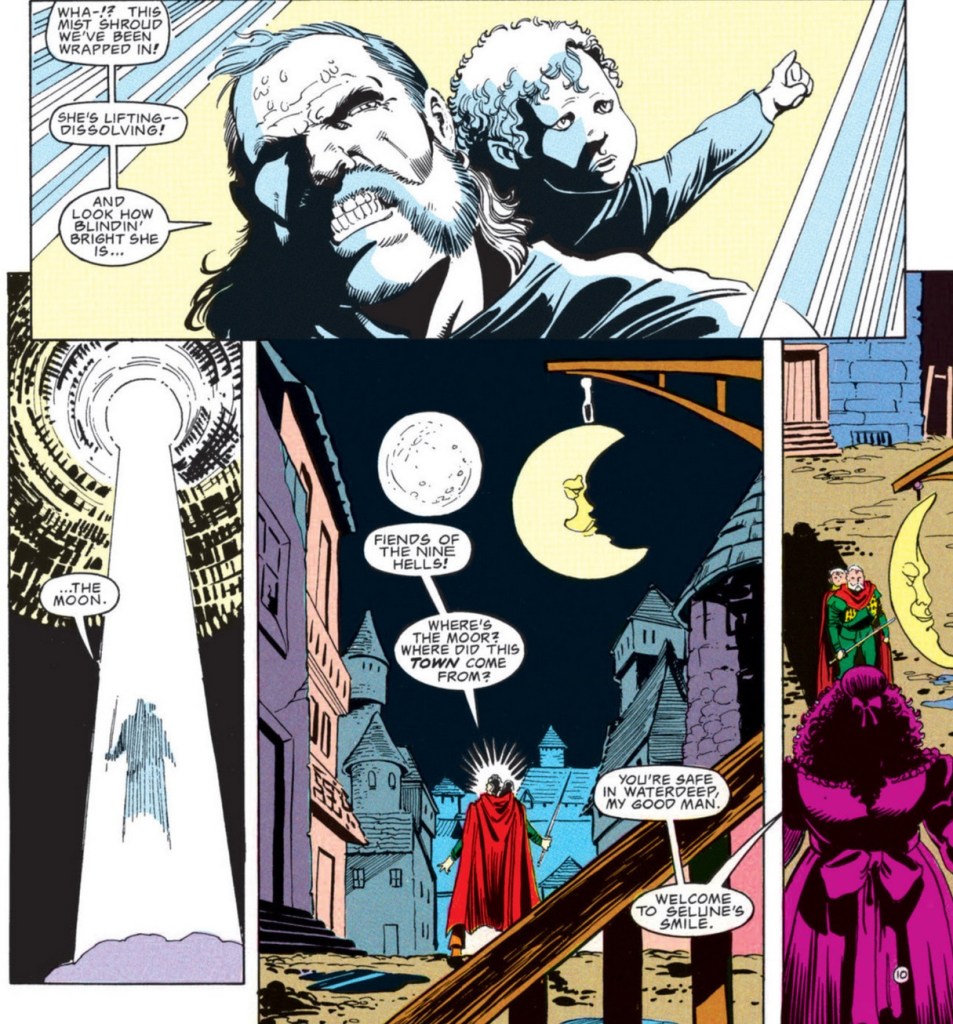
Throughout the early issues of this comic, the story weaves between the adventuring group and the evil wizard Imgig Zu, who spends most of his time walking around his tower and boasting about his master plan. But the creators of this book must have had faith that it would be popular enough to last, because they also sewed some seeds for plots that wouldn’t be resolved for some time yet. For example, a man named Connor finds himself beset by wolves while protecting a mysterious child. Suddenly, he vanishes from the wilderness and appears right in front of Selûne’s Smile.
Speaking of little bits of weirdness, Jogaoh has the adventurers drag him through battles against zombies and up a sheer cliff in order to recover a gemstone. Once they’ve done that, he gives Agrivar his gauntlets of ogre power, restoring his strength. He could have done it all along, but he needed the group to get him the gem so he could transform into his true form: a fire elemental.
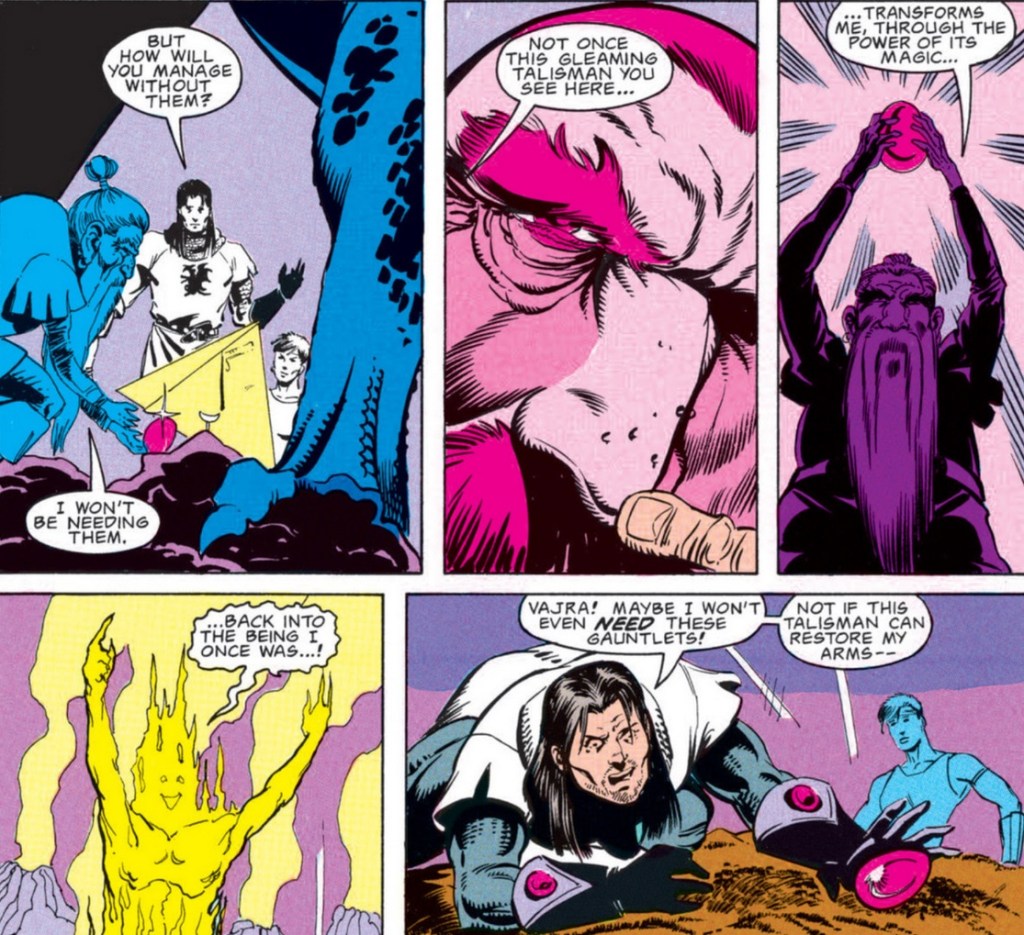
Of course, taking the gem awakens a basilisk that attacks the group just after Jogaoh departs. And, unfortunately for Agrivar, regaining his strength does not equal regaining his will to fight. He freezes in battle and nearly gets everyone killed. After the basilisk is defeated, he skulks away in shame.
More unfortunately for the remaining group, some slave hunters have been tracking down Vajra, who escaped from the gladiatorial arena without buying her way to freedom. The past catches up to her and results in the whole band (save the dejected Agrivar) getting captured.
A Chance at Redemption
Agrivar’s quest to find his way serves as a major character arc that runs through two separate D&D comics–both this one and the Forgotten Realms series. He takes his first step toward redemption here by returning to the group he abandoned and dropping a dagger to Vajra so she can lead an escape.
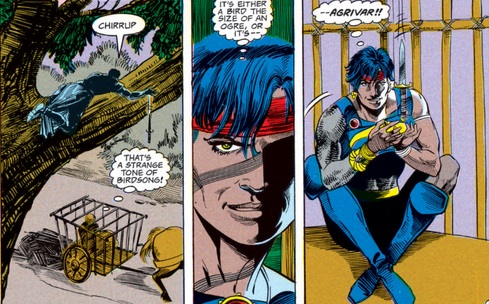
The way Agrivar helps is a nice build-up to his eventual rehabilitation as a hero. He doesn’t strike down the bandits by himself or anything of the sort; he starts small by providing aid in a much more subtle way. Once the group is free, they continue their quest to save Cybriana’s sister. But first, we learn the secret behind Imgig Zu’s via a story told by an innkeeper.
An Innkeeper’s Secrets
Back at Selûne’s Smile, the innkeeper Luna tends to the mysterious young child that Connor saved. To get the child to sleep, Luna begins telling a story that is strikingly autobiographical…
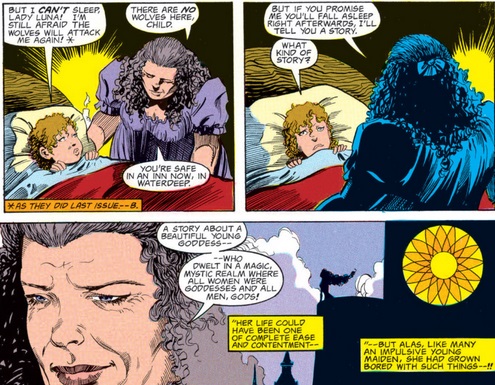
The comics hide the truth from the heroes, but any reader who knows the Forgotten Realms can quickly see the obvious: Selûne’s Smile is run by the actual Selûne, goddess of the moon. As she relays her tale, she tells of a time years ago when she became infatuated with a mortal who was really Imgig Zu in disguise. Imgig tricked Selûne into bringing his forces into Faerûn and nearly killed her. However, a man on horseback…Agrivar’s father…saved her.
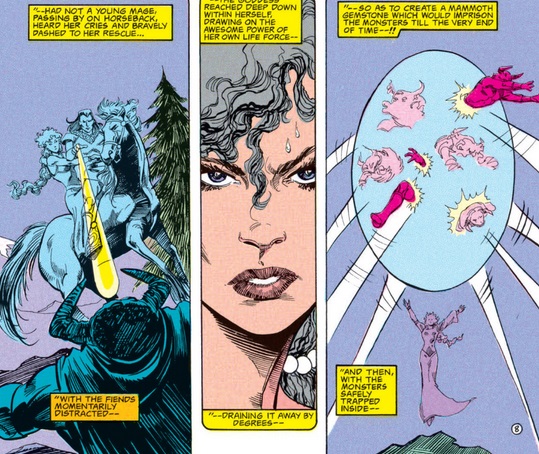
And so we discover that Imgig Zu’s plan is to unleash the magical gem that Selûne used to trap his forces so they can wreak havoc across the Forgotten Realms.
Having an actual goddess running an inn is a very Realms thing to do. The setting thrives on its odd little details, where every inn and hostel has some hidden backstory behind it. Luna also works very well as a mysterious patron for the heroes: powerful and wise, but not retaining her true godly strength because of the treachery of Imgig Zu. (Don’t ask me how she retains the ability to empower her followers, though; that never gets explained.)
The True Nature of Evil (?)
While we’re in the mood for expositions, Cybriana finally explains the truth about her and her sister. She knows magic instinctively thanks to the fact that her human father was a wizard of some power. However, she soon developed a strange black birthmark that grew a consciousness of its own…
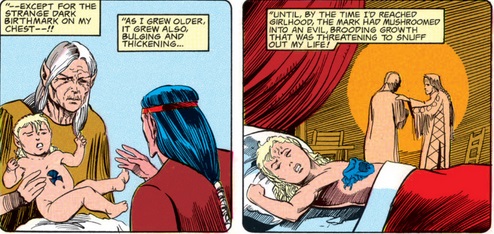
Cybriana’s “sister,” Kilili, is actually the manifestation of her mother’s evil, separated in a ritual meant to save young Cybriana’s life.
Moments after showcasing one of the strengths of the Forgotten Realms, we delve into one of its weaknesses: muddled storytelling created by an over-reliance on magic. Setting aside certain fantasy tropes that don’t age well (a reliance on bloodlines for power, light being good and dark being evil incarnate, and so on), Cybriana’s story bogs down the narrative and still leaves large swaths of our narrative unexplained. Why is she turning to crystal? Because she has some connection to Selûne’s gemstone…but that’s about all the explanation we’ll get on that.
Regardless, Kilili has allied with Imgig Zu and aids him in kidnapping Cybriana. Her magic will supposedly unlock the gemstone and let the evil warlord’s forces into Faerûn. The stage is set for a climactic final battle.
The Final Battle
With Selûne’s Eye on the verge of opening up and letting Imgig Zu’s forces out of their prison, the evil wizard retreats into his stone fortress with Cybriana his captive and Kilili at his side. The stage is set for some heroics, such as when Agrivar finally answer the bell and saves Vajra from a collapsing ceiling.
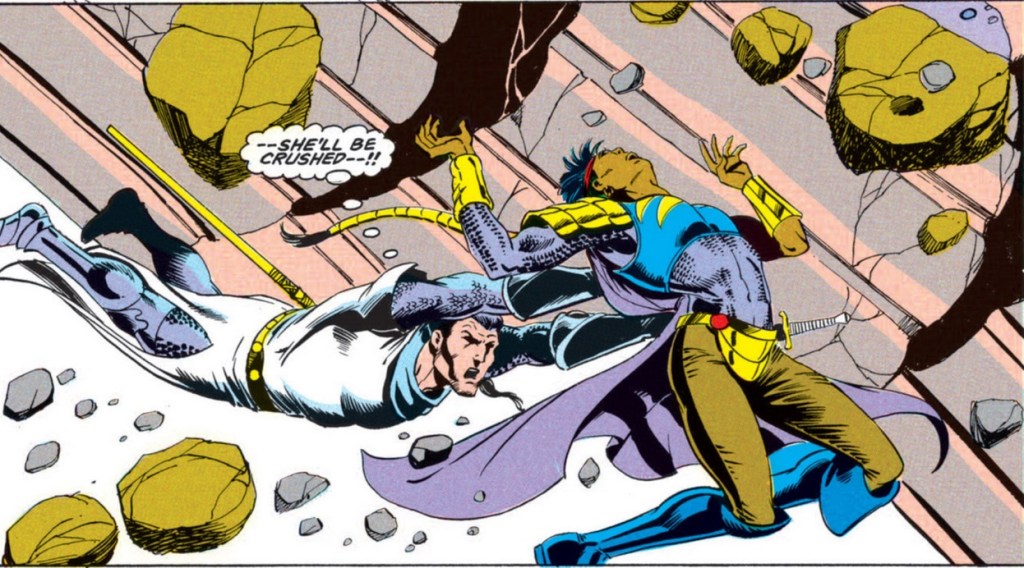
The trap still leaves Vajra badly wounded, which leads Agrivar to reach deep within himself and summon up his paladin healing powers once more. (In a game, he technically would have to get an atonement spell, but that would kill the drama of the moment.)
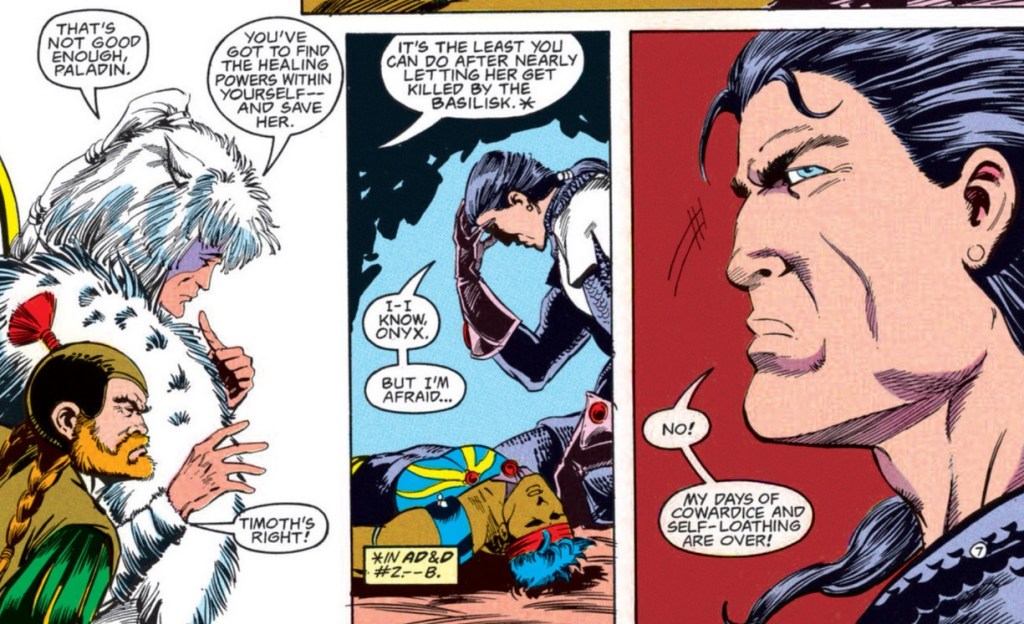
Unfortunately for our heroes, they are still no match for Imgig Zu’s years of preparation. Overcome, all seems to be lost, until…
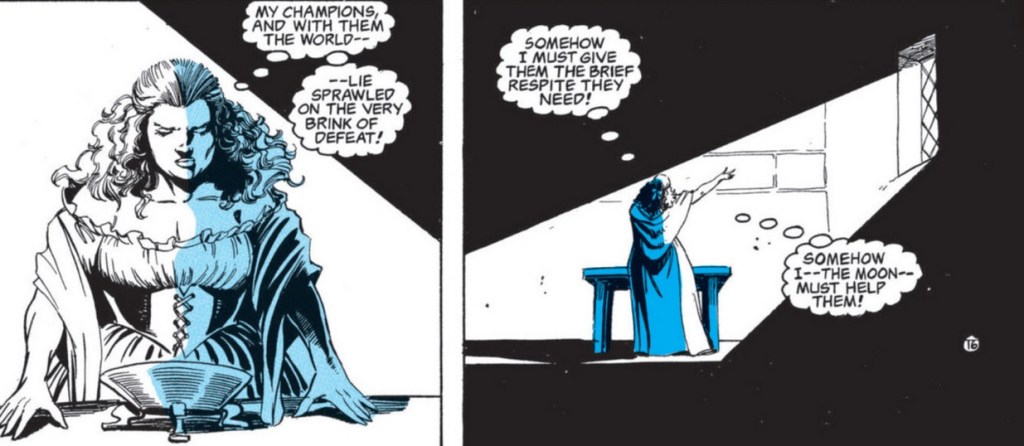
Luna provides some aid, although not the sort of all-powerful magic that D&D typically refers to when it talks about divine intervention. She sends a shaft of moonlight to blind Imgig Zu just before he can deliver a killing blow. This allows Agrivar to strike the evil wizard down. As for Cybriana and Kilili…
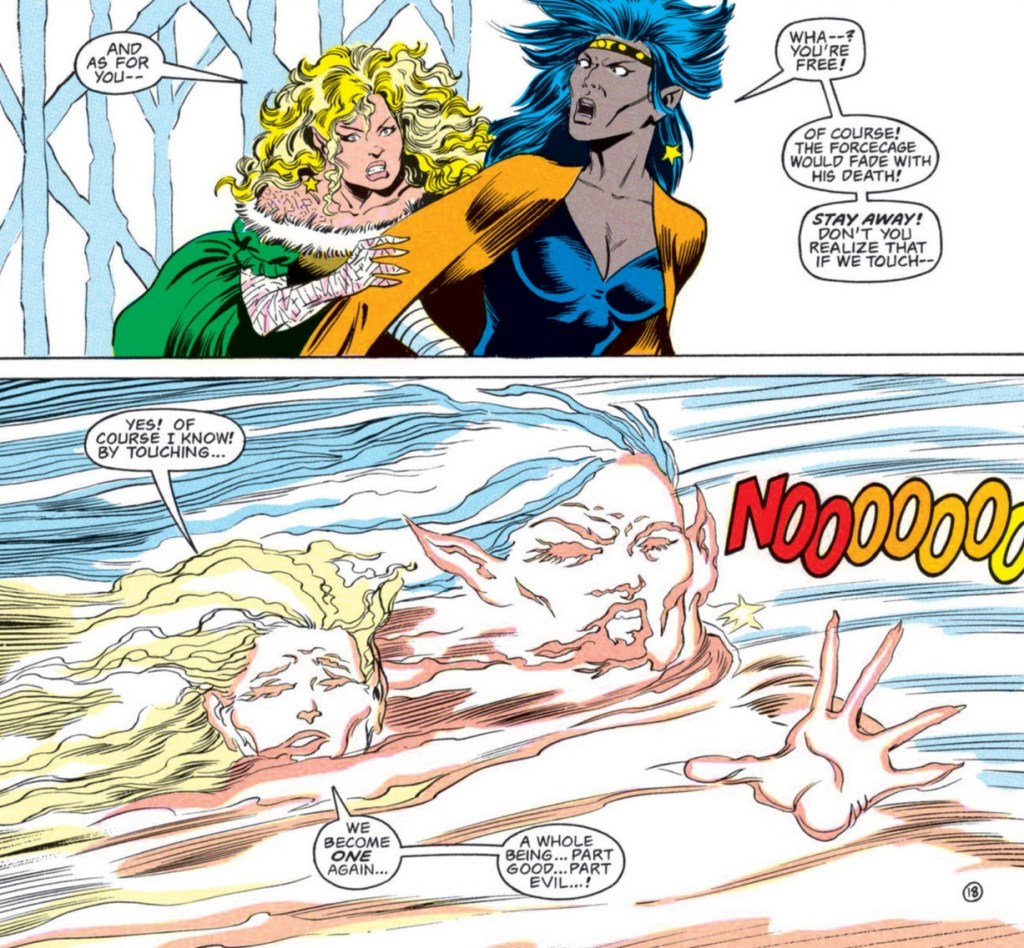
They merge into a new being, good and evil halves united in one half-elven woman named Kyriani.
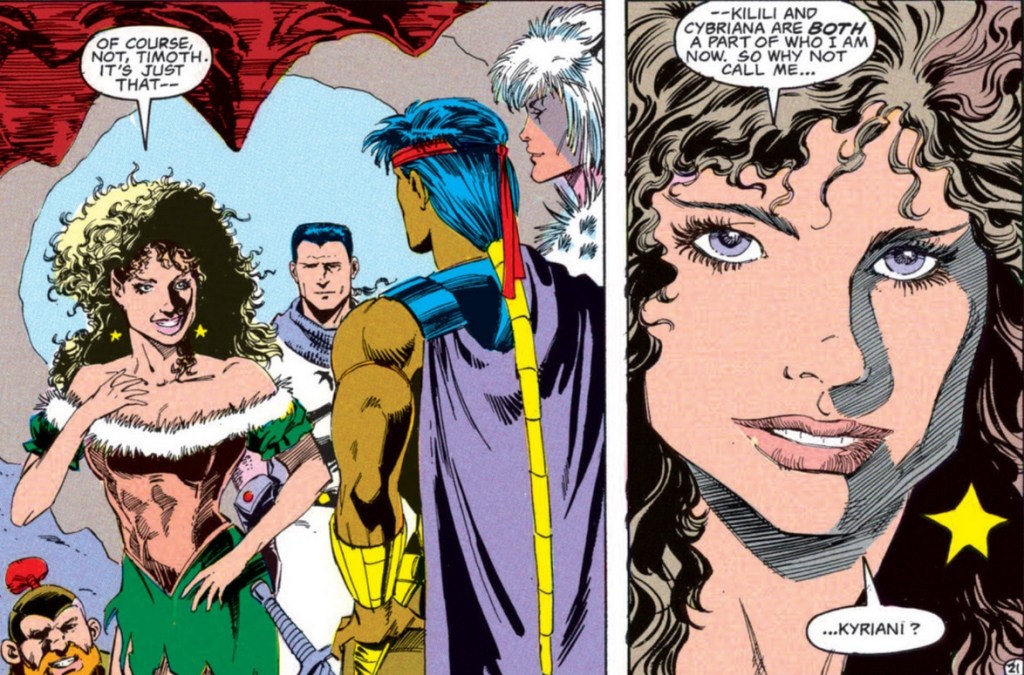
This would not be Kyriani’s last major transformation.
Whew
If this seems like a lot, that’s because it is. This comic was written in the late 1980s, when a ton of plot got put into every single issue. At four issues long, it contains a ton of content with plenty of seeds sewn that will be reaped later in the series. Modern comics tend to be much more decompressed and don’t have the guarantee that they’ll be around long enough to plant hints about what might be revealed in two or three years.
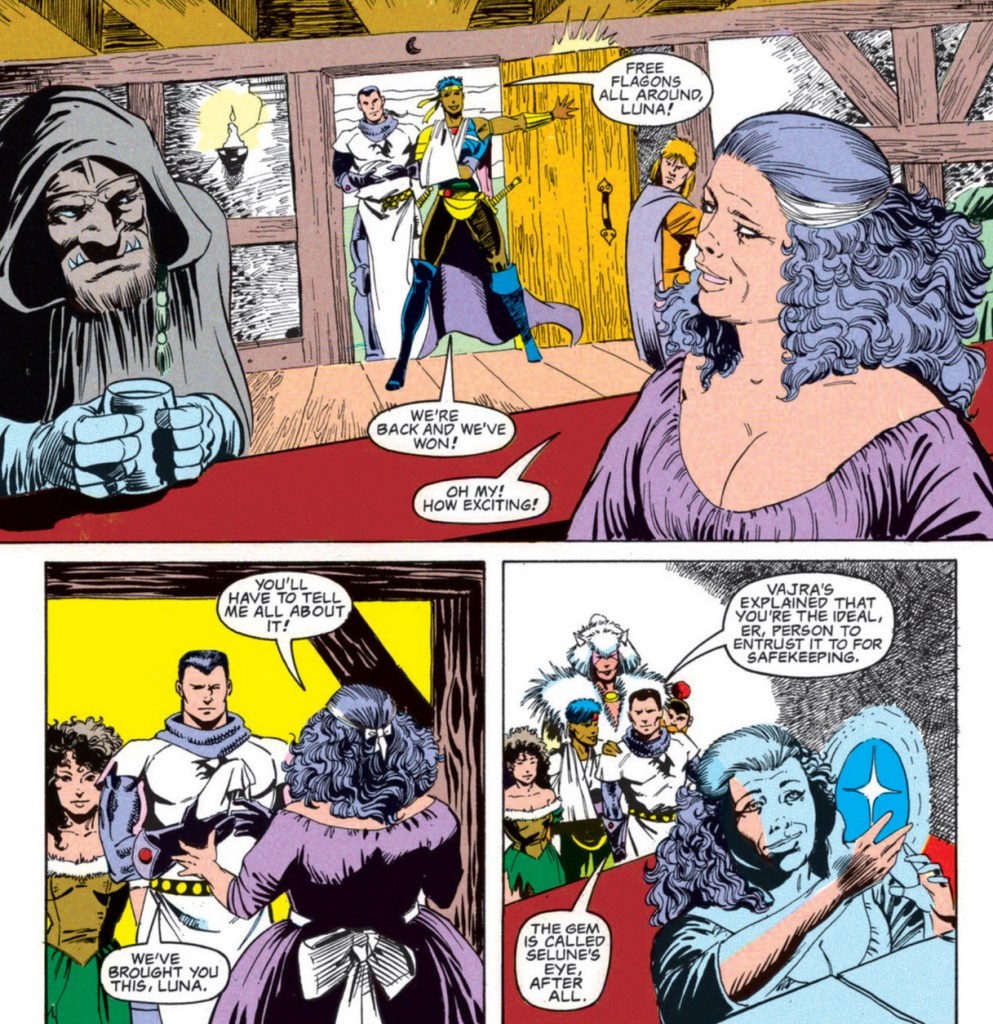
Not only is this comic a good encapsulation of storytelling from the industry at the time, but it catches the feel of D&D from that era as well. The Dragonlance novels had opened up a whole world of epic storytelling that proved very popular. At the same time, the game kept the trappings of mercenaries seeking treasure in ancient dungeons. “The Gathering” combines gruff mercenaries like Onyx and Vajra with idealistic heroes like Kyriani and redemption stories such as Agrivar. It combines all of that with an epic quest that seems like a lot for a new group to take on.
Each issue includes some game stats as backmatter. The heroes in this group range from 4th to 7th level. That puts them in the low mid levels, yet somehow they are touched by destiny enough to draw the attention of a goddess (however limited her powers may be). That, too, is in keeping with D&D of the era, where adventures got more story-focused and epic in scale rather than the dungeon-delving emphasis in the early 80s.
One thing that “The Gathering” doesn’t really hit upon is the weird sense of humor that thrives within D&D lore. Luckily, things only get stranger from here.
 Babbling Brooks