Superhero Evolutions: Renee Montoya

As the Question, Renee Montoya isn’t a character who has seen a lot of costume changes, but she has gone through many other developments over her time in comics. To date, she has spent more time as a police officer than a superhero, beginning as a supporting character and working her way up. This long development has also left her as one of the more interesting characters in DC Comics.

Continue reading “Superhero Evolutions: Renee Montoya”

Where Memory Lane and Rejection Road Meet

My house has too much stuff in it, so I went through my possessions to decide what needs to go. Finally, I came across my Big Box o’ Rejections.

When I first started writing, I decided to save all my rejection letters as a way to keep myself motivated. But now that rejections come electronically and are almost exclusively form letters – and now that I have a lengthy publications list – I don’t feel that I need it anymore. So this box has got to go.

The box itself contains rejections, old drafts of stories from writing workshops, and a few magazines and newspapers where I got my first publishing credits. As I sorted through old letters, I got the most enjoyment out of reading some old rejection letters from my high school days, when I wrote articles for Dragon Magazine.

Continue reading “Where Memory Lane and Rejection Road Meet”

Lessons Learned from the Silver Age Green Lantern

Silver Age comics care more about fun than common sense. While storytelling has evolved significantly since the 1960s, the sheer goofiness of classic comics has a certain charm that can’t be replicated. And there is perhaps no character with more potential for goofiness than Hal Jordan, the Silver Age Green Lantern. With a magic ring that can allow him to do anything, he is only limited by his common sense…or lack thereof.

As a kid, I loved Hal Jordan because he had a cool costume. As an adult, I love him because he is such a nimrod. Brave, noble, and dumb as a post, he is perhaps the perfect Silver Age superhero.

Continue reading “Lessons Learned from the Silver Age Green Lantern”

Doctor Who and the Skye Boat Song

Spoilers for “The Power of the Doctor” follow.

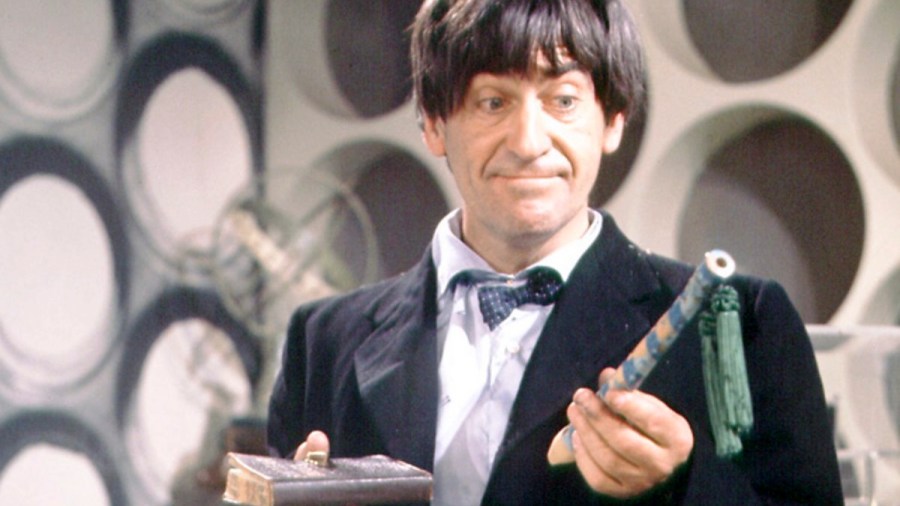
Patrick Troughton had one of the hardest jobs of any actor to play the Doctor; he had to follow the original. Had he failed, Season Four of Doctor Who would have gone down as a forgettable failed experiment. The science fiction series would have died in the 1960s after the lead actor, William Hartnell, was forced out due to his health issues. But Troughton, an amazing character actor, succeeded by all measures, proving that the show could regenerate and renew itself as needed.

Troughton created a Second Doctor who was most unlike his predecessor, delving into silliness and acting the fool where the First Doctor almost always remained dignified and serious. At the same time, Hartnell had imbued the character with a sense of humor and a streak of childlike curiosity that came to serve as the Doctor’s core across many iterations. Playing a younger and re-energized Doctor, Troughton ran with that sense of fun. To cement this, one of the first things he did was to pick up a recorder and start playing tunes. That instrument became the Second Doctor’s signature, even more so than his use of the sonic screwdriver and the tendency of offering people Jelly Babies (something that Troughton did first before Tom Baker’s Fourth Doctor adopted it as his own).

Troughton played many tunes on his recorder, but I’m going to focus on one specifically here: “The Skye Boat Song,” which he first played in “The Web of Fear.” That performance is recognizable enough that it got a reprise in 2022’s “The Power of the Doctor,” and it carries more significance than meets the eye.

Continue reading “Doctor Who and the Skye Boat Song”

The Dark Knight Trilogy: The Rogues Gallery

Let’s face it: nobody really gives a damn about Batman.

Sure, he’s a great superhero. He’s got a cool costume, a good origin, and is the epitome of the badass normal vigilante. But he’s not the reason people read his comics. The reason people read Batman comics is because he has the best villains. Bar none.

Outside of Spider-Man and Dick Tracy, nobody in the history of comics has the sheer quantity of recurring rogues that Batman has. Spider-Man’s rogues gallery is vast, but there are a lot of them that are just plain duds. Dick Tracy has an array of enemies spanning back decades, but most of them wind up dead after their first appearance. Batman’s rogues, on the other hand, have been developed and fleshed out over the course of 70 years. You love to hate them. And, on occasion, you feel genuine pity for them.

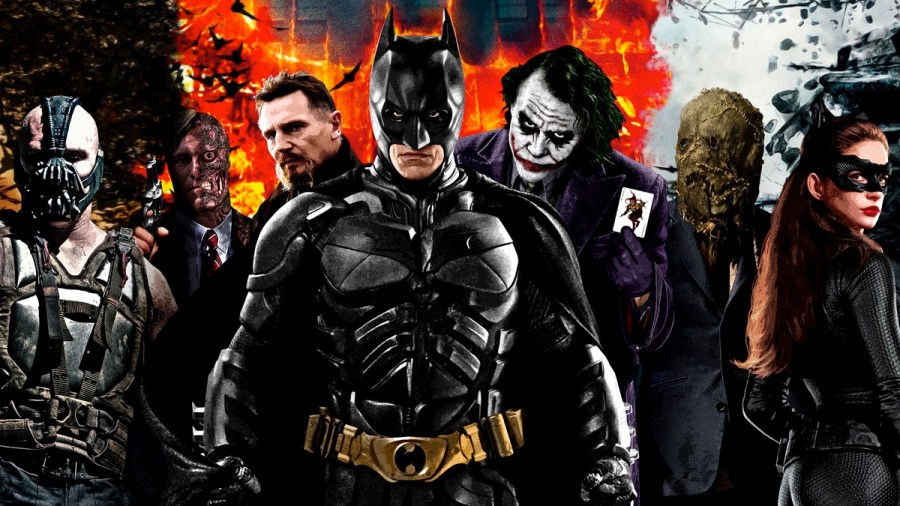
Here’s a quick breakdown of the villains that showed up in the Dark Knight Trilogy and how they connect to their comic counterparts.

Continue reading “The Dark Knight Trilogy: The Rogues Gallery”

The Dark Knight Trilogy: Elemental Forces

The Dark Knight Trilogy is a big, epic set of movies with big, epic themes. For all the talk about them being darker and more realistic than your average superhero film, they actually have the same scope as a lot of epic fantasy tales, with battles between pure good and fell evil and the fate of an entire city in the balance. With such big action and high stakes, the films have some large themes and symbols behind them. In Batman Begins, Bruce Wayne crafts Batman as a symbol that is, “Something elemental, something terrifying.” Today we’re looking at some of that elemental imagery and how it runs throughout the films.

Continue reading “The Dark Knight Trilogy: Elemental Forces”

The Dark Knight Triology: The Importance of a Symbol

In a genre that has become all about setting building, The Dark Knight Trilogy stands out as a rare example of an arc-driven franchise film. It doesn’t introduce us to an expanded cinematic universe (although I think it should have, but that’s a discussion for another time). Instead, it tells the story of Bruce Wayne, his transformation into Batman, and his eventual retirement after a job well done.

So let’s take some time to analyze the three Christopher Nolan/Christian Bale Batman movies: Batman Begins, The Dark Knight, and The Dark Knight Rises. We will begin with the theme of symbolism, which gets to the heart of what Batman sought to accomplish throughout the triology.

Continue reading “The Dark Knight Triology: The Importance of a Symbol”