
Criminals are a superstitious and cowardly lot, so my disguise must be able to strike terror into their hearts. I must be a creature of the night, black, terrible…
A seemingly perfect counterbalance to Superman, Batman first appeared in 1939 in Detective Comics #27. A creation of Bob Kane and Bill Finger, Batman was dark and brooding where Superman was colorful and bright, fallible where Superman was seemingly invincible. He perfectly defined the other side of costumed superheroes, becoming the archetype of the highly competent yet still mortal vigilante.
Along with Superman and Wonder Woman, Batman forms DC Comics’ “Big Three,” the most recognizable and longest-lasting comic book icons in history. That recognition doesn’t give him immunity to people mucking around with the core concept of who the character is, though.
Rise of the Dark Knight
While Superman was a mold-breaker for his time, Batman was surprisingly similar to a lot of other costumed heroes at the time. His dual life as a rich playboy by day and a costumed crime-fighter by night mirrored Johnston McCulley’s Zorro. His tactics and hard stance on crime resembled characters such as Doc Savage and the Shadow. Outside of the strange costume, Batman didn’t seem all that different from many other pulp heroes.
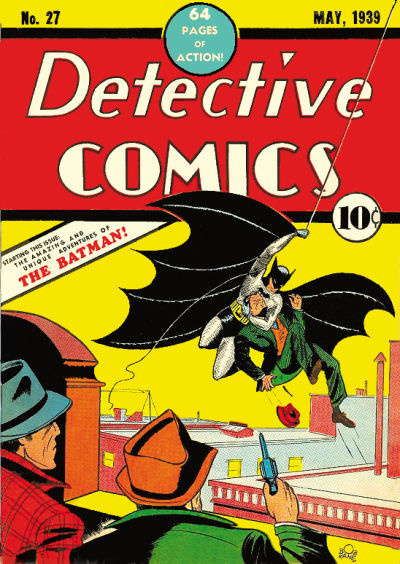
My theory about what made Batman such a big hit focuses on two factors. First, he had a costume, and a very distinctive one at that. Batman’s outfit has been redesigned many times over the years, even changing colors between blue, black, and gray, but the pointed-ear cowl, long cape, and bat symbols have remained constant because they are so iconic. Following Superman’s early success, the public was looking for more superheroes, and Batman gave them a different kind of masked avenger. Second, like the newspaper strip hero Dick Tracy, Batman quickly found himself with one of the best rogue’s gallery in all of fiction. It wasn’t enough to have him just face off against normal street thugs – he instead did battle with disfigured monsters, injecting a fantasy-like quality to the crime-fighting story. When he first began, Batman was a faceless crime-fighter battling against some of the most deranged criminals one could find. His first appearance in Detective Comics #27 didn’t even reveal that he was really Bruce Wayne until the last page of the story. Even before his personality was in place, Batman’s look and the beginnings of his rogue’s gallery put him on the map.
Origins Revealed
Batman’s origin story as a major change in his status quo. While most superheroes get their origin explained in their first appearance, Batman’s motivations were an enigma at the beginning–in Detective Comics #27, he had already been actively fighting crime for some time, and nobody really knew why. Without an origin, it took a while to nail down his character. The Batman of 1939 differed from the modern version in many ways, most notably his tendency to kill. He didn’t go out of his way to kill criminals, but he didn’t mind if they fell into a vat of acid, and he had no compunctions against tossing them off the roof of a skyscraper. In some early stories, he used guns, which has since become one of Batman’s biggest taboos.
Batman got his origin story in Detective Comics #33, and it changed the way writers approached the character for years to come. A young boy who watched his parents get gunned down in front of him by a nameless mugger, Bruce Wayne dedicated his life to fighting crime.
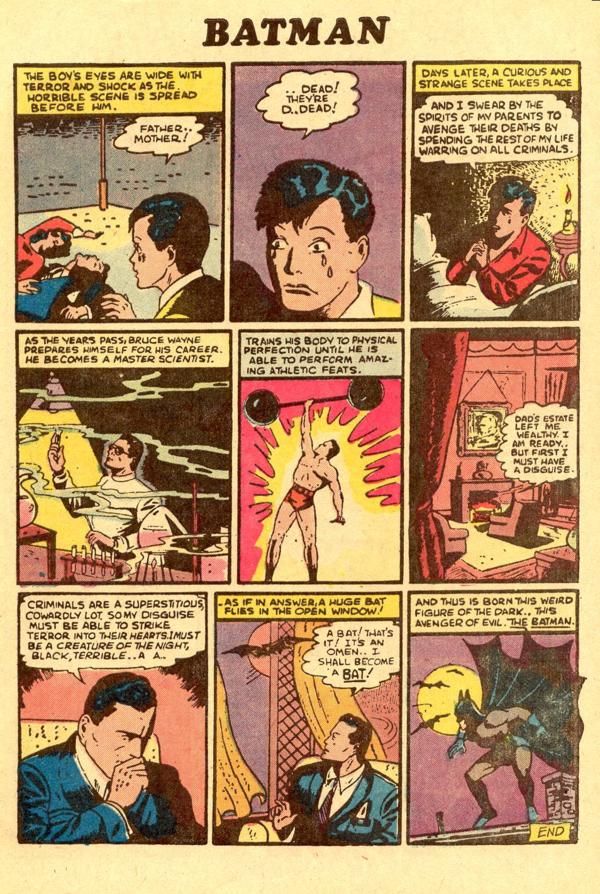
Although it didn’t happen immediately, that origin helped solidify Batman as a man who fought not out of some hatred of crime but because he longed for a world where a boy would never lose his parents to some thug with a gun. Had this origin story not been told, I think the modern Batman would look a lot more like the Punisher: a hardened man who did whatever it took to take out criminals.
The Boy Wonder
Batman’s early years continued transforming him from a heartless force of vengeance to a humanized superhero who fought crime to protect the innocent. And while it wasn’t a change to the character himself, Detective Comics #38 continued this process of humanization by giving him a kid sidekick called Robin. Like Batman, acrobat Dick Grayson lost his family to criminals. He was taken in by Bruce Wayne and eventually given a costume of his own. Robin began as a push by DC Comics to make Batman more kid friendly, but the character developed into far more than a marketing gimmick. Stories throughout the Gold and Silver Ages emphasized Batman’s need for companionship despite his apparent status as a loner. A prime example would be the tale “Robin Dies at Dawn” from Batman #156, where the mere hallucination of Robin’s death paralyzes Batman with fear and almost ends his career as a crime-fighter.
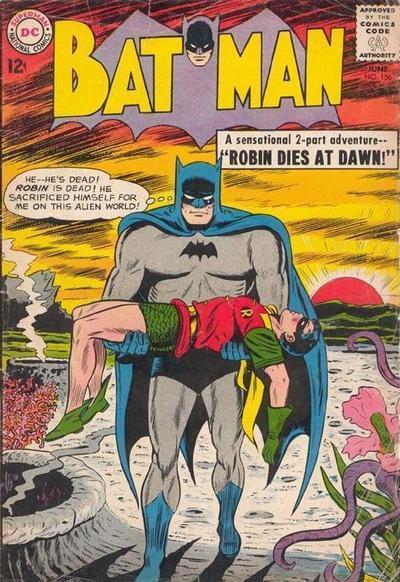
As the years went on, Dick Grayson eventually grew into adulthood and took on a new identity as Nightwing, but Robin remained important to Batman, as he quickly took on a new ward named Jason Todd. Following Jason Todd’s death at the hands of the Joker, a boy named Tim Drake noticed that Batman was becoming more suicidal in his actions and took on the mantle of Robin after concluding that Batman needed a Robin in order to stay sane. Others have worn the Robin costume since, with the important theme that Batman needs a family to keep him sane.
Enter Adam West
Comic books in general took a hit during the 1950s and 1960s due to the Comics Code Authority. Basically, a bunch of politicians got it into their heads that comic books were corrupting our youth. Because politicians are just sooooo good at judging right from wrong, they decided that comic books needed to be cleansed of violence and bad messages. Few superheroes were hit harder than the gritty detective Batman, who suddenly became light-hearted and campy. The Joker, one of his most brutal and deadly villains, became a madcap clown. For a very long time, Batman was no longer the Dark Knight but rather a boisterous, cheerful crimefighter whose adventures ranged from the ludicrous to the bizarre.
Ironically, in seemingly ruining Batman, the Comics Code Authority actually wound up creating one of his most popular incarnations. In the 1960s television adaptation starring the great and powerful Adam West, Batman embraced that campiness and played it for laughs. The television show still ruffled some feathers, largely because Adam West and Burt Ward realized the homoerotic overtones between Batman and Robin and played that up through their ad-libbing. Moreover, they took much of the anger thrown their way by concerned parents and turned it on its side, making it a part of the humor. For example, when somebody raised a concern that the Batmobile had no seatbelts, the next episode featured Batman admonishing Robin that he should always buckle up before racing off in costume to deliver vigilante justice against thieves and murderers.
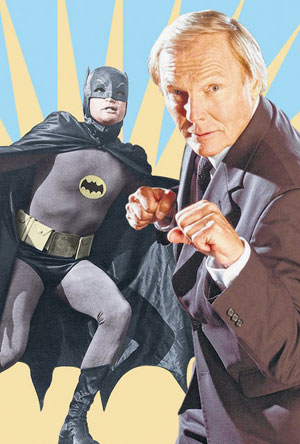
Because of his excellent delivery and charisma in the role, the Adam West version of Batman greatly influenced the comics, taking those weird adventures and turning them into something that can be played for laughs. For fans of the grimmer and darker Batman, West’s performance was somewhat damaging, keeping Batman’s perception as a campy superhero long past the point where the Comics Code became more lenient. Even when Tim Burton did a new, darker film adaptation of the Caped Crusader in 1989, many people still believed that the only true Batman was Adam West. Love it or hate it, the campy period of Batman changed the character for decades. With few exceptions, no actor so greatly influenced a comic book icon as Adam West.
The Triple Whammy
The Bronze Age of comics is usually defined as the period around the 1970s and 1980s when the Comics Code Authority became less restrictive and comics started to become more mature again. During the Bronze Age, Batman began to return to being the Dark Knight again, but he still kept some remnants from his campy period, too. The Joker in the Golden Age, for example, had been a homicidal maniac with a clown face as his only real gimmick. In the Silver Age, he became a harmless jokester and buffoon. The Bronze Age combined those two versions, turning Batman’s number one villain into an insane comedian whose jokes ended in murder. Batman became a more serious figure again, but still referred to Robin as, “Chum.” All of that changed with the triple whammy of iconic Batman comics in the 1980s.
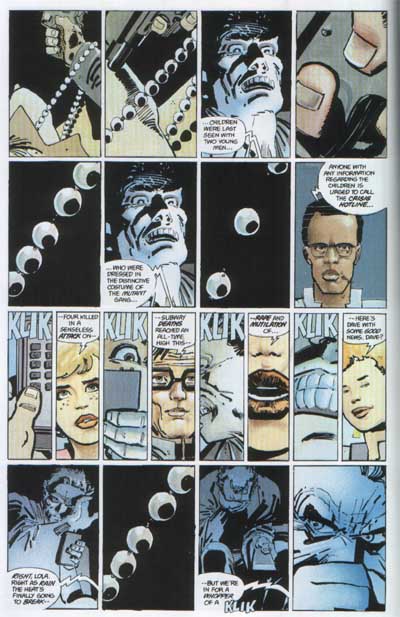
1986 brought us Frank Miller’s The Dark Knight Returns. Although an out-of-continuity story that took place in a future where Batman had grown old, it added a lot of iconic moments to the Batman mythos, including Martha Wayne’s broken pearl necklace that hit the pavement of Crime Alley as she was gunned down in front of young Bruce Wayne’s eyes. There was no hint of campiness in Miller’s tale, and its success took root in mainstream continuity. Notably, Batman stopped cracking jokes or showing himself as anything but serious. The climactic battle between Batman and Superman in The Dark Knight Returns also established Batman as the master of preparation, capable of doing almost anything with enough prep-time. It’s at this point that I think Batman stopped being a guy with no powers. When you can stand toe-to-toe with Superman and literally fight gods, you are no longer a normal human, regardless of how often the comics state that you have no super powers.
Two years after The Dark Knight Returns, Alan Moore wrote the one-shot The Killing Joke, which explored the Joker’s tortured mind and his possible past. Although it didn’t have a major impact on Batman’s powers or look, it continued moving him toward the humorless vigilante of today. The Joker also stopped being someone that readers could see as remotely harmless as he shot Barbara Gordon (aka Batgirl) in the spine, ending her costumed crimefighting career for decades, then attempted to drive Commissioner Gordon insane by stripping him naked and tormenting him with pictures of his wounded daughter.
Finally, in 1989, we got the third part of Batman’s grim-darkening. In A Death in the Family, the Joker continued showing how dangerous and evil he had become when he killed Robin. And we’re not talking about a quick bullet to the brain or something that could be glossed over between panels. The Joker beat Robin to the brink of death with a crowbar. Then, just to make sure the job was done, he blew up the building in which the helpless Robin lay. Robin’s actual fate was left up to readers. In a move that really demonstrated how comics fans both despised Jason Todd as a replacement for Dick Grayson and had grown jaded with comics where the heroes always escaped by the skin of their teeth, readers dialed in on a phone survey to vote Robin dead.
Following the change in tone started with The Dark Knight Returns, the crippling of Barbara Gordon in The Killing Joke, and the death of Robin in A Death in the Family, all in a period of only three years, any trace of humor was lost for a very long time in Batman. And writers were at their limit as well. I mean, what else can you do to a guy who has lost that much? Well, you could have him fight all his villains at once and then have some guy on super-steroids break his back, but that would just be crazy.
Wait a minute…
Knightfall
As I mentioned in the discussion about Superman, the death of Superman told both DC and Marvel that one of the easiest ways to make money was to either kill or replace an iconic character. Superman died, Spider-Man got cloned, the Green Lantern went insane, and Batman…well, Batman got broken.
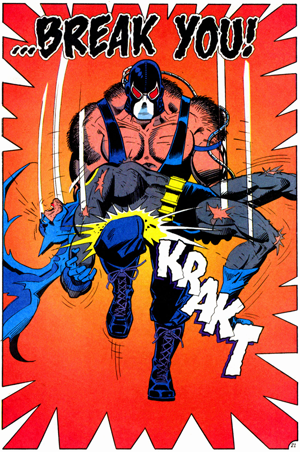
The three story arcs Knightfall, Knightquest, and Knightsend followed an almost archetypal structure for a saga. Knightfall saw Batman against a conflict greater than he had ever encountered, Knightquest dealt with his fall from grace and subsequent climb back, and Knightsend brought the story full circle, returning the hero to the status quo. Depending on who you ask, it was either a brilliant marketing ploy or a clever commentary on the more brutal heroes of the 1990s. In truth, it’s a little bit of both.
Knightfall introduced the villain Bane, a man who was at once Batman’s equal and his opposite. Where Bruce Wayne had his parents’ fortune to help provide training and hone his skills, Bane began with nothing, born and raised in the brutal prison of Santa Prisca. While Batman saw the world as something inherently good that needed saving, Bane saw it as just another prison to be controlled. Despite these differences, Bane was Batman’s physical and mental equal, self-trained and self-taught. He came to Gotham in hopes of conquering it as his own, and saw Batman as the big guy in the prison who had to be made an example of. Aided by a super-steroid called Venom that gave him near-superhuman strength, Bane had a plan that was both simple and cunning: blow up Arkham Asylum and let all of Batman’s old villains run loose in Gotham.
For most of Knightfall, Bane merely watched Batman from afar as the gauntlet of criminals wore him down physically and emotionally. In observing his body language and mannerisms, he deduced that Batman was Bruce Wayne. Finally, with Batman too exhausted to fight back, Bane confronted his quarry in the Batcave itself, manhandling Batman in a fight and breaking his spine.
Following Bruce Wayne’s defeat, someone else had to take over the mantle of Batman. Bruce chose not to have Dick Grayson take over, citing that he had become his own man in taking on the identity of Nightwing. Instead, he handed the mantle over to the mentally unstable Jean-Paul Valley, a man who had been raised and brainwashed by an insane cult before being rescued by Batman. The brainwashing wasn’t all out of his system, and while Bruce recuperated, Jean-Paul designed a new, more brutal Batman costume, with deadly weapons and powerful armor built in. Jean-Paul wound up defeating Bane, but in his attempt to reclaim Gotham City, he started killing criminals. This was at least partially an address to fans of the more brutal direction that superheroes in the 1990s had taken, showing for the first time in several decades a Batman who was willing to take lives. The direction quickly became unpopular with fans, who didn’t want to psychotic Jean-Paul Valley as their beloved Dark Knight. Ultimately, during Knightsend, a recuperated Bruce Wayne returned and defeated Jean-Paul, reclaiming the mantle of Batman.
Knightfall gave Batman the same type of treatment Superman had received in The Death of Superman, breaking the hero down, putting him on hiatus, and forcing him to claw his way back to relevance. In some ways, it was almost like a rite of passage for the iconic superheroes who many modern fans had begun to see as outdated – both Superman and Batman got XTREME! and NTENSE! replacements that killed and did the dark sort of things that 1990s superheroes were supposed to do. Had any one of those replacements been popular with fans, the change could have easily become permanent. Instead, the older heroes rose back up to reclaim the mantle, showing that they were still timeless, even in a drastically changing world.
The Death of Batman
Apparently, a rule of comics is that everyone has to die at least once. Batman ran up against his end in the 2008 storyline Final Crisis, written by Grant Morrison. You’d think that Batman would meet his end in his own comic, particularly since Morrison had also just written a story called Batman: RIP in which Batman surprisingly does not die, but I guess that made too much sense. No, Morrison decided that he wanted Batman to go out the same way he had been created: with a gun.
The events of Final Crisis involve the villain Darkseid from Jack Kirby’s New Gods taking over the Earth with the Anti-Life Equation, a mathematical formula that erases a person’s free will (who says mathematicians aren’t evil?). Batman, realizing what is at stake, goes against his long-held aversion to guns and takes a literal magic bullet that Darkseid used to kill his rival Orion at the beginning of this mess of a storyline. Batman then shoots Darkseid with said gun, while simultaneously getting blasted by Darkseid’s Omega Beams, powerful eye lasers that kill instantly and cannot be dodged.
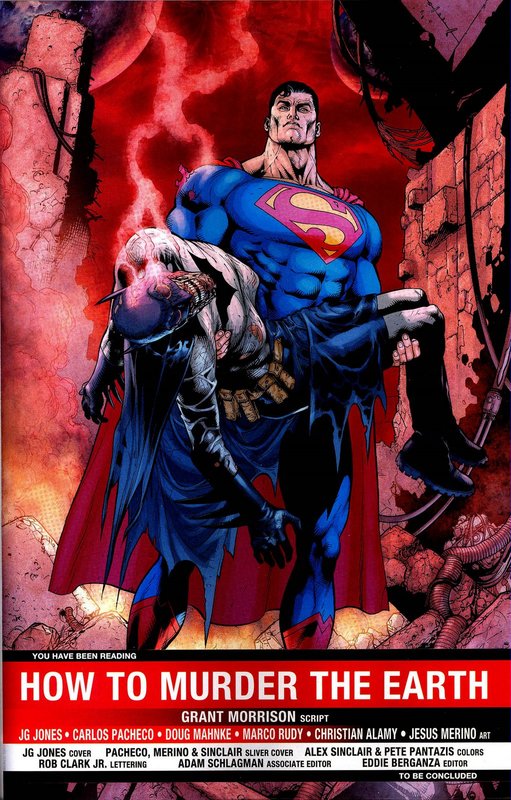
Personally, I really hate Batman using a gun in this story. While the symbolism is powerful, it seems very forced. Final Crisis deals with such big and abstract notions that virtually any plot device could have ended Darkseid’s threat. The story doesn’t really give a compelling reason why the final weapon needs to be a gun, save for the fact that Morrison really wanted the closure of Batman’s career beginning and ending with a gun. I think a much better use of Batman wielding a gun happened in the TV series Batman Beyond, where Bruce Wayne suffered a heart attack while fighting some thugs and had to scare one of them off with a gun because he couldn’t fight back. That traumatized him enough to force him to retire in an incredibly powerful scene.
Long story short: Batman with a gun is a powerful image because it means he’s broken one of his own rules. However, forcing that situation inorganically ruins the theme because it becomes less about the development of the character and more about an image the author really, really wants to push.
However much I disagree with the handling of Batman’s death, and regardless of how obvious it was that it would be a long weekend rather than an actual demise, some good did come out of the story. Namely, Dick Grayson stepped into the Batman costume for a little while, with Bruce’s son and then-newest Robin Damian acting as his sidekick. This gave a nice inversion of the Batman and Robin interaction where Batman was more likely to crack a joke and Robin was the serious one. It was also something of an apology to folks who wondered why Dick didn’t replace Bruce as Batman back during Knightfall, since he would have been a more logical choice than the insane Jean-Paul Valley.
Finally, the eventual return of Bruce Wayne did set up a new evolution for the character that proved quite interesting for a little while…
Batman, Inc.
There aren’t a lot of times when a publisher calls something a “bold new direction” and the boast is actually true. The “Batman, Inc.” storyline is one of those times. With Bruce Wayne’s return came an unmasking of sorts as he revealed to the public that he had funded Batman for years (neglecting to mention, of course, that he was Batman). This led to the formation of Batman, Incorporated, where Wayne’s money funded multiple bat-themed vigilantes across the globe.
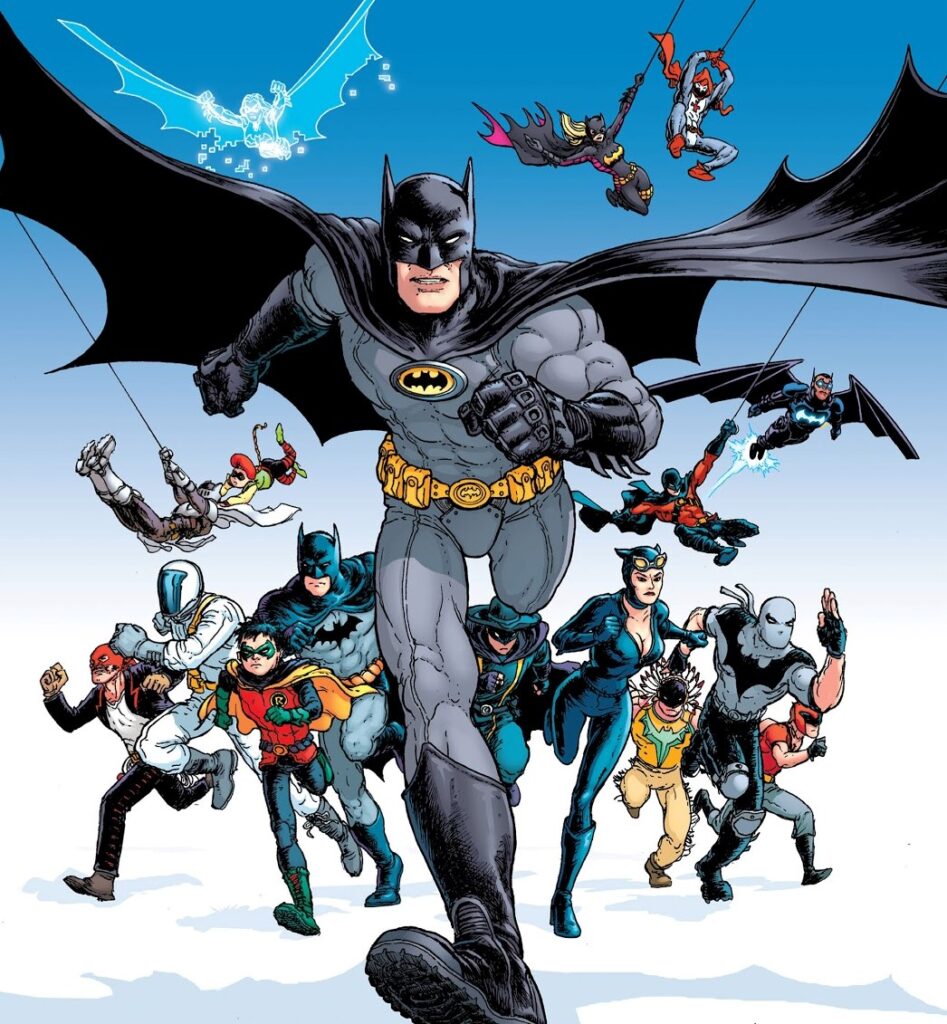
“Batman, Inc.” brought the character from the shadows into the public light, forcing both Batman to fight crime not as an urban legend but as someone with the cameras on him. It also pulled several characters out of obscurity, including righting some wrongs that had been done to supporting cast members like Cassandra Cain, who had gone from being Barbara Gordon’s successor as Batgirl to a crazed villain. A little retcon magic brought Cass back into the fold of the good guys and enabled her to fight crime with the Bat-family again.
Naturally, such a radical change wouldn’t last forever. Batman is not a celebrity superhero like Iron Man. Eventually, some scheming from Tali al-Ghul (who, unlike Cassandra Cain, was not saved from her turn toward villainy) brought the Batman, Inc. experiment to a close.
So, after that bold new direction, what happens next? DC rebooted its comic book universe through the “New 52” initiative in 2011, but Batman remained largely unchanged (and, in fact, “Batman, Inc.” ran as part of the New 52). So, with DC wanting to shake up the status quo again, they went back to a well they had drank from not too long ago. They killed Batman again.
Dead Again
Since The Dark Knight Returns showcased a Joker who went catatonic when Batman retired and re-emerges when Bruce Wayne puts the cowl on again, comics have been all-in on the bond between Batman and the Joker. This culminated in a “final” battle between the two where both of them seemingly died in a cave-in. In the interim, Jim Gordon became the newest person to don the cowl, although he leaned heavily on technology to make up for the fact that he didn’t have Batman’s fighting skills.
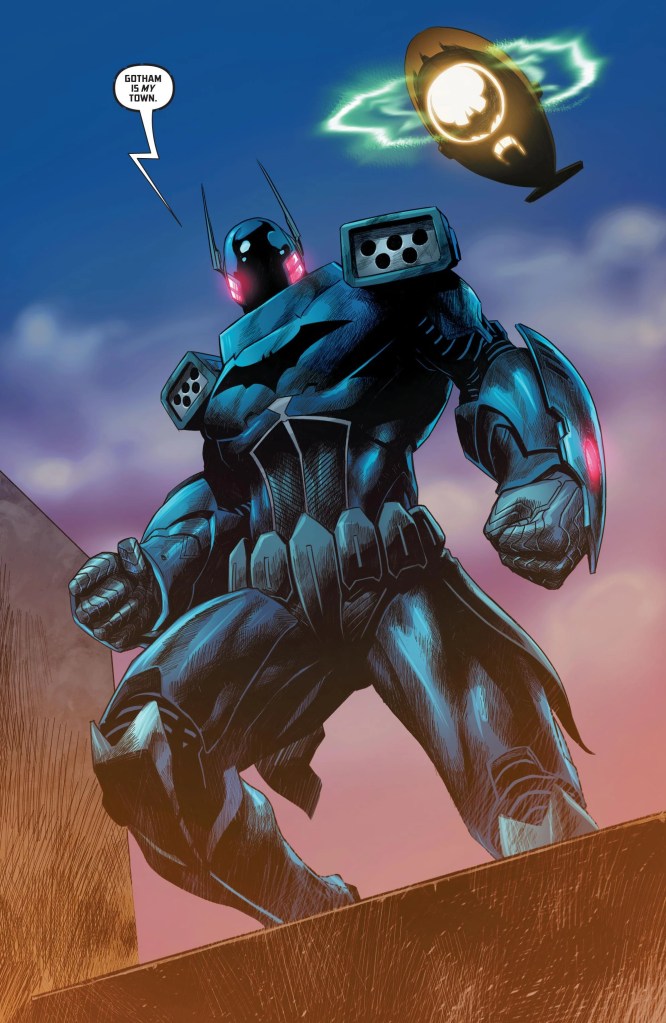
Possibly inspired to come back to life because of Gordon’s terrible design choices, Bruce Wayne resurfaced, albeit with amnesia. The Joker, likewise, had amnesia. The two became friends for a time, with the Joker showing actual fear that he would eventually regain his memories. Sadly, such a reversion was inevitable, and Bruce Wayne returned as Batman…and the Joker came back with him.
Batman Today
Batman saw many fluctuations in the 2010s and 2020s, but has generally remained stable as the Dark Knight who acts like a loner yet has a surprisingly large family. The makeup of that family has changed now and then, such as when he almost married Catwoman.
2020’s “City of Bane” storyline included the death of Bruce Wayne’s longtime butler Alfred, which is not as surprising as the fact that Alfred remains dead as of this writing. Such an iconic character seems hard to say goodbye to, but Alfred’s memory has played a big role in Batman stories since, so it may be a little while longer before someone pulls him out of his grave.
As of 2024, DC is creating an alternate continuity called the Absolute line. In those stories, Batman is quite a bit heftier and wields a battleaxe whose head serves as the chestpiece of his costume.
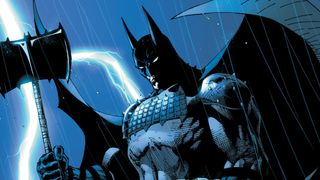
I have no doubt that particular feature will remain in the alternate continuity where it belongs, but it will be interesting to see if the Absolute version of Batman sells well enough to inform the main continuity. After all, it wouldn’t be the first time that we’ve seen a violent, borderline murderous Batman.
Wherever the character goes, Batman remains one of the most complex and popular characters in the DC stable. His general look undergoes relatively few revisions, but his personality and methods have ranged from overly zany to extremely dark and depressing. We will likely continue to see both in the future.
Images: DC Comics
 Babbling Brooks