
In case the first three parts of this breakdown didn’t make it clear enough, the Hulk has changed a lot…arguably more than any other comic book hero. He’s been a tough one to fit into the Marvel Universe. Conceived as a cross between the Frankenstein monster, Dr. Jekyll and Mr. Hyde, and a cautionary tale about nuclear warfare, he has never quite fit in with other superheroes, save for his run with the team known as the Defenders – a group whose whole hook is that its members don’t really fit together on a traditional superhero team. Whenever the Hulk did get some stability, some external factor shook that up, be it Bill Mantlo getting exhausted with the character and passing it over to John Byrne or editorial getting in the way of a long-term story planned by Peter David. As the character headed into the 2000s, he was in for more of the same, with a lot of changes in a short period of time. Fortunately, at the end of it, the Hulk got a brief renaissance that produced a modern classic for the character.
The Return of John Byrne
Following Peter David’s departure, Marvel’s editorial wound up looking like asses as the big movie they were expecting to tie the comics to never materialized. The comics, too, started going south. Since this was the late 1990s and the speculator craze wasn’t quite over, Marvel decided that the Hulk needed a new #1 issue to draw in people who thought that any “first issue” would be worth money someday. (Sadly, this notion is still in people’s heads even today. Folks, comics are not an investment hobby. I’ll possibly go into the various reasons why in another rant.) And who better to reboot the Hulk than the guy who rebooted Superman back in the 1980s, John Byrne?

Well, I guess that nobody in the Marvel boardroom felt like pointing out that: A) John Byrne had lasted all of six months on the Hulk last time, B) His story sucked, and C) He had a well-known rivalry with Peter David, and thus hiring him was more likely to mean the book would get mired in a stupid pissing match between him and the previous writer instead of a halfway decent story. Preceding Byrne’s relaunch was a pretty mediocre run by Joe Casey, in which he established that the Abomination had killed Betty and that the Hulk was actually growing weaker due to the mental breakdown resulting from Betty’s death. Then Byrne took over and immediately brought back the savage Hulk personality (take a shot!) with absolutely no explanation as to why (take a shot!). He also wrote Hulk: Chapter One, in which he revisited the Hulk’s origins and established that shape-shifting aliens were to blame for Banner becoming the Hulk And, as expected, he took a few cheap shots at Peter David. To be fair, Peter David took some shots back at Byrne in his Captain Marvel series, including a panel where Rick Jones read Hulk: Chapter One and laughed it off as really bad fiction. Most fans were more forgiving of David’s zinger, since Hulk: Chapter One was really bad fiction, and all Hulk fans were quite happy to have it kicked out of continuity in a single well-placed panel.
Just as Byrne had clashed with editor Jim Shooter and left after six issues in the 1980s, he clashed with editor Tom Brevoort and wound up leaving quickly this time around, too. To be fair, he managed a whole seven issues this time, plus the aforementioned annual. The run was pretty unremarkable, involving the Hulk’s old enemy Tyrannus creating an earless version of the Hulk and having him kill people. (Seriously, the green and gray Hulks I get. The merged Hulk, okay. But an earless Hulk? Why even bother?!) Byrne left mid-story again, and a bunch of other writers finished the story off with mediocre tales whose only real entertainment value is seeing characters say, “My God…the earless Hulk” with a serious expression on their faces. Astute individuals might notice that the relaunch had only the word Hulk in its title, not The Incredible Hulk. There was a good reason why this run didn’t bear the word “incredible” in its title: it would have been false advertising.
Following Byrne’s departure, Marvel went to their well of popular writers and found a Brit named Paul Jenkins who had just gotten critical acclaim for his miniseries The Inhumans. Jenkins became the next Hulk writer and began a run that was one-half awesome and one-half nonsensical mess.
The Thousand Hulks
Paul Jenkins came aboard and decided that he wanted to go back to a more psychological take on the Hulk. In his first issue, he had Banner take a journey into his own subconscious, encountering not only the child-like Hulk but also the gray Hulk and the merged Hulk. Banner was dying of ALS, aka Lou Gehrig’s disease, and the pent up angst created a new, monstrous version of the Hulk. The Hulks teamed up to take that creature down, but while in his mind Banner also found that there were literally thousands of other Hulk incarnations, including a Devil-like version of the Hulk.
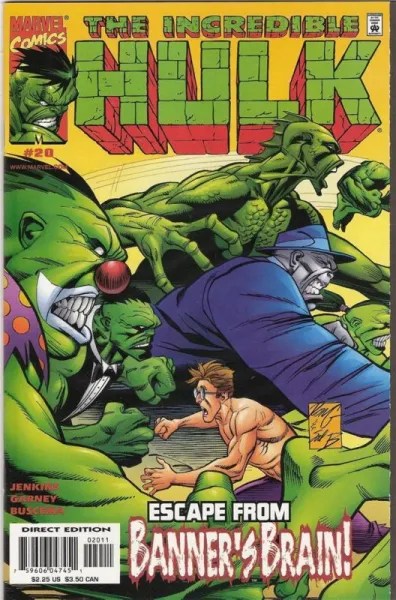
As a result of this storyline, Banner made a deal with the Hulks in which he would turn into the savage Hulk, the gray Hulk, or the merged Hulk depending on his mood and motivation (take a shot, take a shot, take a shot).
But wait…how could the merged Hulk be there when he was a combination of Banner and the other Hulk personalities? Well, it turned out that Jenkins didn’t like the idea of a merged Hulk, so that version became “The Professor.” It was revealed that the Professor wasn’t actually a merged version of Banner’s psyche, but was instead Banner’s idealized self. Or maybe he was the amalgam of experiences that made up Banner’s adulthood. Or maybe he was Banner’s forgiving side. All three were offered up as explanation at various times during the run.
Jenkins also introduced a new bad guy named John Ryker who was like General Ross turned up to eleven. Obsessed with learning the secrets of the Hulk’s transformations, Ryker captured the Hulk and tortured him, watching as Banner transformed into dozens of different Hulks (take a shot, take a shot, take a shot…oh, just down an entire bottle).
Jenkins did have some strong stories, such as a decent confrontation between the Hulk and the Abomination in which the Hulk beat the tar out of his foe for killing Betty. But the weird ass psychobabble and the reduction of each Hulk incarnation to one element of Bruce Banner (savage was Banner as a child, gray was Banner as a teenager, and so on) hurt the book. Jenkins also wound up getting a bit half-assed in the end, too, due to the fact that he suddenly had writing gigs everywhere. His final story, “Spiral Staircase,” was co-written by Sean McKeever and wound up bringing the Leader back to life only to kill him again, then cured Banner of his ALS with pineapple juice and the DNA of his dead father. And no, I’m not going to explain that one any further.
Near the end of the run, most of the other Hulks in Banner’s psyche were destroyed, leaving only the child, the gray Hulk, the Professor, and the Devil. The Devil remained restrained by the other incarnations, keeping him from controlling Banner.
So what happened to that evil Hulk, anyway? You’ll have to wait for a future installment to find out.
Return of the Monster
As Jenkins left the book, Ang Lee’s Hulk movie was gearing up for a big release. Once again, Marvel wanted to cash in on the movie. Once again, they totally missed the boat.
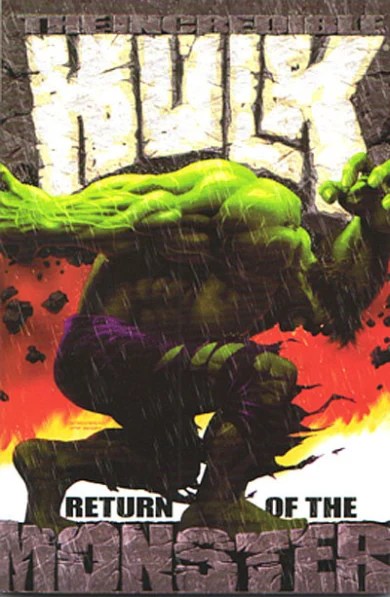
Editor Axel Alonso came aboard and hired Bruce Jones to do the writing. Alonso was fond of chatting about how his father always told him that the problem with Jaws was that they showed the shark, and he decided to bring that philosophy into the comic book – ignoring the fact that you can’t exactly make readers forget that this big green monster has been in the title since 1962. Bruce Jones knew next to nothing about the Hulk and even stated that he was the worst possible guy to write the book, which is reportedly why Alonso wanted him on board. Seriously…by Marvel’s own admission, they put the worst possible writer for the Hulk on the Hulk specifically because he was the worst possible writer for the Hulk.
Bruce Jones was tasked with giving the Hulk a darker, more realistic take on the Hulk…or at least that’s what Marvel claimed. I don’t think he himself got that memo, because here’s a summary of the “realistic” take on the Hulk:
A secret government agency has doctored up footage to make it seem that the Hulk killed a small child in one of his rampages so the whole country turns against him. Then they send a bunch of secret agents out to take down the Hulk with a special gun designed specifically for the Hulk, which turns out to be a dart gun with a massive tranquilizer in it. The secret agents turn out to be vampires, and one of them is out to rescue her son, who is the boy the Hulk supposedly killed. Banner gets help from Doc Samson, but he wound up getting knocked out and having his eye replaced by a camera by the evil agency when his girlfriend, who is the vampire mother of the little boy, caught up to him and knocked him out. But Samson realizes that his eye has been replaced by a camera and removes it. Banner, Samson, and the vampire lady team up against a super agent who got all dosed up on Hulk blood and they find the little boy, but he’s a robot. Then it turns out that the entire setup is a plot to get the Hulk’s blood so they can create Hulk clones. Oh yeah, and the Hulk is sometimes mute (take a shot), sometimes has Banner’s brain (take a shot), sometimes speaks like an amalgam of himself and Banner (take a shot), and sometimes has super animal senses (take a shot), all with no explanation (take four bonus shots). And sometimes he has super strength while in Banner form (take a shot). But it doesn’t really matter because the Hulk barely ever shows up in his own book. While Banner remains on the run, he sleeps with a girl named Nadia, who is actually the Abomination’s wife who Banner has seen before but totally doesn’t recognize. The evil organization frees the Abomination and he fights the Hulk and gets killed. Then Betty’s alive again, and she has psychic powers and is lusting after Doc Samson. The Hulk fights a clone and it turns out that the entire thing is the plot of the Leader, who is now just a brain in a jar and mentally controlling the Hulk even though he has specifically been unable to do so in the past. The Leader’s jar gets smashed, but Nadia dies because of something Samson does and the Hulk beats up Samson, then runs away because Betty hates him now. And thus this grim, dark, gritty tale of clones, robots, vampires, and psychic brains in jars comes to an end.
REALISM!!!
It was All Just a Dream…or was It?
The funny thing about the Bruce Jones run on the comic is that it was meant to cash in on the movie, but the actual 2003 film drew most of its inspiration from the work Bill Mantlo, Peter David, and Paul Jenkins had done on the character. (Remember the infamous Hulk dogs? Those actually came out of Jenkins’ “Dogs of War” story.) Jones’ run did have some success in terms of sales, but considering that the comic increased in sales up until the movie came out and then dropped off, it’s reasonable to assume that anyone could have had some success at that time.
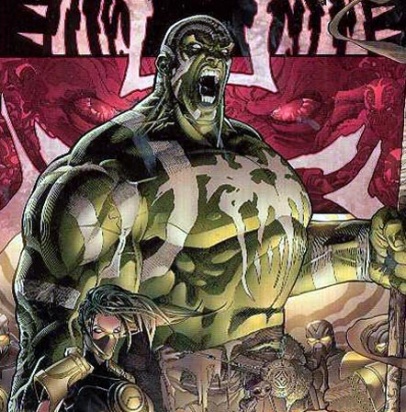
Most galling with Jones’ story wasn’t the actual comic, but rather the marketing surrounding it. For some reason, Marvel’s marketing revolved around insulting the past stories writers had done on the character, especially Peter David’s 12-year long run. This was quite odd in that it pissed off a lot of existing fans. It was even stranger when you consider that the guy who picked up the book following Bruce Jones was – you guessed it – Peter David. Returning to the book, David reverted the Hulk back to the version he used at the end of his run (take a shot). In his first story, “Tempest Fugit,” he established that the villain Nightmare had been screwing with the Hulk’s brain, and later writers took the cue to remove Bruce Jones’ stuff from continuity, relegating it to all being just a dream.
Peter David’s second run was somewhat unremarkable. It had some good stories, but got sucked into the big Marvel crossover at the time, “House of M,” during which the Hulk joined an aborigine tribe in Australia and got the tribal tattoos you see above. Shortly after “House of M” ended, David got more work on other books and, combined with the fact that he wasn’t happy with his return not making much of an impact from sales, left the book again…at least on good terms with editorial this time around. The good news is that the next writer didn’t follow the trend that each new writer over the past seven years had followed in trying to re-reinvent the Hulk. The even better news is that, after a short stint by writer Daniel Way, we got one of the best Hulk stories ever told.
Planet Hulk
So I’ve just spent a long time ripping apart almost a decade’s worth of Hulk comics as being a waste of paper. Why do I bother reading the comics, then? Well, like another franchise I’m obsessed with, Highlander, the Hulk has bright spots that make up for the crap. There’s a lot of stuff that isn’t my speed, but when things are good, they’re really good.

Case in point: “Planet Hulk.” It’s one of the best comic book stories out there, and it could only have been told with the Hulk. A group of Marvel’s top minds decided that the Hulk was too dangerous to remain on Earth, so they tricked him into a space shuttle and blasted him off to a remote planet devoid of intelligent life. The real kicker was that in order to get the Hulk into space, they had to ask him to save the entire planet from a crazy super-satellite that had gained sentience. The Hulk, wanting to be a hero, saved the world before being exiled. Naturally, he got pissed, and his ensuing rampage sent the ship off-course through a wormhole.
The Hulk wound up on a planet called Sakaar. Weakened by the passage through the wormhole, he was made a slave and forced to fight in a gladiatorial arena. He battled his way from slave to savior to king on Sakaar. “Planet Hulk” is a fourteen-issue epic taking the Hulk on a journey from monster to hero. During the trip, he gains friends and even a wife. Ultimately, though, the ship he was sent on blew up, killing most of the planet including his pregnant alien bride. This sent the Hulk and his remaining allies on a roaring rampage of revenge that brought them back to Earth in “World War Hulk,” which could just as easily have been entitled, “The Hulk smashes the Marvel Universe.” Only the revelation that one of the Hulk’s own allies was responsible for the destruction of Sakaar stopped the Hulk from destroying New York City after revealing the corrupt activities of its heroes. The revelation, though, caused the Hulk to become angrier than ever before. He became what the people of Sakaar referred to as the Worldbreaker, reaching heights of strength so great that his mere footsteps caused earthquakes. Ultimately, the Hulk allowed himself to get taken out before he split North America in two with mere footsteps. Banner was rendered comatose for a time and placed in military custody, but the legacy of Sakaar was not gone. On that ruined planet, the Hulk’s son had survived, and he would soon head to Earth himself.
The Hulk Family
Following “World War Hulk,” the title got another reboot, this time written by Jeph Loeb. You might know him as the writer of the Batman stories “The Long Halloween,” “The Long Halloween,” and “The Long Halloween.” Actually, that should be “The Long Halloween,” “Dark Victory,” and “Hush,” but they’re all pretty much the same story: nonsensical mysteries where the identity of the villain is obvious from the get-go but where there is some lame and predictable red herring to throw readers off the trail, with the entire story being saved only by an excellent artist. Loeb brought his expertise to the new Hulk title, which appropriately lost the Incredible part of the title just like Byrne’s reboot did. This title focused not on the actual Hulk, but on some other creature known as the Red Hulk. And I’ll just spoil it for you right now. The Red Hulk is General Ross. It’s incredibly fucking obvious from issue #1, but for some reason the lameass mystery lasted for three years and included the obligatory issue where Loeb insults the readers’ intelligence by “killing” off General Ross only to reveal later that he totally wasn’t really dead. Meanwhile, the Hulk got to be a bit player in his own book. Some other highlights of Loeb’s run included:
- The Hulk inexplicably becoming the child-like incarnation again (take two shots – one for the change, another for the lack of an explanation).
- The gray Hulk popping out of nowhere at one point (again, two shots).
- The gray Hulk disappearing for no given reason and being replaced by the child-like Hulk again (two more shots!).
- The Hulk being bitten by the monster known as Wendigo and becoming “Wendi-Hulk” (no, I am not making this shit up), despite the fact that the Wendigo is not a goddamned werewolf (Two. More. Shots.).
- The Hulk suddenly gaining Bruce Banner’s brain, getting killed by the Red Hulk, getting brought back to life by a cosmic being, then turning back into the child-like Hulk again. (Let’s see…one, two, three, four shots.)
- The Red Hulk pulling a new power out of his ass and absorbing the Hulk’s gamma energy, turning him back into Bruce Banner (take another shot).
- Bruce Banner again gaining control of the Hulk for no given reason (two more shots, then die of liver failure).
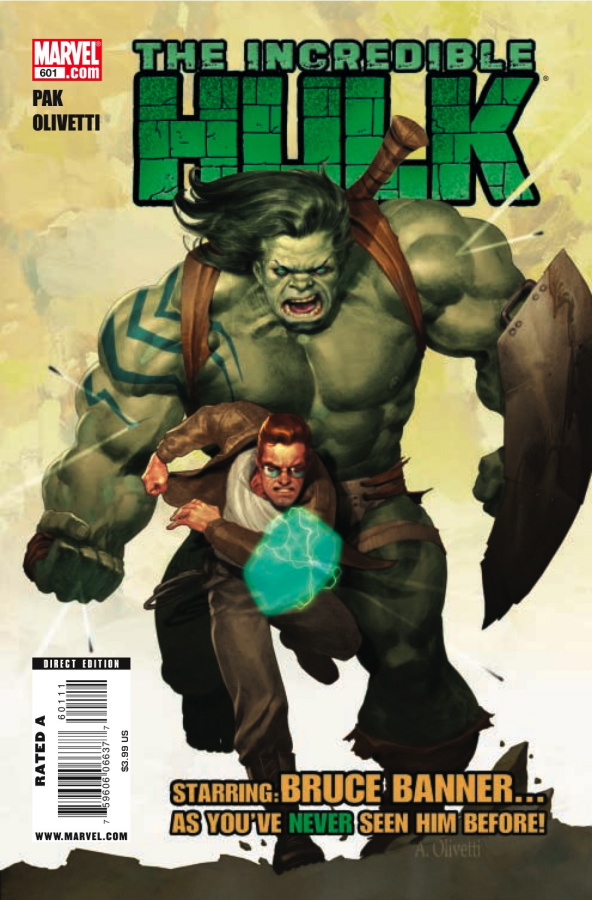
What makes all this crap worth going through? The eventual return of Greg Pak, writer of “Planet Hulk.” He came back and salvaged what he could of Jeph Loeb’s mess, brought the Hulk’s son Skaar to Earth, and paired the Hulk with the growing family of gamma-irradiated creatures that had come out of Loeb’s run, including a mutated Rick Jones and Betty Banner, who had been brought back to life by the Leader (yeah, he’s alive again…no explanation as to how or why, either) but transformed into a Red She-Hulk (better than it sounds, believe me). The original Hulk returned (take a shot), and the Hulk, who had always wanted to be left alone, wound up forming a truce with Bruce Banner so they could protect their new family. All of this led up to…
…wow, this has gone on for quite a while, hasn’t it? Can you believe we need Part Five? Admittedly, we’d probably get such long histories with other characters if my knowledge of them matched my interest in the Hulk. But the big green guy has my heart, and thus we will put a pin in this installment of Superhero Evolutions for next time. Join us again as the Hulk takes on Greek gods, evil mutants, and death itself!
 Babbling Brooks