The RPG hobby got its start in Lake Geneva, Wisconsin with a tiny company known as TSR. That company will go down in history as the original owner of Dungeons & Dragons. Unfortunately, it is also notable for horrendous mismanagement that caused it to struggle through the late 1980s and ultimately go broke in 1997, where it was ultimately purchased by Wizards of the Coast. But the mismanagement of many years doesn’t hold a candle to the series of PR disasters that struck an ill-fated attempt to revive the TSR trademark in the summer of 2021.
The First Revival
After Wizards of the Coast purchased TSR, they quietly phased the brand out. TSR remained as a subsidiary for a few years, their logo gracing the covers of Advanced Dungeons & Dragons titles and video games like Baldur’s Gate. But by the time D&D went into its third edition, the brand was shut down and left to the annals of history. In 2004, Wizards of the Coast let the TSR trademark expire.
Fast forward to 2011, when Jayson Elliot, the co-founder of the podcast Roll for Initiative, chose to resurrect the trademark. Interested in creating content for old-school D&D players, Elliot created a new TSR and launched Gygax Magazine, named after Gary Gygax, one of the game’s co-creators. He also recruited both of Gygax’s sons, Ernie and Luke, to contribute to the magazine.
Gygax Magazine lasted from 2012 to 2016, at which point legal restrictions involving the name forced it to end. Gail Gygax, Gary’s widow, owned the rights to his name and estate and chose not to enter into a business relationship with the new TSR. Rather than attempt to rebrand that magazine, the new TSR ended it. They did not, however, shutter their business.
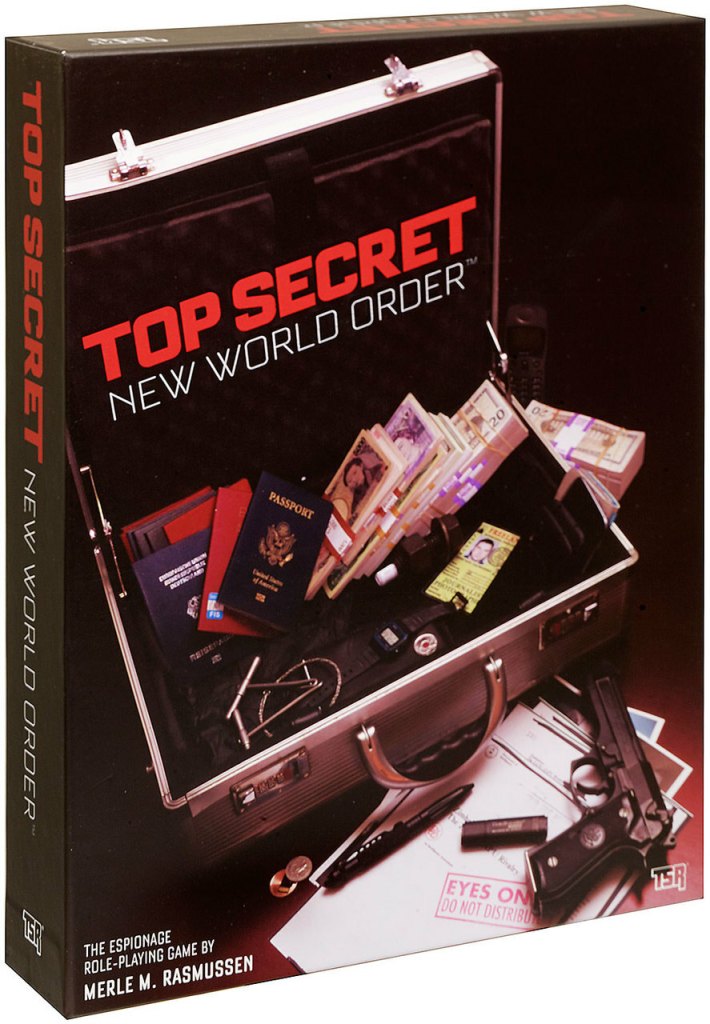
Instead, the new TSR launched some games of their own, including a remake of one of their predecessor’s old games, Top Secret. The company continued on for years to come and is now Solarian Games (more on that rebranding in a bit). Unfortunately, legal matters again spelled trouble for the younger TSR. The company failed to properly file paperwork to renew its trademark in 2020, leading to them losing control of it:
Now…who was the other group that swooped in and snatched up the TSR name when Elliot’s business failed to renew the trademark? That’s where the story starts to get weird…
Ernie Gygax’s Unfortunate Interview
Once the TSR trademark lapsed, Justin LaNasa swooped in and picked it up. He allowed the other TSR to pay a licensing fee for the trademark, ensuring that they didn’t have to go through and rebrand their products. The new TSR quickly announced a new role-playing game called GiantLands, which had been a previously unfulfilled Kickstarter that raised about $8,000 from 77 people in 2019.
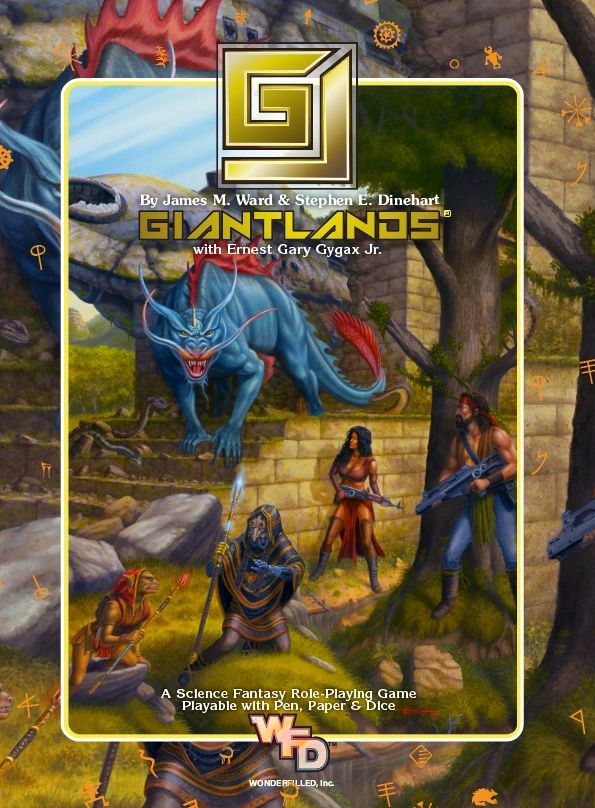
The game certainly hearkens back to old school role-playing, with art by popular Dragonlance artist Larry Elmore and writing by RPG veteran Jim Ward. Notably, though, Ward (and presumably others) produced their work on a freelance basis and initially knew nothing about a new TSR.
Meanwhile, the new TSR also offered some strange new bells and whistles to tie into GiantLands, such as a planned theme park…exceedingly ambitious for a group that had failed to make proper use of the $8,000 they raised on Kickstarter two years ago.
The existence of two separate TSRs, the sudden emergence of a game whose contributors knew nothing of the publisher, and the pie-in-the-sky nature of the newest TSR’s other promises caused a great deal of confusion. And so, to promote the new game and clear some things up, Ernest Gary Gygax, formerly associated with the previous TSR’s Gygax Magazine, appeared on a YouTube show called Live from the Bunker to promote the new company and their upcoming flagship product.
It did not go well.
Among other things in the interview:
- Gygax admitted to LaNasa snatching up the TSR trademark from Elliot and attempted to describe it as a friend helping a friend rather than a rather shady business move.
- He insulted the trans community with the statement, “recently they were dissed for being old-fashioned, possibly anti modern trends, and enforcing, or even having the concepts of gender identity.”
- He made the following statement about Native Americans: “American Indians did the same thing they would wipe out another tribe many times, take the women and children, and murder off everything else, and leave to make your tribe that much better, room to grow.”
- He announced the upcoming release of the old (original) TSR game Star Frontiers, apparently ignorant of the fact that Wizards of the Coast still sells that game.
- He insulted Wizards of the Coast for not working with the new TSR (which, again, had not yet released an actual product).
- He defended his own unfulfilled Kickstarter, Marmoral Tomb, which raised over $126,000 in 2015, because he had not realized that Kickstarter charged fees and that a business needed to pay taxes on revenue.
The interview caught fire, with Gygax’s insensitive comments toward marginalized people drawing the most ire. Suddenly, the new company that had yet to make a single sale had a major PR crisis on its hand, caused by its highest-profile employee.
The Baffling Response
In the wake of Gygax’s disastrous interview, the newest TSR chose not to issue an apology but rather go on the defensive using a variety of different tactics.
First they opted to distance themselves from the statement:

Then they opted to deflect the blame, using the time-honored strategy of, “other people in history did things that are worse.”
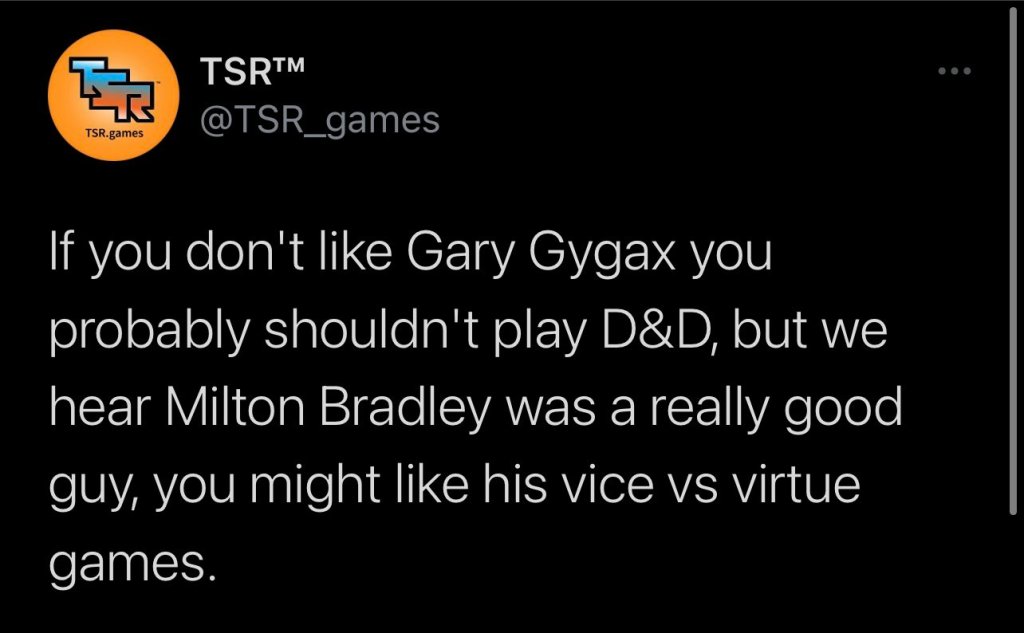
Through their Dungeon Hobby Shop Museum account, they opted to rally against the “woke,” claiming that the controversy had driven their sales (for products that don’t yet exist) up:

When pressed on the topic of trans rights, they opted instead to call a trans woman disgusting:
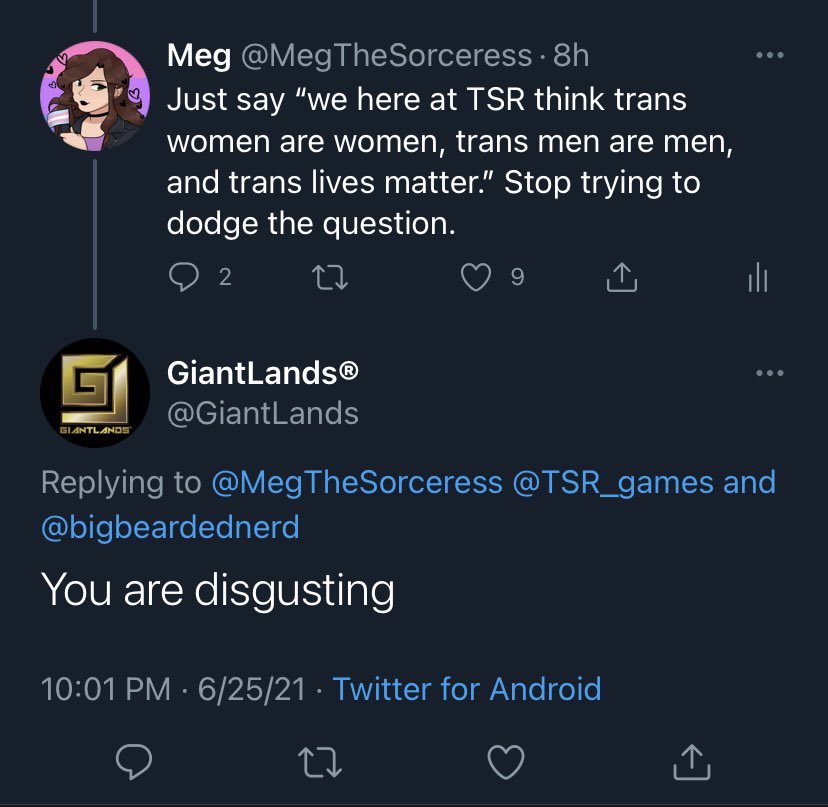
Finally, Ernie Gygax himself stepped in to apologize. Unfortunately, his apology only made things worse, in large part because in a ramble about how he had been bullied in high school, he stated, “I began to wish that indeed I did have a Thompson 45 Machine Gun…so that I could wipe away some of those laughs.” This, obviously, was an especially poor choice of words given the ludicrous amount of mass shootings that occur in the United States in this day and age.
Meanwhile, Stephen Dinehart of TSR opted to blame the whole fiasco on Wizards of the Coast (WotC). Notably, no representative from WotC or Hasbro had said anything regarding this matter. One would presume that, even if TSR did have a published product and if that product did sell well enough to make them real competition of the soaring D&D franchise, that the corporation would be well-suited to sit back and watch them destroy themselves through PR mismanagement.

And finally, as if the company had not brought enough ire upon itself, it tried to deflect the issue by claiming that Ernie Gygax was on the autism spectrum. This stance is rife with problems, first because it’s not ethical of a company to publicly out somebody as autistic and secondly because it’s problematic to use autism as an excuse for offensive behavior of this sort.
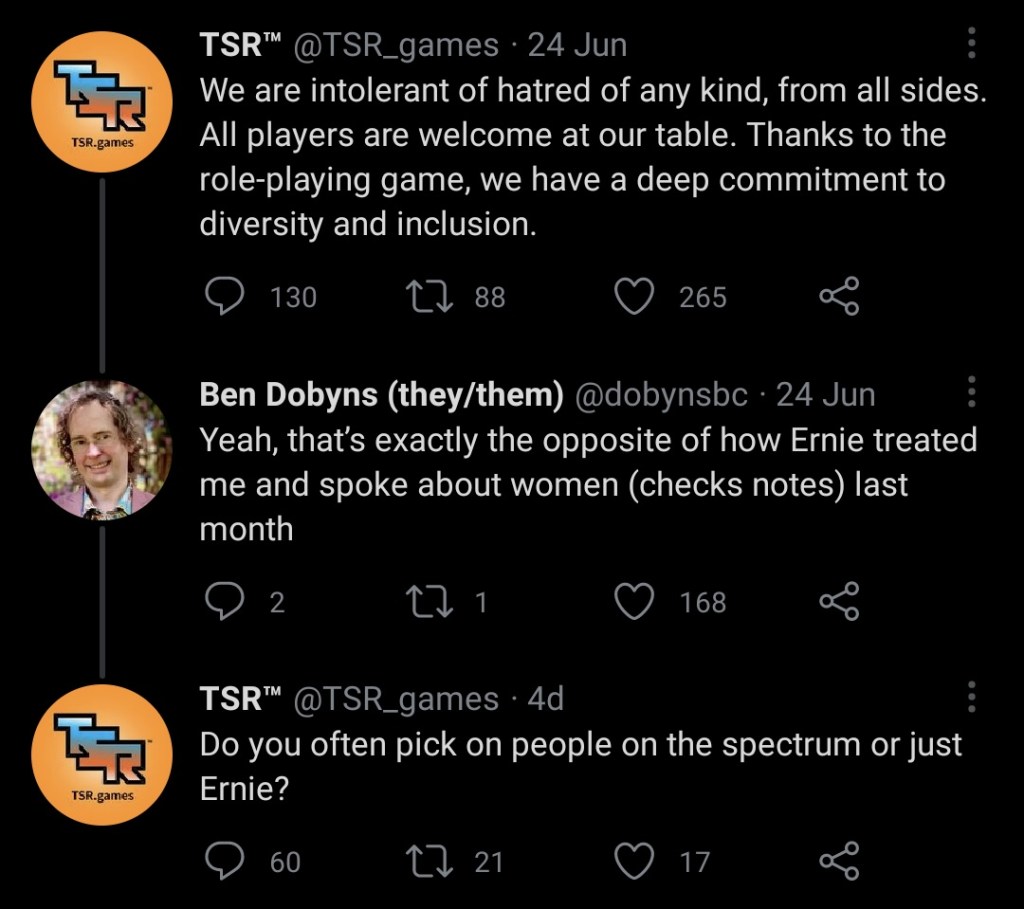
These various responses on social media are not presented in chronological order. Do note, however, that all of them occurred in the space of less than two weeks. TSR had barely even settled on a defense for the interview before they leapt to a new one. And, by this time, the company’s response had become a bigger issue than the inciting video.
A Toxic Trademark
In a short time, the newest TSR had gone from a minor point of interest for those nostalgic for old school role-playing games to a toxic brand for people to associate with. Notably, many of the people who had done work on Giantlands did so on a freelance basis and were not associated with the company’s decision-making. However, TSR (and, eventually WFD…again, more on that soon) listed those individuals in a light that made them seem like employees. For folks like artist Jeff Dee, this meant being unwillingly associated with toxic views. In Dee’s case, this led to him publicly stating that he had no association with the company and returning payment for a piece of art that had been commissioned.

Other major movers and shakers of the RPG world, including the Game Manufacturers Association (GAMA), Gen Con, and even Luke Gygax, all went out of their way to distance themselves from the new business, with GAMA and Gen Con barring the latest TSR from tabling at their events.
Finally, the second TSR, the one that had actually produced product by this point, decided that the brand was too toxic to warrant a licensing fee. They rebranded as Solarian Games…which, among other things, meant not being able to sell their old stock with the TSR logo on it, effectively taking a loss on all of that so they could move forward without the toxic association.
So, after the firestorm, there was only one TSR left standing. However, that one would disappear, too.
Wonderfilled
After the newest TSR tried to reframe everything that happened as a coordinated, clandestine attack on the part of Wizards of the Coast (which, again, had made no public response in the matter), Dinehart and company apparently recognized that the TSR name had drawn too much bad publicity to make Giantlands, or any other project, work. Thus, Giantlands moved to the property of Wonderfilled, while TSR remained technically a company but lacked any upcoming product to sell.
I refer to this company as Wonderfilled despite the fact that their website refers to it as Wonderfilled Inc. mostly because I’m not sure if the company is actually incorporated or not. They certainly claim to be, but the change happened so rapidly that I question whether the claim is accurate. It certainly wouldn’t be the first time that the people involved in the company have shown a lack of awareness as to how the business world works.
Wonderfilled, among other things, claims to have a “TOP-SECRET” (sic) project for Rovio Entertainment, with a team that has supposedly worked on “franchises from Harry Potter, to Link, Mario and Batman.” The Giantlands website, meanwhile, comes just shy of being dishonest by implying that the creative team hired for that game made Dungeons & Dragons as well as the video game F.E.A.R. (in truth, individuals hired on a freelance basis did do work for those properties, but that’s a far cry from “making games,” as claimed by the website). That site also lists the expected release date for Giantlands as spring of 2020, implying that their FAQ, as of August 2021, has not been updated for a couple of years.
As near as I can tell, there is technically still a TSR out there, but it doesn’t currently sell any product and has nothing in the pipeline for the foreseeable future. Its staff seems to have been claimed by Wonderfilled (abbreviated on their website as WFD), although whether that’s a matter of truth or just a misleading website claiming freelancers as employees is anybody’s guess. Either way, the entire bizarre scene has been an amazing lesson in how to turn a minor curiosity into a remarkable trainwreck in the space of just a few weeks.
Images: TSR (the original), Solarian Games, Wonderfilled, Wizards of the Coast
 Babbling Brooks
This is the definition of stupid. You just make up stuff and act like it’s truth.
LikeLike
You know it’s a true shame that it only gets worse from here
LikeLike