
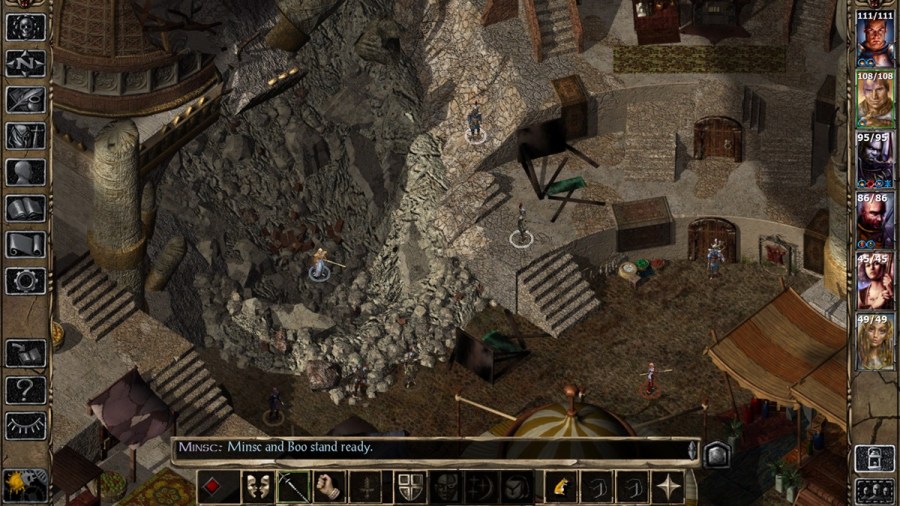
The success of Baldur’s Gate 3 has Hasbro seeing potential gold mines in the video game industry. Unfortunately for them (and us), Larian Studios won’t be working on more Baldur’s Gate games. Not to be deterred, Hasbro is investing $1 billion in new D&D computer RPGs, hoping to catch lightning in a bottle several times over. It’s amusing in its own way, because the company had a pipeline of consistent high-quality video games for a solid decade and let that dry up.
While D&D has seen several periods of success in the video game industry, the one that I experienced directly was the string of releases between Baldur’s Gate, which came out in 1998, and Neverwinter Nights 2, which saw its last official expansion in 2009. Developed mostly by Bioware (and the now-defunct Black Isle Studios), these games expanded the genre in sometimes innovative ways and delivered a consistently fun D&D experience on personal computers.
I’m going to touch on each of the games I’ve played, which covers all the D&D cRPG games released from 1998 through 2009 with the exception of Pool of Radiance: The Ruins of Myth Drannor, The Temple of Elemental Evil, and Icewind Dale 2. The latter two games sit in my GOG account waiting to be played in the future. As to Pool of Radiance…well, based on the reviews I’ve read I might just go back in time and play the SSI “Gold Box” games instead.
Continue reading “The Infinity Engine and Beyond: A Look Back at Classic D&D cRPGs”
 Babbling Brooks