After enjoying popularity in the late 80s and early 90s, Dungeons & Dragons video games had largely gone extinct as the 21st century approached…until a little game called Baldur’s Gate revitalized the genre. The Black Isle/Bioware collaboration became a runaway hit that led to an even bigger sequel a couple years later. With something so popular, and with D&D making a lot of its brand money on its novel lines, a novelization was inevitable.
Wizards of the Coast tapped Philip Athans, their senior managing editor, to write the novel. Athans had spent a long time editing other Forgotten Realms novels and was one of the employees who had stayed with the D&D brand through its transition from TSR to Wizards of the Coast. Sadly, what he wrote turned out…bad. Almost unspeakably bad. Years later, the Baldur’s Gate novel would become a punchline until it was finally written out of official continuity with the approach of D&D 5th edition.
But the failure of Baldur’s Gate as a novel wasn’t just a matter of Athans whiffing on a video game adaptation. There were many factors behind the scenes that doomed this novelization and left Athans holding the bag.
A First Draft of a First Draft
If you check the copyright page on the Baldur’s Gate novel, you’ll notice that it was released in 1999. To be more precise, it was released in July 1999, and the video game it was based on was released only seven months earlier, just before Christmas 1998.
A major novel takes several months to edit, typeset, and so on. Most printing happens overseas where paper is cheaper, adding at least three more months to cover the printing, binding, shipping, and distribution of the product. Even assuming that everything happened on time and there were no delays, that would mean that Athans would have had to submit the final draft of his novel when the game itself first hit shelves at the end of 1998.
As it turns out, based on Athan’s own telling of the tale, that is exactly what happened. The only problem is that the final draft of the novel also happened to be his first draft.
Per Athans’ retelling of the process, he got the job of writing the novelization–his first novel–in October 1998. The first draft was due before Christmas of that year, meaning that he had about 60 days to write a full novel. And when he did turn it in…
“After a few weeks I got notes back from my editor, and nothing from anyone involved in the game except some kind of vague, ‘It’s fine.'”
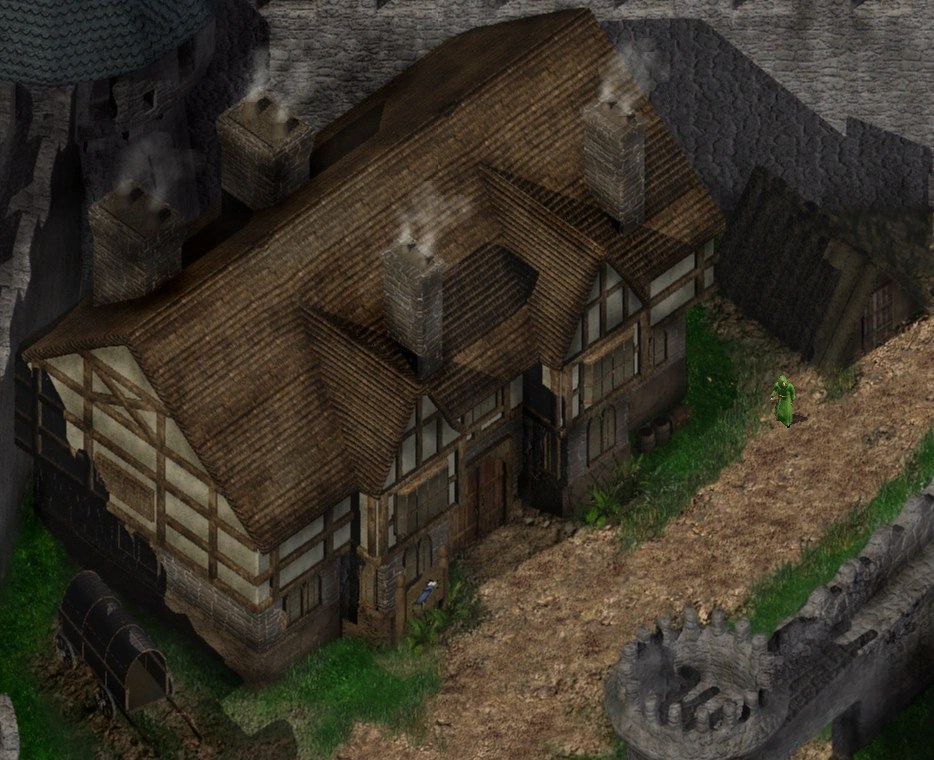
So Athans’ first draft of his first novel, written in a 60-day window, basically had no editing to it. That explains why such errors as calling the Friendly Arm Inn the “Friendly Arms Inn” slipped through. But what about the characters…why do they bear no resemblance to their video game counterparts?
Working from an Unfinished Game
Reading the Baldur’s Gate novel after playing the game creates quite a shock to the creative system. The novel doesn’t just miss core elements of the game and its characters; it depicts them in ways that are completely contradictory to their essence. Khalid, the shy half-elf fighter who is utterly devoted to his sharp-tongued wife Jaheira? He’s a womanizer and a wife-beater. Jaheira, the mighty warrior-druid? She has a long scene where she panics because a spider crawls into her armor and the main character “saves” her by….*checks notes* ripping her shirt off.
How could a writer possibly get such characters so hideously off-base? As should be expected from anybody who has written for publication, deadlines had a lot to do with it.
“A production deadline loomed before us,” said Athans in his recollection, “and almost as if we planned it, the second the book went to press we got a pre-beta version of the game that crashed too early on to tell how off the mark I was, but gave me just enough negative feedback to know I was in trouble in Chapter 1.”
Athans worked from an early summary of the story which left out a lot of details and even a lot of important characters. For example, where is Imoen, the plucky girl from Candlekeep who serves as a constant companion to the main character?
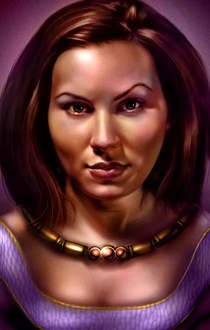
Athans had probably never even heard of Imoen until he had delivered his draft and booted the game up for the first time. In the game, she was a late addition when the development team realized that the available companions lacked a good-aligned thief…which means the main character would have needed to be a thief themself, rely on the psychotic halfling Montaron for much of the game, or take damage from every single trap on the Sword Coast.
It’s hard to imagine the Baldur’s Gate series without Imoen, especially since she plays such an important role in Baldur’s Gate 2. But she’s completely absent from the novel, and that’s probably because the story summary that Athans received never mentioned her. With that in mind, it seems likely that the notes on Khalid and Jaheira might have simply read something along the lines of, “a quiet fighter and his acid-tongued wife,” from which Athans may have developed the abusive persona for Khalid to add some drama to the book. Unfortunately, that characterization of Khalid is so far off from the final version that, out of context, it seems like the novel was deliberately trying to disrespect the game.
No Dramatic Beats
The tight deadline and lack of ending explains why we miss out on characters like Imoen and why a description of a fight ends with a line like, “Abdel, still wild with a murderous frenzy now wholly out of his control, chased the man down and butchered him into a mound of bleeding meat.”
It even explains the aforementioned spider-in-Jaheira’s-shirt scene, which includes these lines: “A tear burst from her eye, and Abdel stopped smiling. She was trying to pull her blouse off, and he helped her. The fabric tore away with an echoing sound, and Abdel swatted the spider from between Jaheira’s exposed breasts before either of them realized what he was doing. The spider jumped nimbly onto Abdel’s right hand, and the sellsword slapped it with his left, leaving only a crinkling of legs in a brown spot.”
But what probably hurt the novel more is that Athans was working from a story summary rather than seeing the game in its glory. Admittedly, computer game sin 1998 weren’t exactly a cinematic experience, but certain moments in Baldur’s Gate really hit hard, especially the introduction of the villain, Sarevok:
The graphics may have aged, but Kevin Michael Richardson’s booming, sinister Sarevok voice hasn’t. Sarevok has a commanding presence from the very beginning and makes it known that your character is his target by killing your foster father as the game’s first chapter begins. All of that is lost without the audio and visual to back it up.
Sarevok stays in the background for most of the video game, and does so for most of the novel as well. The biggest difference is that the novel includes numerous scenes of him effectively twirling his mustache or killing henchmen, never actually doing anything until the end fight. In the game, his off-screen actions drive the entire plot–even if you don’t truly know that the armored figure who killed your foster father is the final villain, you’re always one or two steps behind in a rush to figure out his scheme.
Seeing some sort of demo or even the opening cut scene might have helped Athans write a better Sarevok, and could have lent gravitas to the rest of the cast and story. Then again, considering what the sequels brought, maybe that wouldn’t have happened after all.
What About the Sequels?
Everything I have discussed so far demonstrates how a short production schedule and a lack of information led to Baldur’s Gate being a terrible novel. But that’s just the fist book in a trilogy.
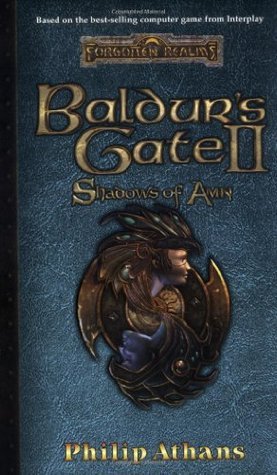
Philip Athans came back to write Baldur’s Gate II: Shadows of Amn. A new author, Drew Karpyshyn, finished out the series with Baldur’s Gate II: Throne of Bhaal, adapting the second game’s expansion. Were they as bad as the first Baldur’s Gate? In my opinion, yes.
Now, admittedly, Athans definitely improved in writing skill between books. While I wouldn’t call Shadows of Amn anything special, it did have some good bits of prose. As a fan of strong first lines, I very much liked, “Late in the summer of the Year of the Banner, Abdel Adrian, son of the God of Murder, returned to Candlekeep a hero.”
But for the most part, Shadows of Amn lands with the same dull thud as its predecessor. The story vaguely resembles the video game, but the characters are way off. Minsc, arguably the most iconic character from the series, inexplicably has red hair and winds up working as a waiter. Jaheira doesn’t have the arc of mourning her dead husband because of the changes from the first novel. Bodhi, the cunning vampire from the novel, becomes a lustful creature who sleeps with the main character because she saw him fight naked. Imoen is here, and she winds up coerced into sex with the drow matron Phaere with the cringey “it’s not rape because she liked it” logic that the early 2000s often had. (That scene is akin to something the main character encounters in the game, but in the game you can avoid the uncomfortable situation via dialogue.)
Throne of Bhaal, meanwhile, is pretty much a bloodbath that wipes out the supporting cast from the previous books and ends with the protagonist Abdel Adrian as the last standing child of Bhaal. Jaheira dies, Imoen dies, even the resurrected Sarevok dies. Abdel himself is pretty wooden as a character and not interesting enough to be a solo act.
How did these other two novels fumble as badly as the first one? There’s probably something to be said for them having to carry forward from the broken first book–a bad foundation and all. But mostly, they repeated the same mistakes as the first novelization, but worse.
Shadows of Amn came out in September 2000, which was the same month as the video game. This went beyond the “first draft is due before the game comes out” mandate of the first book–the first draft was likely due before the game’s developers even had the major bugs worked out of the engine. Throne of Bhaal had a little bit of an easier time, coming out in September 2001 while the expansion had been released in June of that year, but was still likely on an insane time crunch. Making matters worse for the third book was that Drew Karpyshyn had never written a novel before 2001, when he had two debut. When did his other novel, Temple Hill, come out? Also in September 2001…which means Wizards of the Coast had a first-time novelist juggling two manuscripts at the same time, both likely on very tight deadlines.
The Low End of the Totem Pole
If it seems like Wizards of the Coast didn’t really care about making high-quality Baldur’s Gate novels, that’s because they didn’t.
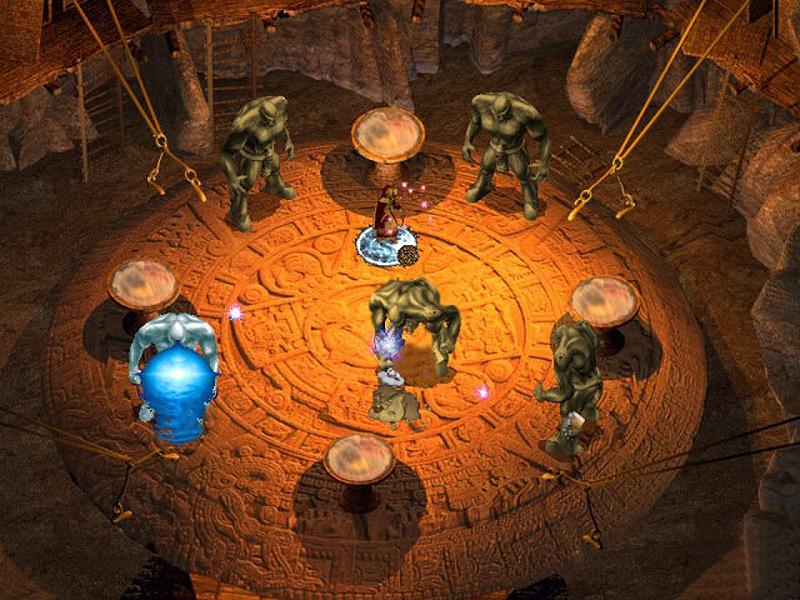
In the modern age where Baldur’s Gate 3 made Hasbro $90 million, it seems like video games would be a huge deal and the company would want to get it right. But the scene was very different in the late 90s and early 2000s. Bioware, the developer of Baldur’s Gate and Baldur’s Gate II, was a relatively unheralded company that had only just created the Infinity engine, which would serve as the “physics” of the series. Moreover, D&D video games had struggled in the late 1990s. Baldur’s Gate was a risk, and Baldur’s Gate II, while a safer bet, still probably didn’t make a ton of money for Wizards of the Coast.
Meanwhile, the slate was filled to the brim with D&D-branded novels. In 1999, when the first Baldur’s Gate book came out, a total of 21 D&D novels hit bookshelves. Most of those novels came from the likes of RA Salvatore and Ed Greenwood, who routinely made the best-seller list. The Baldur’s Gate novels, by comparison, did not receive much of an emphasis. They were tie-in books for video games that Wizards of the Coast didn’t know would take off and likely wouldn’t receive a big profit from if they did.
The potential return wasn’t very high, so the investment wasn’t great, either–a first-time novelist, a tight deadline, and barely any editorial work. By the following year, even if Wizards of the Coast saw the suddenly-successful Baldur’s Gate franchise as worth investing in, they were already cranking out a dozen novels and a sequel to a much-maligned first book probably didn’t get much more than a weary nod.
In short, the works by Athans and Karpyshyn leave much to be desired, but there was never going to be a great Baldur’s Gate trilogy of novels. Wizards of the Coast didn’t see the profit in the books, and they gave no resources to the team working on them. For Athans and Karpyshyn, that unfortunately meant rushing through adaptations whose source material they couldn’t see before their final drafts were due.
Images: Bioware
 Babbling Brooks