This year marks the 20th anniversary of my first published novel, Shadowslayers. While the tale didn’t become the best-selling modern fantasy classic I hoped, it provided me with some very useful experience about the publishing world and helped shape who I would become as both a writer and a person. Here’s how I became a published novelist and what I learned from the experience.
Post-College Writing Malaise
I graduated from college in 2004 and spent most of my time in the following months looking for work. I spent that summer as a clerk in a grocery store, which was a far cry from where I wanted to be. Throughout the rest of the year I was effectively broke, as all my money went toward paying rent and bills. I scored dozens of job interviews, but never landed an actual full-time position.
Between money being tight and my general anxiety telling me that I was doomed to never use the degree I had worked so hard for, I started having panic attacks at night. During this time, all my focus went toward work and feeding my growing depression. I basically stopped writing, managing only 100 words of fiction in six months, as opposed to the hundreds of pages I had written when I was in college and inspired.

This situation mirrored a period of time before college, when I had just graduated high school and was in an abusive relationship that also suppressed my writing. Luckily, this time I had a supportive girlfriend, Sarah (who would eventually become my supportive wife), and she suggested that I give this thing called NaNoWriMo a try. The goal was to turn off the inner editor and write 50,000 words in a month.
I started a bit late, so I needed to run with something I knew would come easily. So I turned to role-playing games, where I had built up a hodge-podge fantasy setting called Blackwood over a period of almost ten years.
Goodbye to Old Friends
I had come up with Blackwood as a spur of the moment thing when I was running an Advanced Dungeons & Dragons game in the Forgotten Realms and my brother George expressed a desire to be playing in our own setting. Using the “color plus noun” formula that seemed to work so well for D&D settings such as Blackmoor and Greyhawk, I went with Blackwood and we rolled right along.
I started running extended campaigns in college, and Blackwood eventually became something more than the Forgotten Realms with the serial numbers filed off. Since the setting had already lived in my head for a long time, I decided to use it to give myself a writing jump start. But I was at a transformative period of my life, going from student to “adult,” and I decided it was time to wrap up my old tales so I could start anew. So my first draft of Shadowslayers was an ending–something very personal to myself that took characters I had created growing up and killed or transformed them. It was supposed to be my personal goodbye to the setting I and my friends had created.
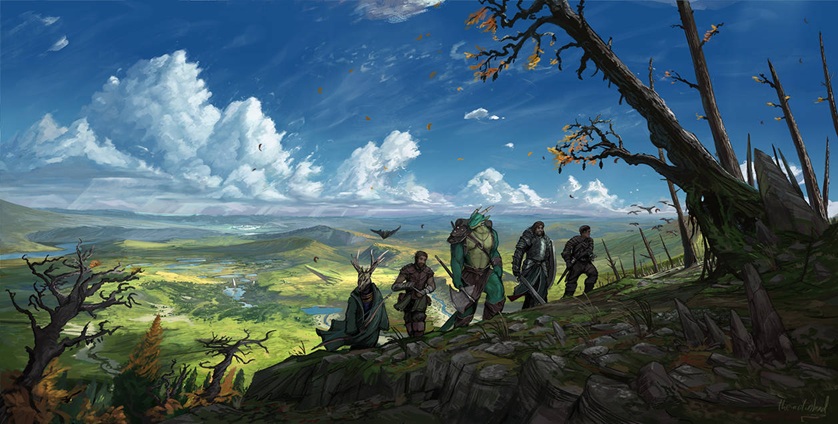
The main character became Garyl Shadowslayer, who had often been my self-insert character in my games. His wife Kajeel, originally created by Nick Culver and used with permission, died in the very first chapter. The villain, Derrezen the Dragon-God, had been intended as a final campaign-ending boss, but none of the player characters ever got high enough in level to face him. So this was going to be it–I was going to kill everyone off in one big battle between good and evil, close out the setting, and use the writing as a way to get my creative juices going again for the future.
That is, by and large, what happened. But the characters didn’t stay dead.
Reawakened Imagination
By November 29th, I only had 40,000 words written. I completed the first draft of Shadowslayers by pounding out 10,000 words in the last two days. I accomplished what I wanted in closing out the setting by the end of the tale; all the major characters were either dead or transformed in some way by the time I wrote the last words of the denouement. But that left a new beginning for the setting.
Shadowslayers did reignite my passion for writing and storytelling. It also taught me the importance of the question, “What happens next?”
The end of my novel transformed the world of Niiran and the kingdom of Blackwood forever…and I started wondering what the world would look like after those changes. Not long after I completed my first draft, I started a new D&D game that picked up 30 years after the conclusion of Shadowslayers. New characters took up the roles of those who had died or retired, technology marched on, and the world recovered from the cataclysmic events of the story.
In time, the old guard returned as well, albeit transformed. Garyl, Kajeel, and Derrezen all came back as NPCs in different ways, and Blackwood as my home setting is still around. In 2026, Derrezen and Kajeel are dead dead (unless they’re not), and Garyl has transformed from a mighty wizard to a spoony bard. It’s been over 150 years since the events of Shadowslayers, but that story still has an impact. By deciding to burn everything down in my novel, I actually sparked my imagination and created stories that are still unfolding decades later.
Entering the World of Publication
After finishing Shadowslayers, I put it on the shelf and let my mind go elsewhere until 2005 rolled around. Then I approached it with fresh eyes and gave it a thorough revision. Some of the major changes I made included the introduction of the character Penelope, who had been created by my friend Beth Hayden, and a complete overhaul of the ending. The new revision added about 7,000 words of story and created a central theme of hatred and what that feeling causes people to do.
Once I had revised the story, I started sending it out for publication. I didn’t get cute with who I sent the book out to; I got a copy of the Writer’s Market and started submitting to every agent and publisher who accepted fantasy. I started in the As, and eventually got an acceptance when I got to the Ps–Port Town Publishing agreed to print the book.

Sarah was in the room with our friend Carrie when I got the acceptance email, and I’m surprised that my high-pitched shriek of joy didn’t permanently damage their eardrums. I had come to terms with the possibility that I would never get published, yet here was my foot in the door. I didn’t realize at the time what sort of publisher Port Town was, and that they probably would have accepted any manuscript I sent them.
At the time, I didn’t care about any of the details. I signed the contract and dove right into working with the editor on a final revision. The release date was set as April 1, 2006 and I didn’t want to miss it because that meant I could give the first copy to my mom on her birthday.
A badly pixelated cover didn’t give ne pause. Terrible binding on the paperback didn’t register with me because I finally had a book with my name on it. By summertime the publisher gave me word that my first print run had sold out. Suddenly, I was not only a published author, but a successful one. It would take a few months before reality finally caught up to me.
A Painful Reality Check
Had I known more about the publishing world, I would have known that it was full of scam artists. I had luckily avoided going for a vanity publisher, because I at least knew that anyone asking for money up front was there to rip you off. But I didn’t realize that Port Town Publishing had all the markings of a crooked organization.
Throughout 2006, when I was living paycheck to paycheck, I waited for my first royalty payment. I wasn’t expecting much, but Port Town’s website claimed that they did minimum print runs of 500 books. If they were telling the truth and Shadowslayers had sold out, that meant I could at least get a rent payment out of the royalties.
Well, they weren’t telling the truth.
I waited a full year before inquiring about royalties. I never got a response from them. In the midst of writing a sequel for Shadowslayers, I noticed the company’s website suddenly mention that authors needed to pay a fee up front before being published. The publisher claimed that this was so writers could prove how serious they were, but I recognized it as a scam and decided not to submit anything else to them.
Later that year, I found out that Port Town Publishing was being investigated for fraud–and that the owner had a prior record of business fraud. (In fact, she was on probation for that charge when she founded Port Town Publishing.)
Port Town sent an email to their authors telling us that the company was in financial trouble and urging us to support the business by purchasing book from the other authors. This seemed reasonable on first blush, but in retrospect it was just a way to squeeze some more dollars out of the gullible before the company closed its doors.
Finally, Port Town informed us that they were going out of business. I reached out inquiring about my long-awaited royalty check, still hoping to pay a month of rent if nothing else. The owner responded with a claim that Shadowslayers had sold almost nothing and that I would have to pay them to buy up the remaining stock of my book.
Fortunately, I had kept receipts. I went back and forth with the publisher, producing the owner’s own words about the success of my book. But I learned that everything relating to sales numbers was just the publisher blowing smoke–they never had reliable numbers, and they never intended to pay me. In the end, we reached an agreement where I gave up those royalties which were never going to come and got the remaining stock of my books in the trade. More important to me, though, was that the deal meant I got the rights to my book back. So while Shadowslayers is no longer available in paperback, it lives forever as an ebook, allowing people to pay a dollar and enter the world of Blackwood.
And I had learned some valuable lessons.
Was it Worth It?
The business end of Shadowslayers sounds like a tale of woe, but I don’t really have many regrets about how things worked out.
Do I wish I had held out for a better publisher? Yes, but I don’t have jumping feet-first into the publishing world and learning some hard lessons. I came out of the process with an ugly-looking paperback, but I remain proud of the words between the covers. I made no money, but I luckily knew just enough to keep myself from being victimized by a publisher hoping to bleed desperate authors dry.

The writing process of Shadowslayers taught me that I could sit down and just write an entire novel. It revitalized my gaming setting, creating stories at the table that my friends and I still talk about today. The novel broke me through a period of misery and anxiety. It reignited my passions and helped me through a very difficult time.
I don’t have much good to say about the business end of things except that I learned some valuable lessons. It would have been nice to learn them before getting targeted by a predatory publisher, but at least now I knew what signs to look for.
The business experience helped me out twice. First, I recognized the signs well enough to back out of a publication deal for a novel called The Shadow Queen (which I had originally intended to be a prequel to Shadowslayers). I received a contract offer but, after researching the company, realized that it was a bad deal and backed out. The Shadow Queen remains unpublished (and if it ever does get published it will definitely have a better title), but it is still mine without having had to fight to get the rights back.
Secondly, the experience helped me find a good publisher for my later novel, Greystone Valley (again using the time-honored color plus noun naming technique). When Grey Gecko Press reached out to me about publishing the book, I initially balked because of my experience with Port Town. The owner of Grey Gecko eventually reached out to me, and we got to talk through my concerns. I eventually published both Greystone Valley and Conquest of Greystone Valley with them, and the experience was the polar opposite of my Port Town days. The books look great, they’ve sold well (by the standards of a small publisher, at least), the editing process helped me add important story notes, the cover art by Jessica von Braun is beautiful, and I even got to “talk to”meet” actress Serena Scott Thomas, who provided the audiobook reading of Greystone Valley.
As to Shadowslayers itself, I sometimes reread parts of the book expecting to cringe at the way I used to write. But I’m honestly pretty happy with it. I would change a few things if I rewrote it today, but it hangs together pretty well. I’m a better writer now than I was then, but I was still pretty good back then.
Two decades have passed since I first published Shadowslayers. I learned a lot through the process, both on the creative end and on the business end. If I could do it all over again, I would still choose this story to be my first book…but I would have taken a different route to publication if I had the chance.
Featured Image: Matías Callone, CC BY-NC-SA 2.0, cropped and resized
 Babbling Brooks