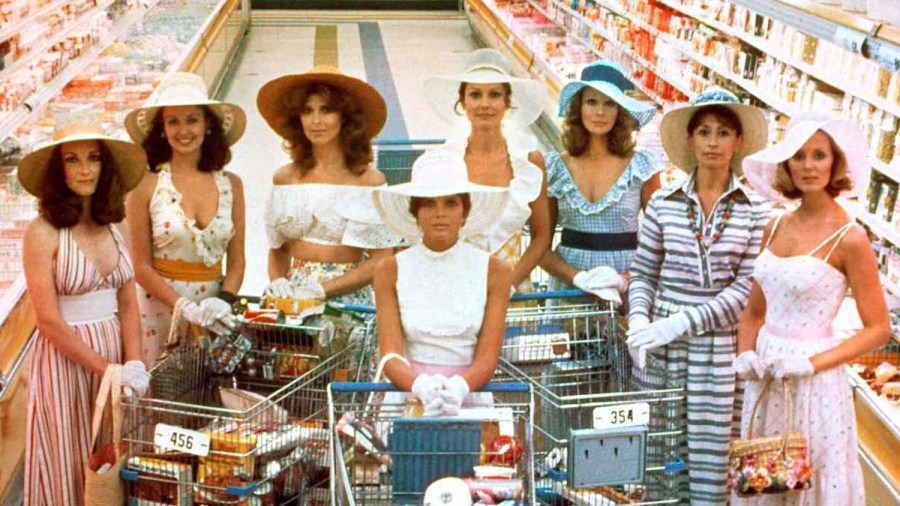
Some years ago, I watched the 2004 version of The Stepford Wives and came away thinking the film had a good premise but some missed opportunities in the execution. Later, I discovered that said movie was a remake of a 1975 horror film, which itself is based on a novel by Ira Levin. While I haven’t yet read the novel, I did watch the 1975 film and found it to be drastically different, to the point where putting the two versions side by side highlights the differences in our movie audiences between generations.
If you don’t know the story, I suggest checking it out before you read the rest of this. While the tale still resonates if you know the big twist, there’s much to be said for seeing it yourself fresh for the first time. If you do already know the twist, let’s delve into the major differences that 30 years makes in a story’s adaptation.
The Story in Both Versions
Although the two Stepford Wives films are dramatically different in tone and content, they share the same overall story: a family moves to Stepford, Connecticut, where everything seems suspiciously idyllic. The women of Stepford seem to come right out of a fantasy from the 50s. They do nothing but cook, clean, and work to please their husbands, and that seems to be their only joy in life.
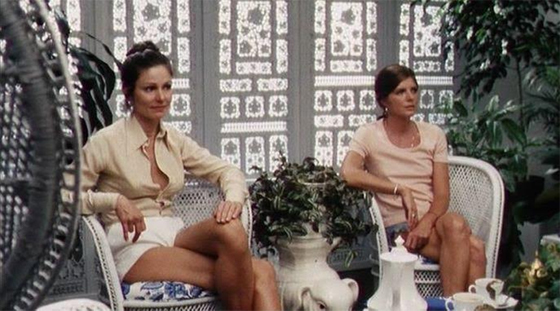
The family’s mother, Joanna Eberhart, becomes increasingly alarmed at something uncanny happening within the town. As she continues her investigation, she discovers that the men of Stepford have been killing their wives and replacing them with robots (or, in the remake, doing some weird nano-thing that makes no sense…more on that later). Naturally, she discovers this just as the men make her their next target.
Horror versus Dark Comedy
To begin the comparison, the 1975 version and the 2004 version are entirely different genres. The 1975 version is a horror film, while the 2004 version is dark comedy.

Why did the remake shift so drastically in tone? Largely because its creators played it “safe” in the story’s critique of patriarchy. The 1975 film takes direct aim at the way women are treated in society and presents a group of normal men who, when given the chance, would strip the humanity out of their wives. It had a subversive theme and asked the audience to take a good, long look at themselves. In the 21st century, where movies are more and more expensive to make and are expected to at least double their budget at the box office, studios tend to take safer routes that don’t involve directly criticizing 50% of the potential audience. By making things a little more surreal and adding some laughs, the film gives the audience a safety net: “Yes, we’re criticizing men, but obviously not you men because this is a comedy.”
The shift away from horror may have also been an over-correction based on the 1975 film’s initial critical responses. While the movie became recognized as a classic over time, it was not well-received by feminists of the era. Notable activist Betty Friedan supposedly stormed out of the screening, believing that the movie depicted Stepford, Connecticut as the way things should be–and to be fair, it seems that way through much of the movie, until the underlying horror is slowly revealed. Any filmmaker aware of that reaction would likely have wanted to front-load some of the “this is bad” moments, but doing so ruins the build of a horror film and requires a change in genre.
My belief that the 2004 film played it safe is backed up by the words of director Frank Oz, who said when referring to the movie, “I fucked up.” But Oz, who is an excellent director whose knack for blending horror and comedy was showcased in full in Little Shop of Horrors, didn’t set out to play it safe. Instead, he went against his instincts as he landed stars bigger than he expected and the budget ballooned:
“I had too much money, and I was too responsible and concerned for Paramount. I was too concerned for the producers. And I didn’t follow my instincts, which I hold as sacred usually. I love being subversive and dangerous, and I wasn’t. I was safe, and as a result my decisions were all over the place, and it was my fault totally. And by the way, I’m very proud of many aspects of the movie. The people were great. But when you sense that there’s no governing thought, or that the governing thought is kind of ‘Gee, I’m not sure where to go,’ you can sense it.”
Being a comedy made in an era when topical humor seemed to find its way into every film, the 2004 Stepford Wives leaned very much into jokes that were a product of its time. The film makes references to reality television, Microsoft, AOL, and so on. Larry King appears at the end of the movie and has the main characters on his talk show.
By comparison, while the aesthetics of the original film adhere very much to the 1970s, the rest remains almost timeless in terms of presentation and theme. Aside from some fashion choices and expressions that never made it past the 80s, the film can be watched and understood by audiences of almost any generation.
Laying Out the Mystery
Stemming from the differing genres, the two films also present the clues to the mystery of Stepford, Connecticut in very different ways. In the 1975 film, the early clues are easy to miss or dismissable as a quirk of a character’s personality. One of the inciting incidents that raises suspicions with the protagonist is when her athletic friend has the tennis court outside her home destroyed. This is suspicious, but also something that other characters in the town can dismiss as a shift in personal interests. As a result, our heroine Joanna sounds crazy when she starts talking about people being replaced.

All the answers to the core mystery are there for the audience to see, but until the end it’s hard to tell what is a clue and what is Joanna’s paranoia. Little details like a sketch artist drawing Joanna’s eyes or the numerous scientific and industrial facilities outside of Stepford eventually add up, but no one ever gives a monologue to explain things in plain terms for the audience. The ultimate revelation comes when Joanna, in a paranoid fit, stabs one of her former friends, causing the robot to malfunction.
The 2004 version does away with any pretense of a mystery, presenting a town that is obviously abnormal from the very beginning. Moreover, the audience sees things that the main characters don’t, such as a scene where Joanna and her friends idly play with a remote, letting the audience see a robotic wife in the background change breast size and otherwise malfunction while the protagonists in the foreground remain oblivious.
The difference here again boils down to what is “safe” and what isn’t. In the 1975 film, the audience follows Joanna’s perspective almost exclusively. We see only what she sees. As a result, there is a degree to which the audience can identify with Joanna’s rising terror–if something happens to her, we lose our primary connection to this story. The 2004 film gives the audience knowledge of what is going on long before our main characters figure things out. As a result, the sense of tension of danger becomes lessened–even if Joanna gets assimilated, we still get to see everything unfold. We may have some investment in Joanna, in no small part because she’s played by Nicole Kidman, but there’s less of a loss if she meets a tragic end.
Intolerance through the Years
Both films touch on the idea of social tolerance, albeit in different ways. The 1975 film makes mention of the first black couple to move into Stepford, and suggests near the end that the wife will eventually become one of the Stepford wives as well. This has an absolutely sinister tone, as the men of Stepford would likely see that woman’s assimilation as an enlightened thing–on the surface Stepford becomes a mixed-race community, but in truth everything unique about anybody gets erased so they can fit into the hive mind.
By 2004, a mixed race community was less scandalous or, at least, something people didn’t like to admit to seeing as scandalous. The film instead introduces a gay couple, but resorts to the pop culture stereotypes about gay men that were very prominent in the early 21st century. One of the gay characters serves as the masculine one in the relationship, while the other is the sort of camp gay character that sitcoms love to lean on when they introduce a female character’s gay best friend. The former becomes accepted by the men of Stepford, while the latter gets assimilated with the rest of the women…and for some reason his assimilation means running for public office as a republican.

That turn is very much reflective of its time. The George W. Bush-era republicans used the LGBTQIA+ community as bogeymen of the era, with many state elections including same-sex marriage bans on their November ballots. At the same time, pop culture’s understanding of homosexuality was badly behind the times, so if a character was gay they were usually define solely by their orientation and pigeonholed into one or two narrow stereotypes. Thus we got one gay man who was basically shown to be denying himself by living a more conservative life and another whose flamboyance was such a defining trait that removing that was the nail in the coffin that proved definitively that something was very wrong in Stepford.
Feeling Replaced
Being made 30 years apart, the two films both examine gender differences in our society, but from very different perspectives. The first film happened during the heyday of the women’s liberation movement, and the men aren’t so much overtly threatened by their wives as they wish things would go back to a “simpler” time when women didn’t have lives outside their domestic responsibilities.
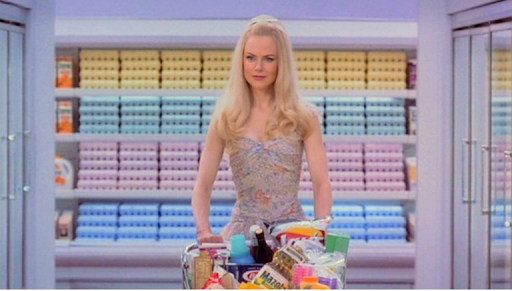
The 2004 film comes from a very different place, as women’s lib had made major strides in the past generation. While there were (and are) still a lot of inequities, many goals had been achieved–women were common in the workforce, many were equal earners with their partners, and they weren’t expected to stay out of “men’s business” anymore.
As a result, the second film shifts the motivation of the Stepford husbands ever-so-slightly. In the 1975 version, the men wanted to “adjust” their wives but remained in a position of power throughout. In the 2004 version, the men of Stepford came to the community because they felt threatened by their wives. Those women all had jobs that gave them power in the form of money, celebrity, or both–authors, financiers, lawyers, and television producers. The men transform their wives because they feel threatened want to be in control of their family again.
The differences in this area say a lot about society and how it has changed. We see the 2004 version play out again and again as people give kneejerk reactions to inclusion, with more socially conservative folks using terms like “the woke mob” in 2024. In truth, it boils down to those who have traditionally held power feeling threatened by the inclusions of those who have previously been marginalized.
I think the 2004 film hits the right note in this regard, but it unfortunately plays it safe once again at the end. When Joanna learns the truth of Stepford, her husband Walter gives an impassioned speech about how he feels emasculated by her. Joanna ultimately wins that debate, but the volume and tenor of Walter’s monologue compared with Joanna’s shocked and meek disposition leaves the impression that Walter has a strong point–a point which Joanna only gets around by appealing to sentiment rather than logic. When the film could deliver an emotional kill shot, it eases up at the last minute, saying, “Yes, the men went too far, but they do sort of have a point.”
I doubt that was what Oz and the rest of the creative team intended, but the power dynamics flip-flop right at the end, as though the movie is afraid to make the men in the audience think too hard about gender equity.
A Happy Ending?
The 1975 version of The Stepford Wives is a horror film, and there is no happy ending in sight. Joanna’s courage and intelligence only lead her into a confrontation with a robotic version of herself (sans the eyes, which helps make the scene very creepy), which strangles her to death. The final scene ends with the new Joanna walking through the supermarket, having become just another Stepford wife.

That ending seems devoid of hope, but it is also a call to action. Nothing changes in Stepford because nobody in power stood with Joanna. If our real world is to avoid becoming like Stepford, the men who are in power need to step forward and do what is right rather than what is easy.
The 2004 film ends completely differently. We get the supermarket scene from the 1975 version, but the story keeps going after that. Having persuaded Walter that the Stepford model is wrong, Joanna launches a coup that frees all the wives from their brainwashing.
This ending also creates a huge plot hole in the film, as we had previously seen that the Stepford wives were robots, not just brainwashed people. We see one wife change her breast size with the push of a button. At another point, one of the men runs his ATM card through his wife, and she spits out a wad of bills. This gets nary a mention in the end, where a twitch of the head and some comical sparks returns to wives to their normal, pre-brainwashed state.
(I suspect that the original script for the 2004 film repeated the 1975 ending, but that part of Oz’s way of “protecting” the studio was to avoid something so depressing, and that the ending which creates this plot hole was tacked on at the last minute. None of my research has verified this theory, however.)
Staying Too Safe
None of this is to say that the 2004 Stepford Wives doesn’t have its merits. Some of the humor is very well-executed, especially near the beginning of the film. The update to the men’s motivation, going from a reaction against the women’s lib movement to a fear that they are redundant now that women can do anything men can, has a lot of potential. Ultimately, though, the movie seems afraid to make the audience uncomfortable, and that is to its detriment.

Some films are supposed to push the audience in ways they might not want to be pushed. The 1975 film never directly accuses the men in the audience of being on the same tier of selfishness as the husbands of Stepford, but it does definitely ask those men to examine their behavior and avoid those dangerous patterns. Every time the 2004 movie comes close to driving its theme home, it retreats into the realm of comedy and absurdity. Because of that, the remake tries for social commentary but ultimately lands in the realm of absurdity.
Images: Palomar Pictures, Paramount Pictures
 Babbling Brooks