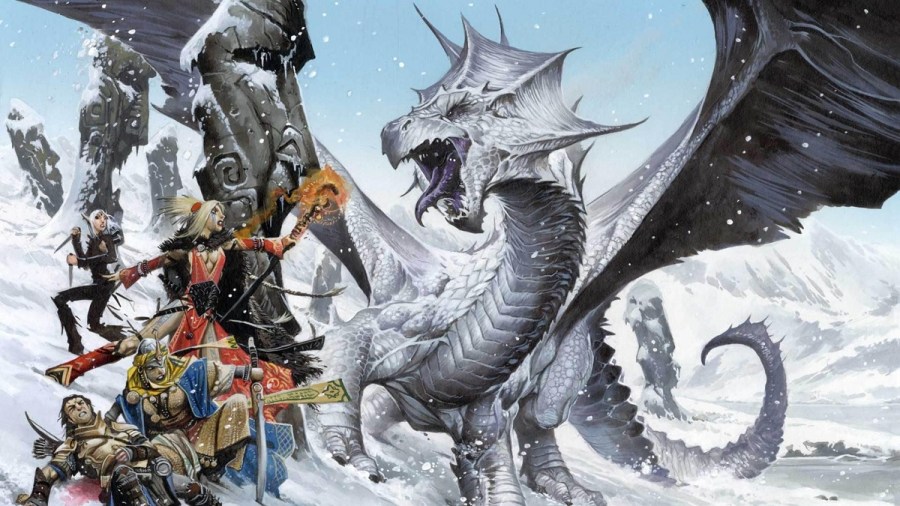
Dungeons & Dragons is the 800-pound gorilla of the role-playing game industry, and Pathfinder is its younger, smaller, but still quite imposing cousin. These two games of heroic fantasy dominate the industry in terms of sales and profile. But what’s the difference between the two of them?
In many ways, they are extremely similar. Pathfinder began as a series of adventures for 3rd edition D&D, and then split into its own game when 4th edition proved to be less popular and third party friendly. Yet despite their similar roots, both games have also gone through new editions since that split. D&D went back to a more classic feel, while Pathfinder embraced mechanics and setting material that helped differentiate it from its ancestor.
Which game is better? I won’t answer that, because that boils down to a matter of opinion. What I will do here is compare the 5th edition of D&D to the 2nd edition of Pathfinder (the current version of each game as of this writing), noting the difference in their design goals. Both games provide a great heroic fantasy experience, but they do so in different ways. And here are the differences as I see them.
The Character Creation Mini-Game
For many, a big appeal of both D&D and Pathfinder is that you get to create and play a unique hero who represents you. While you can play a game with a pregenerated hero, the majority of people look forward to putting pencil to paper and developing a unique player character that comes from their mind.
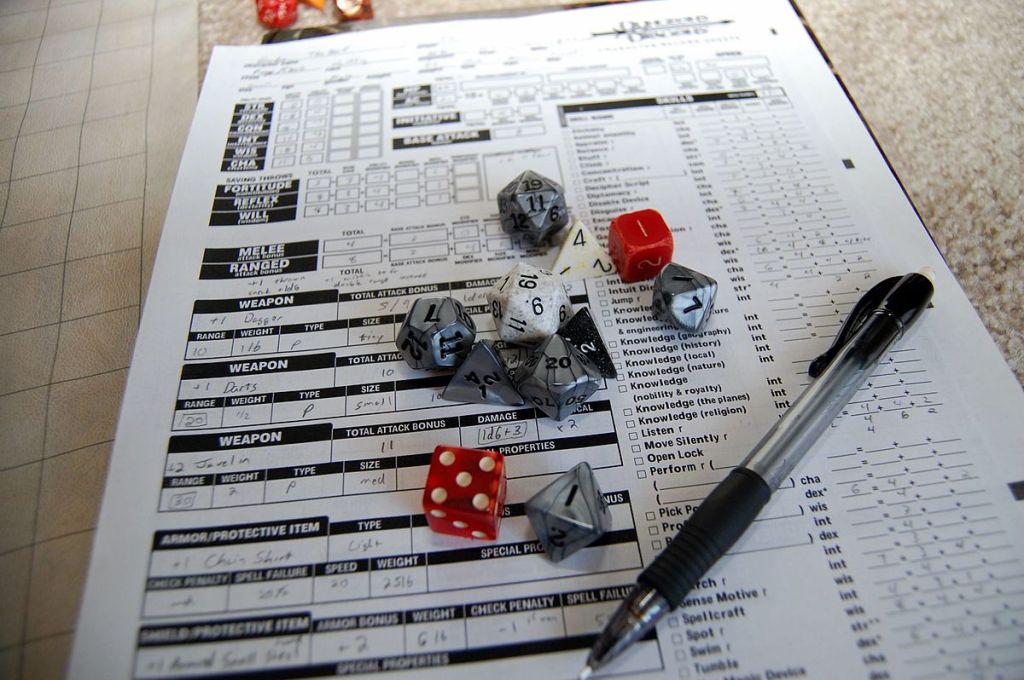
D&D and Pathfinder both put a huge emphasis on character creation, with both games taking up the majority of the core rulebooks detailing the many ability scores, skills, spells, and pieces of equipment that can make your character unique. The difference between the two of them lies in how many decision points you make not only during the character creation process, but as you build your hero over time.
D&D relies largely on broad archetypes, with most of your decision points coming early on in your adventuring career. You pick a race, a subrace, a class, and a background. Each of these choices gives you little packages of skills and abilities which will come to define your character’s capabilities. As you level up, you can usually choose an archetype for your class, such as a school of magic that your wizard specializes or a martial archetype for your fighter.
After you make your choice of subclass in D&D, usually at 2nd or 3rd level, you don’t have to make any other major selections for your character for the duration of your adventuring career. Yes, you need to choose spells and which ability scores get better (although usually the latter is a no-brainer, based on your class), but once you’re locked into a path you can just stay there. Mind that you don’t need to do this if you want more customization–feats, multiclassing, and other options give you ways to customize your character further. But overall, D&D is a game about broad archetypes. Additional sourcebooks provide more archetypes from which to choose, but one bard from the College of Lore will look very much like another.
Pathfinder contains broad archetypes in the form of ancestries and classes, but a lot of customization within these categories in the way of feats–extra tricks and abilities that your character earns as you progress through your adventuring career. You select at least one feat of some kind at every level, and sometimes two. You can also use certain feats to get access to abilities from other ancestries and classes, blurring the lines a bit.
At times, the choices in Pathfinder can be overwhelming. Luckily, the rulebooks usually provide only a few feat selections at each level, allowing you to narrow your focus instead of having to take everything in at once. While Pathfinder has subclasses like D&D, it also has a lot of extra levels of customization. Two goblin chirurgeon alchemists, for example, will likely look very different from one another despite having the same ancestry and class.
Which approach works best for you really depends on how you define your hero. Personally, I like the level of customization offered by Pathfinder, but it can also be a bear for people who don’t want to remember the rules behind their character’s many abilities or who just don’t find character creation to be very exciting. Meanwhile, D&D is excellent for fast starts, easy level-ups, and one-shots. However, it can get annoying when every character of a certain type always seems to revert to the same strategy. Books like Tasha’s Cauldron of Everything fortunately provide ever-expanding options to change things up if they start to feel a little stale.
Bounded Accuracy and the Aragorn Test
During the development of 5th edition D&D, the designers introduced a thing they called bounded accuracy. Basically, this was shorthand for, “the numbers don’t go as high anymore.” While older editions of the game had ever-scaling attack bonuses, defenses, and skill difficulties, 5th edition slowed down that escalation a lot.
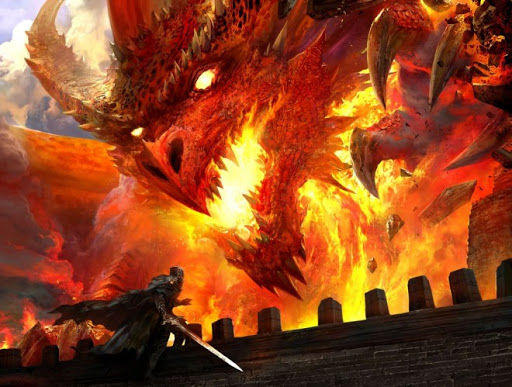
Take, for example, an adult red dragon. In D&D, that creature has an Armor Class of 19–about the equivalent of a guy wearing plate mail and a shield. Your average 1st-level soldier with a longbow has a +4 to attack and does 1d8+2 damage. If the dragon is attacking an army of 100 soldiers, most of those soldiers will miss, but about 30% of them will score a hit. 30 soldiers dealing longbow damage is an average of 180 hit points, and the dragon has 256 total hit points. In other words, he’d better think twice before flying into arrow range.
The Pathfinder adult red dragon, on the other hand, has an Armor Class of 37 and 305 hit points. An army of 1st-level fighters trying to hit with a longbow have a maximum attack bonus of +9. In other words, they can’t get through the dragon’s scales with their arrows, except for the rule that says a natural 20 on the die can make a failure a success.
Moreover, while creatures in D&D only score a critical hit (doing double damage) if they roll a natural 20 on their attack roll, Pathfinder creatures score critical hits on a natural 20 or if the attack roll exceeds the target number by 10. Those soldiers might have an AC of 18 or 19 if they’re lucky. The dragon has a +29 to hit with its jaws, meaning that every attacks is a critical hit (although a natural 1 reduces that just to a normal hit). The D&D dragon sees an army of archers and keeps its distance. The Pathfinder dragon sees 100 bite-sized snacks.
This is by design. D&D wants heroes who can do amazing things but who are closer to mortals. Pathfinder wants heroes who become nearly godlike as they advance in level. Admittedly, they both play more or less similarly at low levels, but the higher you go, the bigger the disparity becomes.
I’m going to call this the Aragorn Test, referring to the many times in The Lord of the Rings films when Aragorn just leaps into battle against 100 orcs and comes out without a scratch. If you want heroes who can do that, Pathfinder is more likely to give you the desired result. If you want heroes who will think twice about picking a fight with a huge number of low-level mooks even when they’re among the best warriors in the land, D&D is the way to go.
The Skills of an Expert
Related to bounded accuracy is the skill system between the two games. To sum things up, D&D puts a lot of emphasis on natural ability, while Pathfinder puts the bulk of emphasis on training.
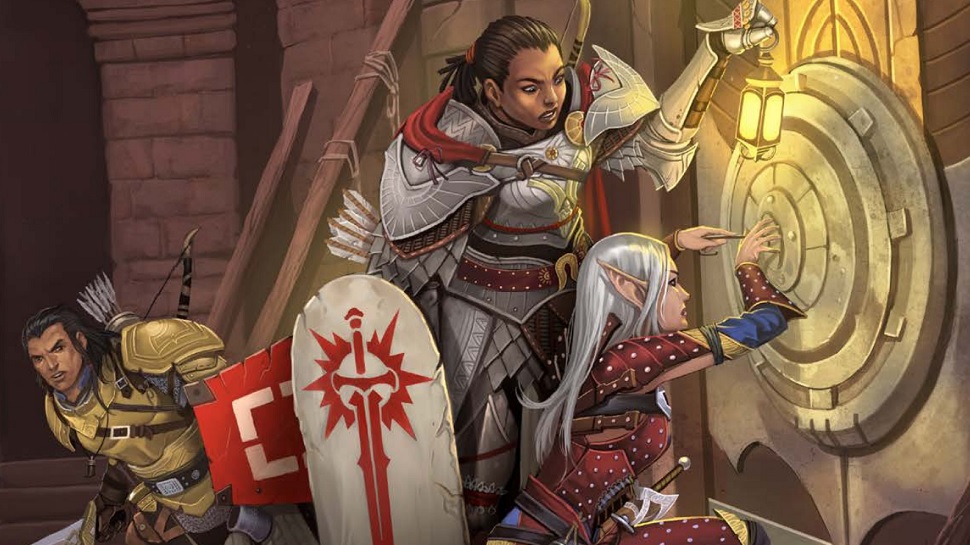
Let’s say you want a fighter who can survive on his own for months in the wild. In D&D, you take proficiency in the Survival skill. Your bonus for Survival checks is equal to your Wisdom modifier plus your proficiency bonus. If you’re an average-Wisdom character, you have a +2 to these rolls at 1st level and can get as high as +6 if your Wisdom remains the same.
Meanwhile, a cleric who has spent much of her life in an urban environment but who has a Wisdom of 18 starts off with a +4 to Survival right off the bat, even without training. This is a person who doesn’t really know the outdoors but who is naturally talented enough to pick things up almost instantly. The average-Wisdom fighter will catch up to her in this field by 9th level and finally surpass her by 13th level. D&D is a game where innate ability generally carries as much or more weight than training.
In Pathfinder, the woodsy fighter selects Survival as a trained skill. At 1st-level, she starts at a +3 bonus to Survival rolls, while the cleric with an 18 Wisdom has a +4. That cleric’s bonus remains static unless she becomes trained in the skill herself, while the fighter’s bonus improves by +1 at every new level. By 2nd level, she has pulled even and by 3rd she’s surpassed the cleric. Depending on how much she wants to invest in the skill by becoming an expert, master, or legendary in Survival she could get a proficiency bonus of up to +28 by 20th level. In contrast to D&D, Pathfinder puts way more emphasis on training over natural ability.
To go further, some skill uses in Pathfinder require you to be trained in them to even attempt them. Do you want to open a lock or disarm an opponent in battle? Then you need to be trained in Thievery or Athletics, respectively. D&D doesn’t have this restriction, so somebody who has never picked a lock before can still try and have a decent chance of success. This is partly a function of how the game works, since it’s easy to become trained in new skills in Pathfinder but hard in D&D, but also part of the design of the game. If you want to do something well in Pathfinder, you should train in it, while if you want to do something well in D&D you should have a high ability score or just hope for a bit of luck on the dice.
Doing the Impossible
Remember that Pathfinder fighter with the +28 to Survival? She can find water in the Plane of Fire or walk through an arctic tundra in her underwear without any ill effects if she takes the right skill feats. Now, the odds of you needing to do that in a fantasy adventure game are pretty slim, but I’m not your GM so I can’t say for sure that the situation will never come up.
Challenge difficulties in D&D usually keep to target numbers in the range of 10 to 20 – because the spread of bonuses is so small, the difficulty ratings need to be something that anybody can conceivably hit. This means that everybody has a chance to do most things, with people who are very talented having a better chance than others. Even weak-willed individuals might be able to resist the charms of succubus, but those with a high Wisdom score and proficiency in Wisdom saving throws stand a better chance.
Most characters have a chance of passing mundane challenges in Pathfinder as well. But because the numbers go higher, the challenges get more fantastic as the game gets up there in level. Somebody with a good Will save can probably resist a 1st level charm spell. At 20th level, they might be able to resist the alluring aura of the demon lord of lust, while the rest of the group stands around helplessly ogling her.
Pathfinder also allows characters to take skill feats that can give them extra tricks to give them more flexibility. These feats start off relatively minor, but get significantly more unrealistic at high levels. A 2nd level character who is an expert in Athletics and takes the Powerful Leap feat can leap five feet farther than normal on a long jump. A 15th level character who is legendary in Athletics and takes the Cloud Jump feat can potentially leap 165 feet without the aid of magic.
People compare the Pathfinder model to anime, but I’m not a fan of doing that because those who say that usually use a derogatory tone, as though anime is inherently bad. What this difference really means is that high-level Pathfinder characters can perform feats normally reserved for legendary figures of mythology or, to put a modern spin on it, superheroes. This appeals to many, but if you want a game that stays more firmly grounded in real-world physics (or as grounded it can be in a world with magic and dragons), you might want to stick to D&D…or at least don’t play Pathfinder past 10th level or so.
One Genre, Two Flavors
When you get right down to it, D&D and Pathfinder are still very similar games that do a lot of the same things. They both fit firmly in the weird fantasy RPG genre which often tries to emulate fantasy epics but usually does its own cool thing instead.
There are many subtle and mechanical differences that I haven’t mentioned here, from D&D tending to feature a quirkier sense of humor to Pathfinder having a much cleaner encounter design system (all in my opinion, of course). But the major differences outlined above are what I believe makes these games feel different, despite their many similarities.
However, both games are pretty robust, too. That means there’s a lot of room to morph them into something you like. Pathfinder‘s GameMastery Guide, for example, has options for the reduction of the level-based proficiency bonus, allowing you to introduce D&D‘s bounded accuracy to that game if you so desire.
If you want to play one of these games but don’t know which one is for you, the stuff up above can hopefully help you make your decision. If you’re still undecided, don’t worry–they’re both great, so you really can’t make a bad choice here.
Images: Paizo Inc., James Jones (using a Creative Commons Attribution 2.0 Generic license), Wizards of the Coast
 Babbling Brooks